First Look
The Final Revelation
a purist mini-campaign for Trail of Cthulhu
ludique · First Look · samedi, 19 septembre 2015 à 23:06:33 · 10 min
Whether we talk about the venerable Call of Cthulhu or the young Trail of Cthulhu, these two role-playing games based on the writings of H. P. Lovecraft offer a choice of mood around the table. GMs can adopt three modes of play: Pulp, Occult Investigation (standard) and Lovecraftian Horror (purist). The fact is that official scenarios in purist mode are a rarity: understandably so, since confronting the players with invincible forces constitutes an antithesis of role-playing in the eyes of many RPG players.
It is no doubt to fill this gap that Graham Walmsley, an author at Pelgrane Press, set about writing several purist-mode scenarios for Trail of Cthulhu. He first published four of them, between 2009 and 2011: The Dying of St Margaret's (2009), The Dance in the Blood (2010), The Watchers in the Sky (2011) and The Rending Box (2011). Then, as if to crown this work, a compilation was written in 2013 under the name The Final Revelation, in which a fifth scenario, a kind of "meta-scenario", ties the four others together through a story within a story.
I heard about The Final Revelation while I was looking to purchase Eternal Lies. At the time, the compilation was not offered on RPGnow, so I patiently waited for it to be before finally diving into my reading. It has been nearly two weeks that this purist adventure is in my hands, so it is time to give a first opinion.
Anatomy of a purist scenario
A crosswise reading of the book attests to one thing: we are indeed looking at a purist compilation.
In "standard" mode, the scenarios stage crawling or imminent horrors that the characters try to stop, even if the outcome must always remain bitter and disillusioned. In pulp mode, an aberration appears in the middle of this dark disturbed web: hope. Winning, putting an end to "evil", is conceivable.
In the case of purist scenarios, the characters have no hope. Here too, they will try to prevent something from happening, but they will only be able to note their powerlessness and succumb. This must be clear to everyone: the rules are not fair, the opposition between the plot and the characters will systematically end in the former's favor. In fact, to appreciate a purist scenario, one must leave the logic of traditional role-playing and embrace that of the "Story Game": everyone creates the story, the players limiting themselves to their character while the GM sets a frame. The pleasure comes from staging the protagonists' downfall.
A purist scenario avoids or desecrates the epic moments, drastically limits the characters' power (yes, even more than usual) and concludes with a horrible truth revealed to the PCs. These usually end up mad, dead or worse. Action scenes are generally few, though particularly lethal, and explicit references to the Mythos become rarer (everything is less codified).
The Final Revelation succeeds in its first wager: the five adventures are tinted with despair, the rare light moments generally lead to more horror, and comfort proves illusory. This merciless stance will determine whether or not you are a good customer for this compilation. As for me, I remain attached to a "ludic" logic which holds that, as a player, I try to fight through my character to obtain as positive an ending as possible. There is therefore little chance that I will play this campaign, even as the GM, but that does not prevent me from being fascinated by what it represents.
The Final Revelation
The Final Revelation cover. Copyright Jérôme Huguenin/Pelgrane Press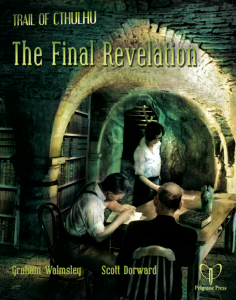
The book itself is 128 pages. The scenarios each spread over about twenty pages, and the rest contains the credits, a few general considerations and game aids. The author notably offers adaptations of the Trail of Cthulhu system, like the possibility of playing a character who has reached 0 Sanity.
Each scenario requires creating a dedicated set of investigators: to this end, pregenerated characters are offered and even recommended (although the tools needed to create PCs are provided).
The following paragraphs partially describe the content of the compilation's scenarios. If you plan to discover it in play, avoid reading further and rather point your GM to this article...
The meta-scenario
The meta-scenario, The Final Revelation, is a mise en abyme in which the PCs have received a warning: the apocalypse is at their door. Following an announcement, they join a group dedicated to finding proof about the end of times. Each clue leads to the tale of one of the campaign's scenarios, a bit like Eternal Darkness where the chapters of the Necronomicon each opened a level of the game. The meta-scenario's sequences work as short interludes, and the grand finale closes this whole adventure in a very pessimistic manner.
My opinion is rather positive: the mise en abyme is a mechanism suited to the style of play, all the more so as it is rather well handled. The "great revelation" should churn your table's stomachs, which is enough to make the meta-scenario interesting. However, I have two big reservations.
- Staging all this is quite a feat. I fear the players will directly suspect the bottom of the affair from the first quarter of the scenario: the messages are not subtle enough, and anyone who has already seen a "Lovecraftian" horror film will quickly guess the situation. Enough to make curiosity drop at an inopportune moment.
- I also regret that the meta-plot has no relation to the scenarios, all the more so as those are loosely tied to one another. By finishing a scenario, the players will not feel they have learned anything that helps them better understand what risks happening to the world, except that strange events take place in a particular region of England. The meta-scenario's progression thus seems a bit arbitrary.
Obviously, it is not conceivable to play this scenario outside of the eponymous "mini-campaign".
The Dying of St. Margaret's
The first plot your players will face takes place in the St. Margaret private school. A relative of each PC has disappeared, so the investigators have decided to join the school's staff and learn more. At the center of the investigation, an entity well known to Lovecraft fans, described here slightly differently so as to preserve its aura of mystery and avoid being seen through from the start by the connoisseurs. The finale is an anti-climax typical of the recluse of Providence's short stories.
I do not know whether reading the scenario truly made me want to play it. I appreciate the efforts to conceal the entity's nature from the players' eyes, as well as the advice for staging a pulp version of the scenario (incidentally, it is a pity this advice was not systematized for the others). The ideas for staging the characters' motivations are also welcome. On the other hand, the investigation seems rather bland and short (so much so that the author offers a lighter version to be played at conventions). Nothing really made me want to play, notably because the anti-climax is... well, an anti-climax.
The Watchers in the Sky
This time, we are talking about birds. Weirdo avian creatures are up to no good, and the PCs take an interest in them presumably because of their exposure to the carcass of one of them (or of one of their victims). The investigation leads them into an unhealthy countryside setting, quite prone to physical confrontations.
Several scenes look interesting to play: the characters' emotional bonds serve a purpose, the discovery of the birds is interesting, the finale is cryptic without being horrible. As a result, I quite like the scenario, and playing it as a one-shot would be conceivable: it lends itself to it rather well, and the emotional bonds could even have more impact by integrating them into a long-running campaign. On the other hand, I am lukewarm about the author's refusal to give the explanations about the birds' origin. According to him, keeping a layer of mystery is faithful to the spirit of Lovecraft's novels. Just like for Anima RPG, it seems wiser to me to give the GMs all the puzzle pieces and let them choose what to do with them.
The Dance in the Blood
The PCs discover that they were adopted and descend from the same parents. They investigate the mystery of their origins and unearth a few horrible family secrets that would have been better left buried.
This third scenario is, by far, my favorite. Presumably inspired by Shadow over Innsmouth, the central idea provides a solid basis for the investigation. It also opens enormous possibilities in terms of roleplay. It would no doubt be better to let the players create their characters, so they feel invested in them: the revelation of their origins will only be better for it. The intervention of the other family members also promises excellent moments, and the finale leaves the players a bit of control, while raising interesting questions.
At first glance, The Dance in the Blood is a pearl that can perfectly be played as a one-shot or as the basis for a campaign other than The Final Revelation. On the other hand, it is unlikely that PCs traveling together for several scenarios would suddenly discover they are from the same family: impossible to slot the scenario into an ongoing campaign.
The Rending Box
Where the previous scenarios carefully avoided involving Mythos entities, this one puts two of them on stage. One is particularly well known (easy to guess, given the scenarios' location) while the other is more original. The PCs are tasked with bringing a strange box to one of their contacts in England. They quickly understand things are not right, start looking for a missing individual and begin exploring a particular place.
While its premises are interesting, this scenario leaves me puzzled by its execution. Apart from the box and its consequences, the components of The Rending Box are closer to pulp mode than purist mode, although the irony of the finale brings back a bit of despair to this excess of adrenaline. Leaning on the box is probably the best way to make this scenario memorable, failing which it risks lacking flavor. Let us say "why not?" within the frame of The Final Revelation, but I am not sure this scenario is worth it outside of that.
Conclusion
Not everything is perfect in The Final Revelation. The meta-scenario's staging seems treacherous to me, and two of the four proposed scenarios struggle to spark interest. The very concept of a purist campaign requires a very particular game philosophy, one many RPG players do not subscribe to. Fortunately, overcoming these problems is not impossible. The two scenarios can be reworked to make them more interesting. With art and manner, a good GM will know how to present the meta-plot with subtlety. As for the players, make sure they understand what the purist mode's philosophy is before starting the scenario.
Once all these reservations are absorbed, it then becomes possible to enjoy one of the rare purist (mini) campaigns created for Cthulhuoid role-playing games. In that sense, The Final Revelation remains a success that deserves to be saluted.