First Look
Coriolis
ludique · First Look · vendredi, 10 août 2018 à 08:15:30 · 9 min
A Science-Fiction role-playing game is nothing new. In my library, however, one only counts a handful of them against the crushing majority of (more or less) medieval and fantasy books. Coriolis represents my second attempt at compensating for this deficiency, and this time, the winds are blowing in the right direction.
(cover illustration: Martin Bergström, ©Fria Ligan)
A few months ago, I started my search for SciFi games with the intriguing Eclipse Phase, whose implementation seemed so treacherous that it dissuaded me from running a one-shot. Admittedly, the universe already represents a challenge, with its transhumanity and its endless possibilities. But another aspect got the better of me: the jumble of uninspired rules, compounded by a desired conversion to the generic Fate system which required, ideally, reading Eclipse Phase in full, then Fate Core, then the adaptation of the former to the latter. Another day, then.
Here comes a new challenger
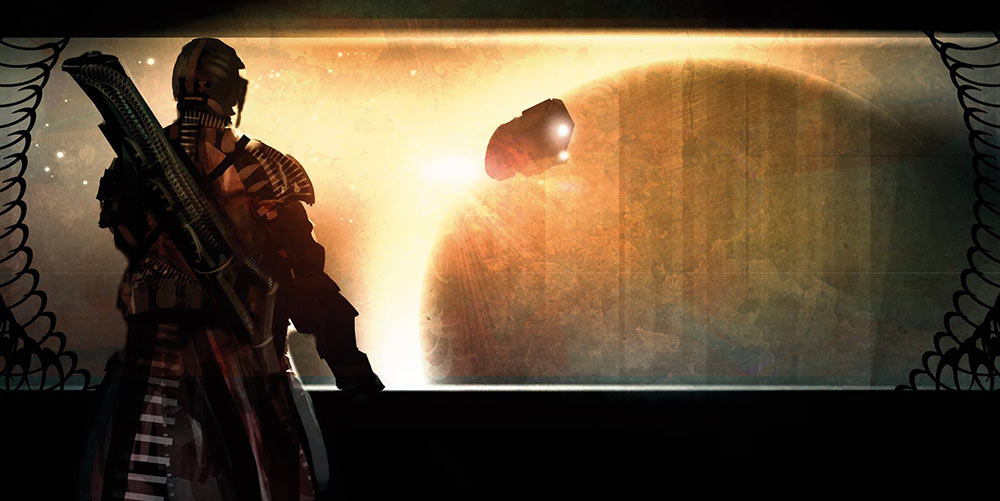
A glance at the RPG news made me discover a serious candidate among recent crowdfunding campaigns. With its distinguished visuals, Coriolis, fittingly named, caught my eye. The title is of Swedish origin, produced by the studio Fria Ligan, then translated into English by Modiphius and into Molière's language by Aka Games. On his blog, the likable Ours will tell you more about the publication context; no need for shameless copy/pasting. Back to the book: its text, quite limpid, directly highlights three original themes.
- Friction between two populations - the first colonists and the newcomers. The action takes place in a cluster of systems called the "Third Horizon". Ironically, the "newcomers" had left to explore this cluster nearly a millennium ago, aboard a ship named "Zenith" (hence their name, the "Zenithians"). It was only a hundred years after its departure that the inhabitants of the First Horizon discovered portals opening the way directly to the Second and Third Horizons. Thus, the first colonists settled and developed their culture, before being joined several decades later by the Zenith.
- The Western influence, usually used as the basis for any science fiction, is replaced by an Oriental veneer. The authors go as far as describing a blend between Firefly and the 1001 Nights.
- Religion is everywhere. SciFi frequently eclipses the religious question, considering that necessarily obscure beliefs have no place in a universe where science reigns supreme. Here, the two mix, since every part of uncertainty is explained in the light of a religion loosely based on Islam. No sillier than any other, this fictional religion seems to do its job (for a religion layman like me, at any rate).
This desire for clarity is found at every level of the game. The layout is beautiful, with its almost ethereal illustrations, despite some overcrowding of tables over a "starry black" background. The background does its job brilliantly; everything makes you want to know more. The factions present themselves as clichéd enough to be easily grasped, but not enough to provoke disbelief. One can summarize them in one line, but discuss them over pages. Two ideological fronts stand out: the pragmatic, expansionist Zenithians and the spiritual, upright first arrivals. Fortunately, the conflicts are not necessarily limited to this dividing line, some factions envying others within the same group. The Emissaries - a handful of non-human entities that appeared out of nowhere - directly arouse mistrust through their surprising stance towards humans. The latter triggers conflicts between the Zenithians and the first colonists. Regarding the background, my big regret lies in the absence of explanations for the mysteries the book throws in our face. You will therefore be able to play adventures that put them on stage, but to explore them in more detail, you will need to buy supplements. Business is business.
Example of the book's layout, taken from the English starter kit.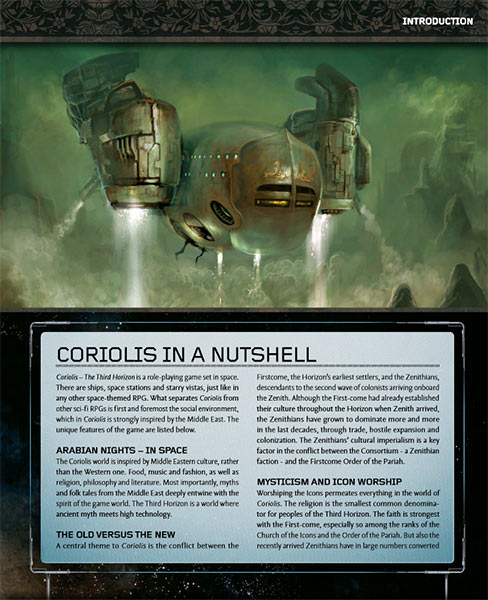
The system, ultimately, has a little "Savage Worlds" side to it in its desire to avoid heaviness. Four characteristics. Sixteen skills, eight normal and eight "advanced". A few talents. Each progression costs the same number of experience points. Character creation, of the restrictive kind (few resources at the start), does not completely neglect roleplay by imposing a concept on the group (agents, mercenaries, explorers, ...) and on each PC a personal problem, as well as an opinion about their traveling companions (among whom a buddy, more precious than the others, must feature). The basic mechanic consists of rolling D6s: a single six means the action is a success, the following ones improve the result. As the only lever, the GM can remove or add dice depending on the difficulty of the action. Despite the little wheelbarrow of dice to roll, assessing the success probabilities is easy (the book even offers some statistics) and reading the result is done in the blink of an eye (spotting the sixes). Add on top of that a Doom Pool, called "Darkness Points" here, and you have a fairly complete picture of Coriolis's rules. Limpid, fast, without ever sinking into the simplistic. I like that.
A caveat, however? Yes, a big one: the chances of success for actions.
A competent character (6 dice) will only have about a 60% chance of succeeding at a normal action, while a novice character (2 dice) will drag along a 70% failure rate. These scores send us right back to the dark hours of the first two versions of Warhammer, notorious for their ability to frustrate players and temper their boldness. The good ones fail almost more often than they succeed, while the less good ones grit their teeth and endure. In Coriolis, the possibility of praying to reroll the dice increases the chances of success, but this option should remain rare because of its mystical scope, all the more so as it strengthens the GM's Doom Pool. As things stand, I am afraid players will mostly use it as a lifeline for almost all their actions. In short, Coriolis is a brutal game philosophy, which you may adhere to, but which seems detrimental to risk-taking to me. Unlike the latest Call of Cthulhu and its pushed roll system, Coriolis insists and drives the point home: you only get one chance to succeed. After a few tumbles, your group will limit its attempts to the scenario's bare minimum, for lack of being able to cover its back.
As a solution, I plan to avoid unnecessary die rolls and to go with an "assessed" base, where the success of actions will be judged essentially on the characters' level rather than on die rolls.
A poorly sold game?
When reading the book, one thing jumps out: the game does not completely match the description given by the authors. This divergence between the promotion and the offering no doubt explains the few mixed, even negative reviews one can read here and there.
We are promised an "Oriental" universe, but it turns out to be merely a tint. Hard to blame Coriolis, for on reflection, the problem is thorny. What are the essential characteristics of an "Oriental" universe? I imagine you will have a harder time answering than if the question concerned an "Asian" universe. In role-playing games, Asian cultures are well represented - whether through a Western lens (Legends of the Five Rings, which insists on honor and respect for hierarchy to the point of caricature) or thanks to a more authentic desire for immersion (Wulin, which transcribes the peculiarities of Chinese popular tales). In Coriolis, the "Middle East" aspect influences no mechanic, nor the narration, unless of course one considers the "religious" dimension as a peculiarity of the peoples of the Middle East (debatable, and that is a euphemism). Here, the names of characters, clothes and some places have Arabic consonances, but the stakes lean more towards Mutant Chronicles and its many factions tearing each other apart, than towards Ṣalāḥ ad-Dīn resisting the crusades. So do not look for some kind of SciFi Capharnaüm, for the Middle East is limited to the veneer. You could be disappointed.
The superb illustrations, the layout: everything breathes the Middle East. But is that enough to speak of a SciFi "1001 Nights" role-playing game? I doubt it. [illustrations: Martin Bergström & Gustaf Ekelund, ©Fria Ligan]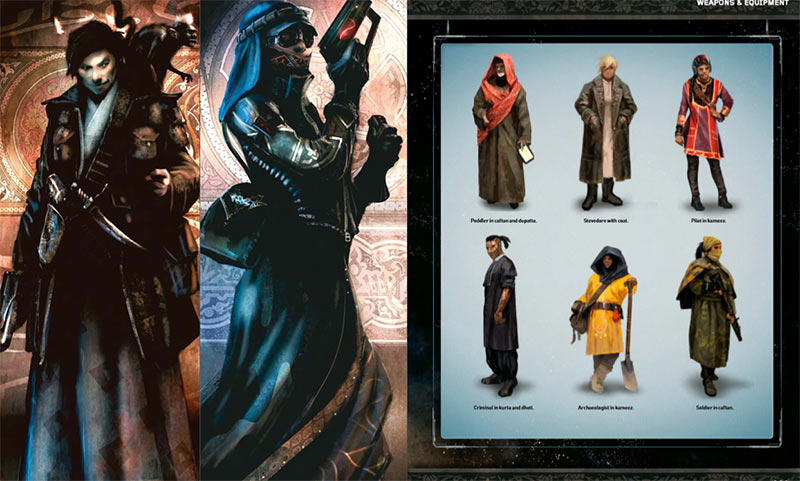
We are also promised "Firefly": what does that mean? Having watched the series, it seems to me that the fundamental principles of "Firefly" boil down to (1) accessible Science Fiction, (2) Team spirit between the protagonists and (3) entertaining "pulp" flair. The first point seems held, since both the universe and the game system spare us the "hard science" (which will please as much as it displeases). The team spirit is precisely a hallmark of Josh Whedon's series, who builds his narration like that of a tabletop role-playing game. No surprise to find this dynamic in Coriolis, as in any other book of the genre. The rules however push the characters to build bonds from creation onwards, certainly facilitating roleplay and the atmosphere on board. On the other hand, the game system oriented towards failure may well limit the players' bold attempts.
These few flaws are not enough to dent my interest in Coriolis. All games have weaknesses, but as long as they are not deal-breakers, it is generally the strengths that prevail. The promises of a pleasing universe, an Oriental layer (failing more) and punchy rules make my mouth water. I hope to have the time to test all this properly before the end of 2019, in which case you will be entitled to a more substantial write-up on Coriolis and its mysteries!