Cat
Good Dog, Bad Cat (part 1)
ludique · Article · mardi, 22 septembre 2015 à 11:36:20 · 9 min
It has been a year now that I have regularly run small off-campaign scenarios in parallel with Cthulhu. One of these scenarios is none other than the long-awaited one-shot of "Cat", whose origins were discussed on the Organisation Très Secrète as early as October 2008. Yes, you read that right: between the character creation and the first group's first session, 5 long years went by (6 in total, to finish the scenario with the second group). After two iterations, I think I will set my creation aside: without being unpleasant, it lacks punch compared to my L5R or Star Wars scenarios (in preparation). A good opportunity for a first "assessment" post, which will be followed by one (or even two) posts summarizing the two groups and how the scenario played out.
Cat, the role-playing game
The Boogeyman is still under the bed. Bloody Mary is still in the mirror. All your childhood fears are alive and well, looking for you. And your only guardian... is Mister Whiskers.
It was in 2005 that I discovered, at the top of the best-rated books of the "Guide du Rôliste Galactique" (GROG, in short), an item with a promising title: soberly called "Cat", the game had been developed by John Wick, the eccentric author who took part in the creation of "Legend of the Five Rings" (L5R). Combined with the rave reviews and my love of domestic felines, this reference quickly convinced me to line up the roughly 5 USD needed to buy the PDF.
If "Cat" proved so seducing, it is obviously because it lets you portray cats, seen from a positive angle. In the game's universe, our feline friends are benevolent - if sometimes reluctant - protectors who watch over the moronic humans we are: they protect us from ourselves, but also from the Boggins, evil spirits that nest in our fears and our deviations. To top it off, the system aims to be discreet and narrativist: when the game came out in 2004, such mechanics were still rather rare. Cats are endowed with six characteristics, backed by "reputations" that work like skills. A cat can, for example, be known for being an excellent mouse hunter. In that case, the player is free to negotiate with the GM to explain how this reputation can help with certain tasks. "Cat" strives to give meaning to the antics cats are known for: your Maine Coon sleeps 14 hours a day? It is exploring the world of dreams to spare you a nightmare come nightfall. Your Persian stares at the wall next to you? A Boggin has probably hidden itself there, be careful.
The game clearly met with some success, since John Wick did it again in 2011 with a "Revised and Expanded" version. This one, however, did not win over the crowds, due to additions deemed rather minimalist and a less professional layout. Personally, I could only test the first edition (my review, written in 2011).
The scenario
A little game about little heroes.
With a pitch like "Cat"'s, it would be easy to imagine childlike, joyful, even puerile scenarios. Incidentally, the second edition offers a whole chapter on how to adapt "Cat" for a young audience.
However, while John Wick saw fit to explain how to adapt his game for children, it was specifically not designed for them. "Cat" is above all the story of a band of felines trying to prevent the decay of their human wards. The stakes are "local", but no less grave for that. In a traditional role-playing game, you expect to overthrow Tyrants abusing nations or to slay evil chimeras to recover the Holy Grail. In "Cat", the PCs are called upon to look into Gégé's alcoholism or Kevin's lack of parental affection. Issues close to our daily concerns, dramatized by the appearance of evil spirits threatening to possess their victims. This is the first pillar my scenario rested on: local, but potentially dramatic stakes.
The second pillar of the scenario is not losing sight of one's feline duty. Indeed, cats can also let themselves be distracted by their routine and ignore the unease weighing on the humans around them. This scenario therefore staged a gang war, furry version, in which it was pointless to get bogged down while a family drama unfolded in the background.
Finally, the last pillar of the scenario was to please dog lovers. Well yes: of the 9 players who took an interest in Cat, 3 admit to being rather fond of those big slobbering, smelly things. As terribly regrettable as this against-nature inclination may be, it motivated me to present dogs as potential allies against the Boggins.
The story takes place in Rotembourg, a fictional city that could look like a typical American town. The PCs are cats living in the suburb of Saume-Vert, known for its identical-looking blocks of houses, its natural park and - above all - its municipal dump. The Saume-Vert neighborhood attracts the covetousness of many cats, to the point that the Old Town gang makes ever more frequent incursions onto the PCs' territory. In truth, the ambitious boss of Downtown - Ondartet (inspired by Don Barzini from the first "Godfather") - is moving heaven and earth... er, paws to trigger a devastating war between Hagen, the brute serving as boss of the Old Town gang, and Don Micione, the venerable godfather of Saume-Vert. Once both camps are weakened, Ondartet plans to swoop down on the municipal dump and dip his whiskers in it without limit. Schemes like this one, the little world of cats sees them about every six months (almost 3 years, in "cat age"). The problems always end up resolving themselves, but it is tempting to take part to build a reputation.
Amid these high-flying feline intrigues, a whole different story constitutes the scenario's true stake. The plot is directly inspired by the "Good dog, bad cat" story hook presented in the first edition of "Cat".
This tragedy takes root last spring. Elektra, the black cat of the Saume-Vert neighborhood, gives birth to four kittens. Her human wards, the Lanford family, were then in full crisis: Helen, the mother and head of the family, had lost control of her alcohol addiction. Garret, the recently laid-off father, had sunk into inactivity. Jeremy, the teenage eldest son, is overwhelmed by his responsibilities towards his parents and his little brother. The latter, Damien, suffers from a lack of attention that manifests as nocturnal fears.
Facing a situation that keeps deteriorating, Helen decides to enter an intensive detox program, whose results struggle to materialize: it has been months since she last set foot in the house. Overwhelmed, depressed and guilt-ridden, Garret loses all control: he considers Elektra's kittens one nuisance too many and calls Ernest, his Redneck brother accustomed to this kind of situation, to help him get rid of them. Locked in a cardboard box, the kitties are driven to Ernest's farm. The man entrusts Josh, his young son, with the task of throwing the kittens against the barn wall. Without the adults knowing, the child cannot bring himself to do it and frees the kittens in the small wood bordering the farm, hoping they will find a way to survive. Back in Saume-Vert, Garret puts the cardboard box in the garage and goes back to dozing in front of the television. Elektra, at her wits' end, eventually discovers the box and smells her kittens' pheromones in it. the scent of terror emanating from it immediately tells her what fate Garret has reserved for her offspring. From then on, she decides to take revenge. She exploits the tormented dreams of Garret, Jeremy and Damien to lead them straight into the wall. Barely a few weeks after Helen's departure and the kittens' "death", three Boggins take hold of the Lanford residence:
- a "Heavy", the repulsive spider that settles on Garret while he sleeps on his couch.
- a "Man in the Closet", who terrorizes Damien and keeps him from falling asleep.
- the "Shoulda and Woulda" brothers, who feed on Jeremy's constant hesitations by whispering in his ear.
This is where Beethoven, the Lanfords' Beagle, comes in. Not very bright, but absolutely loyal, he notices that his masters are behaving in an increasingly self-destructive manner and sets out to help them. His first action is to force Garret to get up. To do so, he grabs the television remote and tries to play with the father of the family, in vain. Elektra understands the maneuver and chases after him. When she brings the remote back to Garret, she makes sure the poor Beethoven is locked in the garage so that he can no longer interfere with her revenge.
When the scenario begins, the situation is already dire. The "Heavy" only needs one short week to possess Garret, the "Man in the Closet" is well settled in, and the "Shoulda and Woulda" brothers are starting to materialize on Jeremy's shoulders. Within two weeks, the whole family will be doomed. Our little heroes will have to set aside the everlasting feline squabbles, expose Elektra's illusions and save the Lanfords...
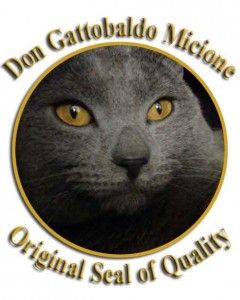
The elegant Chartreux in this photo is called Rosario d'Ar Poul Gwen. He served as the inspiration for Don Micione's character's appearance. Should his owner ever wish me to remove all mentions / photos, I will do so without hesitation and with all my apologies.