Review
Tomb Raider Definitive Edition
the reboot
ludique · Review · mercredi, 11 novembre 2015 à 11:27:38 · 20 min
And there you have it: after months of doubting, I finally picked up (and finished) the 2013 Tomb Raider reboot. With all the contradictory opinions floating around the game, the prospect of being saddled with an Uncharted bis was enough to scare me off when it released on PS3/Xbox 360. In its boundless magnanimity, Square Enix chose to grace the next-gen consoles with a port of its game. How could I refuse to feed it to my PS4?
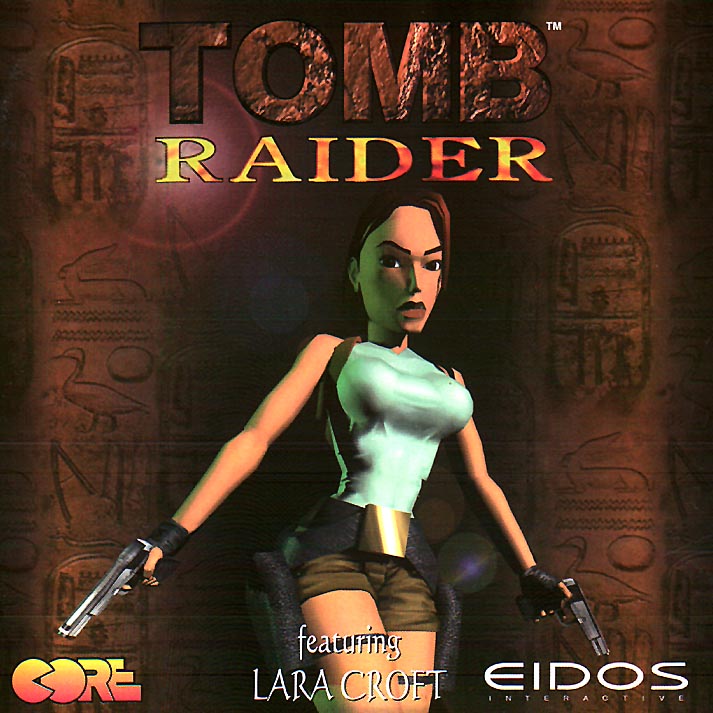
Can we innocently assume that the game's selling point wasn't just its gameplay? :smilewhilelookingupattheceilingwithaninnocentair:
Context
As usual, it's worth placing the game in its context. Tomb Raider is a legendary series born in 1996. The first games were developed by Core Design, an English studio partnered with Eidos. A whiff of adventure, an entirely 3D world, exhilarating puzzles and combat: that's what plenty of players remember when thinking of "Tomb Raider" (the first one, at the very least). And... huh? What? Did I forget a small detail? Oh yes, pardon me: the other thing everyone remembers about Tomb Raider is Lara Croft, its heroine. In fact, it's nearly impossible to talk about Tomb Raider without talking about Lara Croft, who carried the franchise on her shoulders for many years.
You could say that's part of the problem: too confident in its ability to capitalize on its heroine, Eidos ended up neglecting the substance of its gameplay, so much so that Tomb Raider quickly became synonymous with mediocre games and nonsensical stories. Well before Call of Duty and Assassin's Creed, Tomb Raider had managed the feat of imposing one installment per year. From 1996 to 2000, the series saw 5 installments on PC and home consoles, plus one installment on Game Boy Advance. In 2001 and 2002, two more handheld installments came out, pushing critics — slightly exasperated — to regard Tomb Raider as a second-rate franchise. Aware of the problem, Core Design decided to strike a big blow, modernizing its flagship series with "Tomb Raider: The Angel of Darkness" in 2003 — a sort of reboot ahead of its time. The result was dramatically bad, confirming the decline of a series worn to the bone.
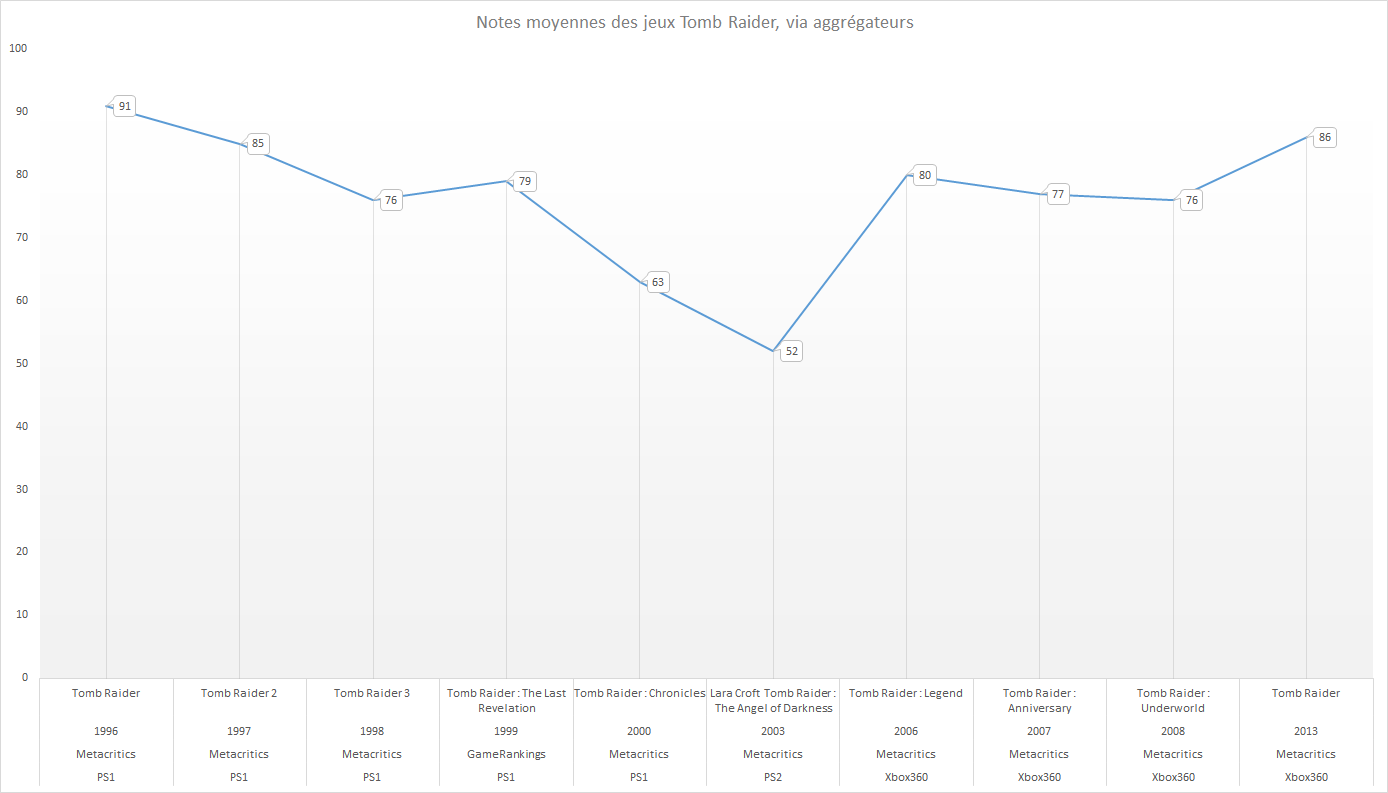
Average scores of the Tomb Raider games, according to Metacritic and GameRankings. The relevant platform is indicated.
For three years — an eternity, given the pace Eidos had accustomed its audience to — Tomb Raider disappears from the radar. The franchise leaves its parents and falls into the hands of Crystal Dynamics, another Eidos studio known for its work on Gex (a series entirely forgotten today) and Legacy of Kain (the bad installments... or rather, the "less good" installments, so as not to offend the fans of Raziel). Hard at work, the studio releases "Tomb Raider: Legend" in 2006. The efforts pay off: critics speak of a resurrection, and for the first time in 8 years the public can finally enjoy a Tomb Raider without being ashamed of it. Two more titles follow: "Tomb Raider: Anniversary", which revisits the first installments, and the conclusion, "Tomb Raider: Underworld". These two sequels are reasonably well received by critics, but Underworld struggles to meet its commercial targets. The sign that the series is running out of steam again: Lara Croft retreats backstage for a few years, before the public loses interest completely.
It's at this time that Square Enix — the company guilty of responsible for the "Final Fantasy" license — buys Eidos in order to "westernize" itself. Under the aegis of SquiX, Crystal Dynamics releases a Tomb Raider spin-off, "Lara Croft and the Guardian of Light", in the form of a small indie game. A surprise critical success, one that earned the spin-off a release on pretty much every existing platform (iOS included). Meanwhile, discussions about the future of the "real" Tomb Raiders are in full swing: it's decided that the next one will be a reboot, featuring a less sexualized and less experienced Lara. The studio works on it for years, proposing many different versions often far removed from the final result (among others, a sort of "Shadow of the Colossus" version of Tomb Raider). SquiX is clearly not shy about spending, to the point that by the time the game ships, financial experts realize it will need to sell between 5 and 10 million copies to break even. Now that's some fucking corporate management!
And so appears the biggest paradox of this console generation: the reboot is very well received by the press, people buy it in droves (more than 4 million copies sold within a few weeks), yet SquiX complains about poor sales. A denial that's hard to swallow. Indeed: after handling Eidos's licenses with its feet, SquiX racked up several similar cases within the same year (Hitman, Sleeping Dogs: good sales, but not enough) and found itself temporarily in a rather unglamorous financial situation, leading to its CEO's resignation. Since then, the company has frantically focused on squeezing out every last cent of profitability, even if it means upsetting its employees or reducing its licenses to mere iOS games (Deus Ex, Hitman), churning out minimalist remakes (Deus Ex, Tomb Raider), or leaving doubt hanging over the future of its licenses (Hitman). Fortunately, it seems the company has nevertheless given the green light for a sequel to the "Tomb Raider 2013" reboot to see the light of day, all the more so since the game has finally become profitable. We can nevertheless imagine expenses will be watched rather closely...
What is this new Tomb Raider worth?
Okay, the contextualization turned out longer than planned, and I'm not done yet. So I'll be brief about my own history with Tomb Raider and my expectations for this reboot: I had the chance to play the first title in 1996, then to buy the second and to vomit it back up with force and conviction (yes, that doesn't mean much). Admittedly, in the meantime Mario 64 had arrived, and freedom of movement in a 3D universe had been transformed beyond recognition. In my eyes, Tomb Raider quickly joined the ranks of the has-been series, along with Resident Evil. At most, I remembered the first installment with emotion — its unforgettable "Indiana Jones" atmosphere and its musical theme, which would sometimes burst in to accompany the discovery of a tomb plunged in darkness.
It was only with "Tomb Raider: Underworld", ten years later, that I bothered to try the demo of a game in the series. Between obsolescence (Lara's look) and pleasant surprise (the gameplay), the final game unfortunately never made it to my Xbox 360.
In parallel, I also had the unpleasant experience of trying "Uncharted: Drake's Fortune", sold as the spiritual heir to Tomb Raider. Honestly, it's hard to imagine a more perfect negation of the very concept of "adventure" (or even, a negation of the concept of "video game"), so thoroughly does Uncharted embody all the worst failings of this generation on its own: freedom completely absent (by "completely", understand "the developers could have removed the ability to move, and nothing would have changed"), gameplay reduced to mowing down hundreds of stupid enemies in endless succession, puzzles and platforming sections so limited they could be taken for insults. The game's atmosphere, decidedly "pulp à la Indiana Jones", saves the day a little, but it too is hampered by the gameplay.
That's when Crystal Dynamics announces the Tomb Raider reboot. Initially presented as "more open", the title quickly piqued my curiosity — an open playground being, in my eyes, the natural evolution of adventure and exploration games. The news that followed, however, showed a game moving ever closer to Uncharted, for obvious reasons: it's the "thing that scores well and sells well". When Tomb Raider, ze reboot, finally releases, press and player opinions are split on this point: some speak of an "Uncharted with Lara Croft", others say the game is actually fairly free-form.
A Sense of Exploration
In the end, it turns out I fall rather into the second category. Tomb Raider offers an acceptable degree of freedom. It's far from open-world territory, but that's sometimes for the best, since the Crystal Dynamics title retains a structure that Just Cause or GTA games sometimes lack: Lara doesn't cross the mountain village the way Rico would fly over the Panao mountain range with his magical grappling-parachute. But most importantly, each discovered location isn't merely a backdrop for endless gunfights, as is the case in Uncharted.
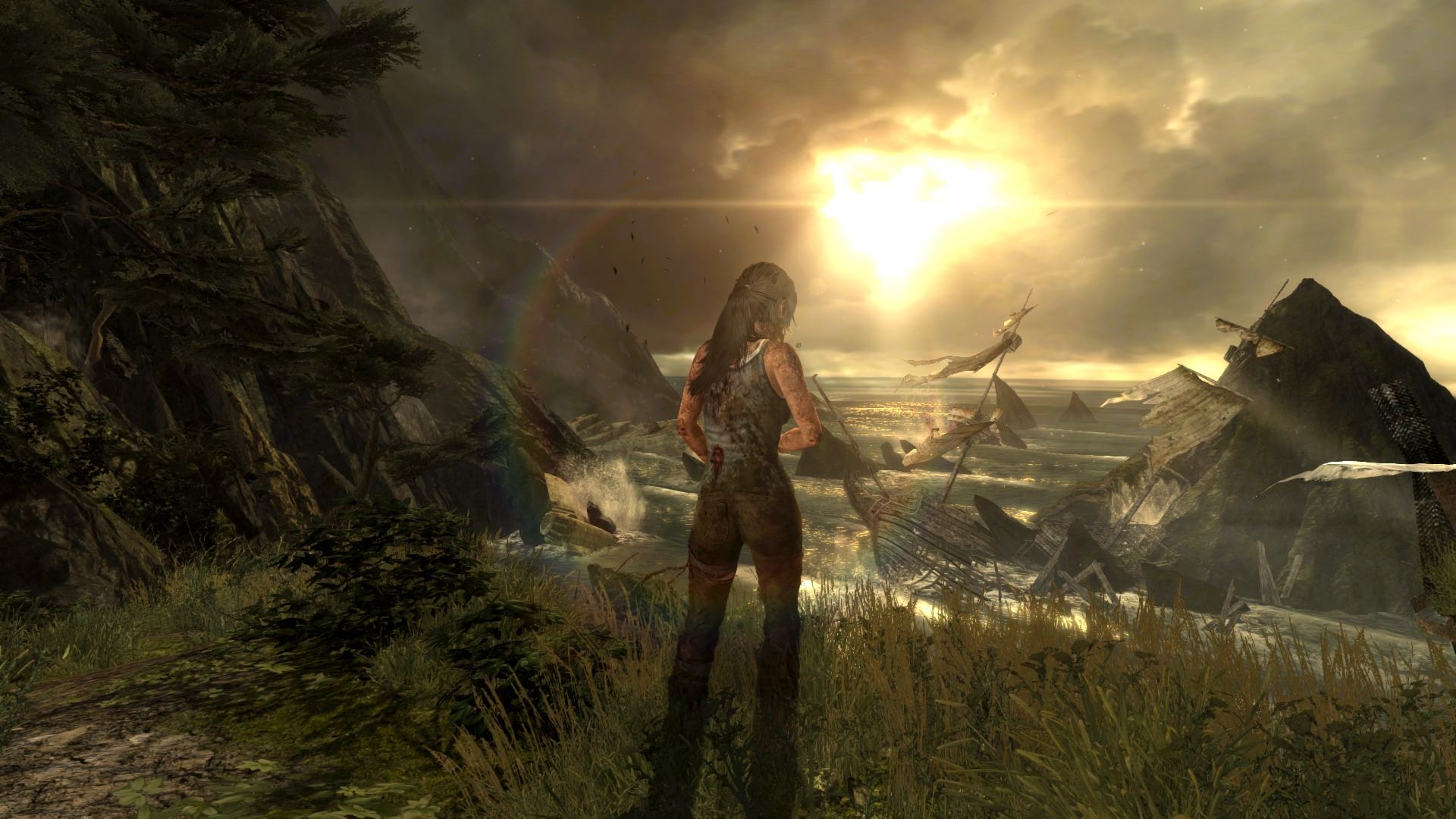
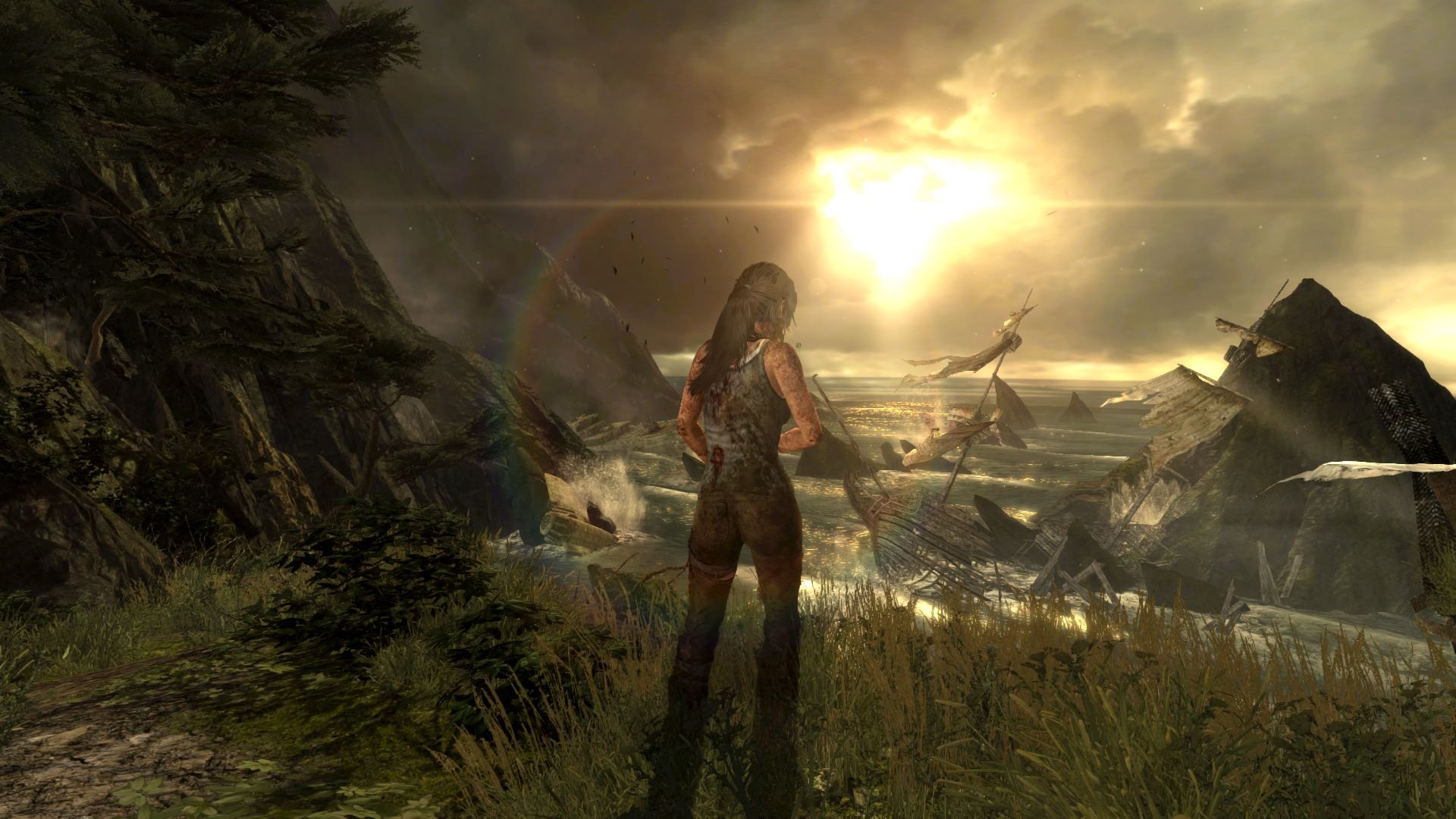
Graphically, it's pretty damn stunning, mind you. On PS4, the game runs at 60FPS in 1080P, which considerably changes the game when you're coming from the previous generation.
In fact, the structure of this Tomb Raider is quite simple:
- The "normal" zones are usually introduced during an action scene. It might be a tense gunfight or a stealth section. Once the scene is over, the player is free to backtrack and explore to find all kinds of bonuses. Once you get into the game, the combat/exploration ratio is roughly 1:2. The zones are often carefully crafted, so discovering them quickly becomes a pleasure. In short, I liked it.
- There are other zones that only serve a specific moment in the story. In general, they're limited to frantic action. Chases, tumbling downhill, brawls, stealth: the menu of this Tomb Raider is fairly varied, but it sinks a little too quickly into "Uncharted-ized" mediocrity with its QTEs, its completely rail-roaded paths of the "go-where-I-want-or-die" type, and its never-ending fights... fortunately, the alchemy between these "scripted" zones and the exploration zones is skillful enough to keep boredom (mostly) at bay. In summary: it's perfectly bearable, even if you hate being treated like a sheep.
The freedom to explore would be nothing if it didn't reward your efforts in one way or another. In this regard, Tomb Raider is particularly effective: the rewards are varied, if not plentiful. So you find experience to develop Lara's skills, materials to upgrade her equipment, documents to better understand the story, or relics to improve your culture (for real, even). Best of all, the "optional tombs" (small rooms with one or two quickly dispatched puzzles) are admittedly few in number, but each benefits from genuine atmosphere work. When visiting them, Lara takes the opportunity to comment on the place, speculating on what it might once have been used for.
So, as you'll have gathered: despite the risks of drift, this Tomb Raider reboot has preserved its "wannabe archaeologist-explorer" roots, and that's pretty much everything I hoped for.
As for the rest, the gunfights aren't too bad. Lara has 5 rather convincing customizable weapons — as many ways to blow a bastard to bits — as well as a few moves to quietly eliminate the careless who failed to notice her (it doesn't happen often, but it does happen). In terms of handling, the heroine responds well: I took more pleasure steering her than putting up with Edward and his unfortunate tendency to cultivate intimate relationships with every wall in Assassin's Creed 4. On the other hand, the QTEs are rather irritating without reaching the most mediocre levels in video game history, and the sliding sequences have little — if any — appeal.
Atmosphere
When it comes to atmosphere, Tomb Raider blows hot and cold. The impression that emerges is that, after much groping around, the game ended up sitting "with its ass posterior between two chairs".
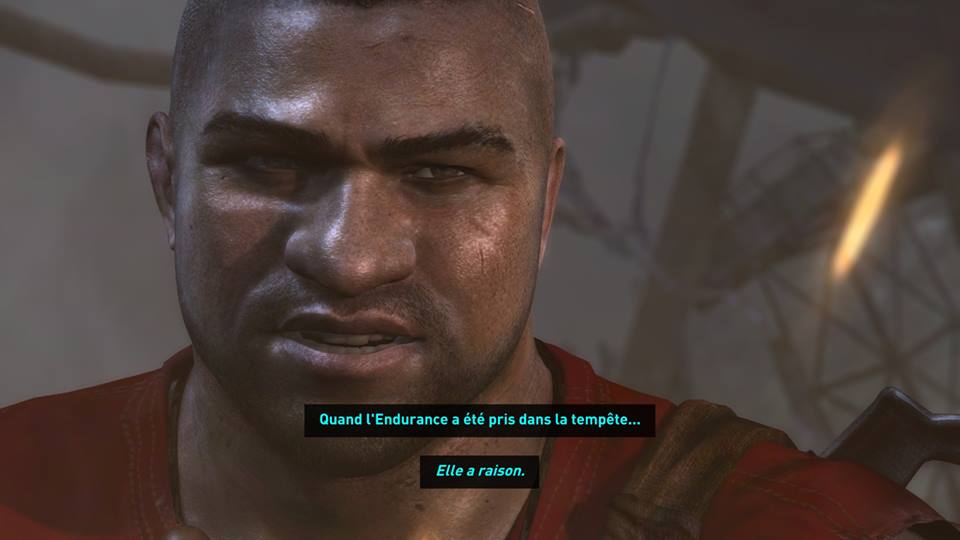
The characters — Lara included, in the end — are neither really interesting nor likeable. In some cases (Whitman), we even reach cheap caricature. Note that caricatures aren't a problem in a pulp universe, which consumes clichés the way a car consumes gasoline. But that's another problem with this Tomb Raider: you can't tell whether it wants to be pulp or wants to be realistic. On the one hand, the story emphasizes the importance of survival in a hostile environment, and a minute later, you're sent to slaughter soldiers ten at a time in a temple that's exploding. The complete absence of humor suits a "realistic" universe well enough, but the situations are sometimes too grotesque to remain credible.
It's on the side of its island and the mystery surrounding it that Tomb Raider finds salvation. The story of the Sun Queen is rather well introduced — all the more so since those who take the trouble to find all the documents will enjoy figuring out what's being plotted in advance. To top it all off, the art direction is interesting: instead of visiting yet another knock-off of Atlantis or ancient Egypt, Lara takes us to a culture not known for its archaeological wonders. So we'll gladly discover an "ancient Japanese" architecture, and duly savor the original presentation of the intriguing Himiko, the first mythical queen of "Japan", with some mentions dating back to the Three Kingdoms era.
In the end, my only real regret is the more than lightweight lifespan of the title. Completing it 100% will take a mere twenty hours or so. For an AAA title, that's still fairly thin, especially since the enemies' resistance is quite relative, even on hard mode. One could also add that the game's soundtrack is rather unremarkable — which is almost surprising given that big games rarely ship without at least one memorable theme.
Nevertheless, one last point remains to be addressed, the kind you can't ignore when talking about a game with a female protagonist...
The New Lara
In recent months — or rather, recent years — the controversy over the representation of female characters in video games has taken on considerable proportions. For those of you who consider this subject pointless, I invite you to run a little test. Take all the games in your library and ask yourself a few questions like these:
- Among the main protagonists / antagonists, what is the male/female ratio?
- Among the female characters, how many of them exist as anything other than a hero's girlfriend?
- Would you be able to describe the faces of the game's female characters without referring to external / changeable attributes (hairstyle, piercings or otherwise)?
You will quickly notice the poverty of female representation in video games. From there, you're free to think that these are "just video games" and that there's no need to get worked up over it. If you go by that principle, then it would be logical to do the same with every subject dealing with video games: no need to ramble on about the relevance of a storyline or the variety of gameplay. After all, it's "just video games"... right?
In any case, I'm one of the people this subject interests. Consequently, the representation of "Lara 2013" matters to me.
Obviously, as the emblematic representative of female video game protagonists, Lara Croft was, is, and will remain at the center of these discussions for a long time to come. Initially conceived as bait for the young male in heat, she surprisingly established herself for some as the symbol of the fearless heroine. Better still, despite her hypersexualized physique, Lara has always retained a "wild", "her-own-master" temperament — a point that brings her closer to a Bayonetta, and one that has won her the affection of some feminists.
As Lara's scandalous reputation was losing its luster, Crystal Dynamics decided to abandon hypersexualization and offer us a more realistic vision of its character. What message does this tamed-down version of Lara Croft send?
Appearance
Let's first talk about her appearance.
It's undeniable that Lara has become more "believable". At the same time, it had to happen: how do you keep exaggerated proportions in a game whose graphical style aims for photorealism? This detail was starting to weigh on the latest productions. Between realistic secondary characters and a fantasy-idealized Lara, there was a gap that undermined Tomb Raider's credibility.
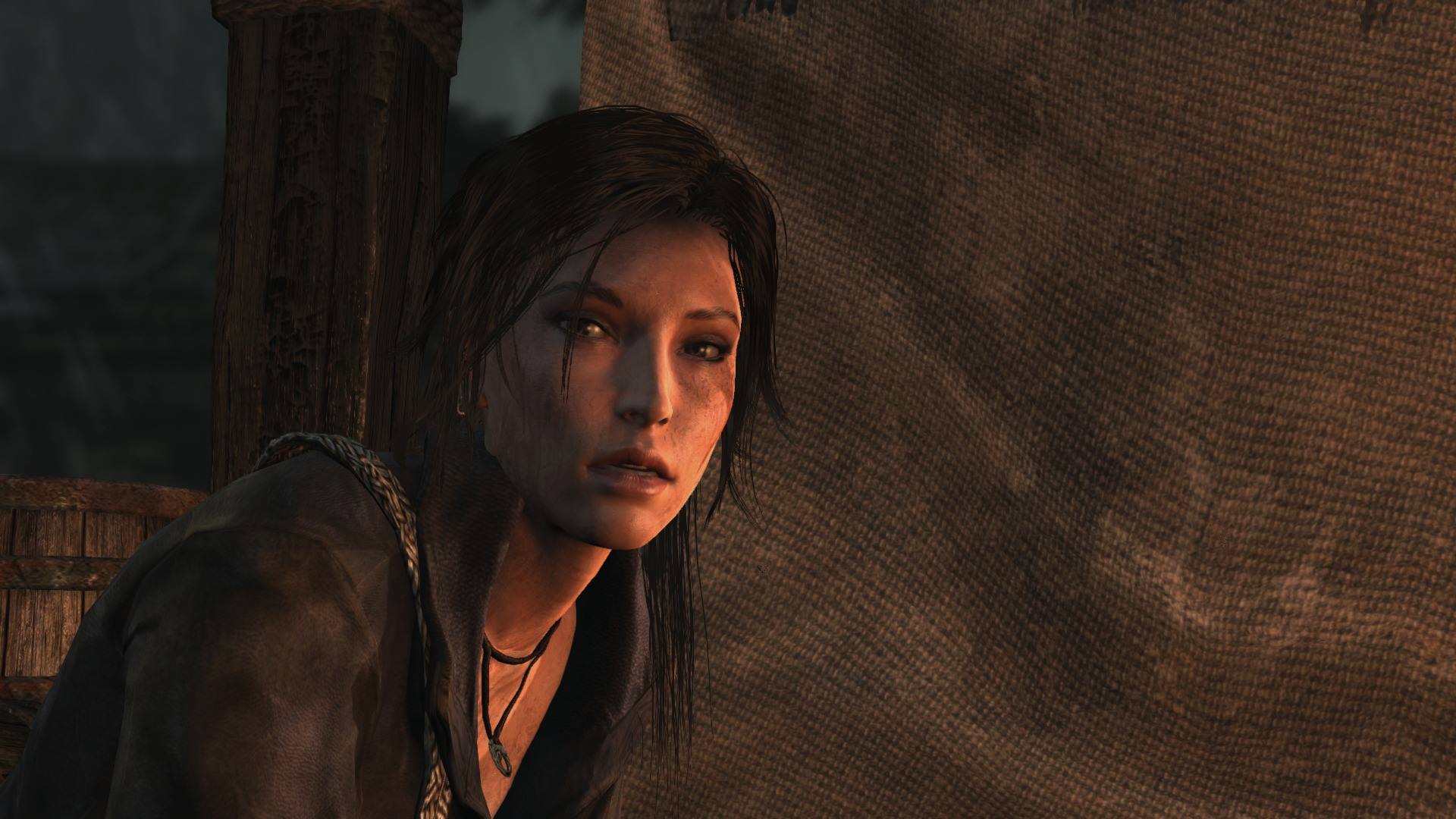
Well, well... if everyone looked "that bad" merely upon waking up in the morning, we could all claim first place in Miss / Mister Switzerland / France / Whatever...
And yet, this new Lara remains a fantasy object through and through. Granted: we've left the "pre-pubescent teenager fantasy" stage to reach that of the "young adult fantasy", but it's still a fantasy. It's hard to find the slightest flaw in her face, or even to describe its contours. In video games, important female characters differ little from the beauty standards of the culture they come from, and this new Lara in no way challenges that statement. We're very far from the work done by Hideo Kojima (often criticized, mind you, for his unhealthy fixations with the female characters of his games) on characters like The Boss or Eva.
This prim refusal to take any risk with Lara's looks even weakens the coherence of her initiation rite. Lara is never marked by what happens to her. At worst, she has blood and mud on her face, and then... that's it. It vanishes as soon as she dips her head in water. It's hard to imagine a character going through such an adventure and coming out physically unscathed. Let's compare once more with Metal Gear Solid 3: Big Boss's baptism by fire had more than one impact on his physical appearance (the most obvious being his gouged-out eye). I would have hoped for similar boldness from Crystal Dynamics. "You don't get to make a pretty female character ugly" remains the watchword in this Tomb Raider.
However, one very good point remains about young Lara Croft's appearance: her clothes. The designers managed to keep ties with the Lara of old while avoiding self-indulgence. A blue-gray tank top as a nod to the skin-tight turquoise bodysuit, archaeologist's trousers rather than very short shorts: Lara's outfit looks like a "practical" one more than a "sexy" one. When alternate costumes were announced, I was convinced Square Enix would give in to the temptation of imposing a sexy outfit on Lara, something like "Original Lara outfit for €10... who wants to ogle the new Lara? Who?". After all, that's what they're doing to poor Lightning. And then, surprise: nothing of the sort. The alternate outfits remain coherent, believable, and perpetuate this idea of a Lara who's "practical above all", an aspect that fits her new personality well.
Personality
Strangely enough, I was more convinced by Lara's personality than by her looks. The early signs were hardly encouraging, though. Between Gamekult's review, which complains about the character's overly rapid transformation, and Merlanfrit's article, trashing the entire game and accusing it of the worst sexist deviances, I was expecting the worst. And that's without mentioning the developers' clumsy justifications inviting players not to identify with Lara the way they would with a male character, but rather to treat her as a weak little thing that we — as males — must help take flight. How sweet...
Ultimately, the character is never portrayed as weak. Yes, at the beginning of the game, Lara isn't yet used to cauterizing her own wounds with a white-hot arrowhead or cutting throats left and right — pardon her. That doesn't mean she collapses like a shrinking violet when these situations arise: Lara considers each situation with realistic apprehension, but carries it out without fuss. Note, among other things, the remark she makes to Roth after killing for the first time: if something shocks her, it's realizing how "easy" it is to kill someone.
Given that, how can one find her "weak" or "submissive"? To my mind, what some deliberately perceive as submission can be explained in two ways:
- Lara's personality. The new Lara is presented as introverted and serious, but not easily influenced or defenseless for all that. This gives rise to situations where she seems passive, even where she blames herself for having led the expedition into its predicament. But she never apologizes for overcoming the trials that come her way (whether environmental or human in origin).
- The game's style. As explained on the previous page, Tomb Raider would have liked to be "realistic". Consequently, it's hard to compare Uncharted's Drake — who is clearly in the "over-the-top explosive pulp" register — with Lara, who should have come across as more believable if the game had managed to respect its register from start to finish. So the problem doesn't come from the character, but from the game itself.
Knowing that Lara was never weak, her development — even though it's handled in a fairly conventional and rarely subtle way — remains coherent. We're very, very far from the caricatural changes of certain J-RPG characters (
, if you're reading this... go fuck yourself).
The presence of her paternalistic mentor — Roth — is another point of debate. Rightly so? Ultimately, this relationship is clichéd, sure, but it's not enough to eclipse the character's qualities. Yes, she lets her guard down when talking to him. Yes, he's very protective. Yes, the resolution of this relationship is superfluous (or rather, they could have presented things differently...). Yes, had the writers swapped Reyes and Roth, we would have avoided the potentially sexist indulgence. But that would amount to saying that a good female character isn't entitled to a male mentor — and so... I wonder where the sexism actually lies.
Finally, note that the game's main antagonist is a man with whom Lara shares many character traits. The story emphasizes this (and it's one of its rare good points): Mathias and Lara are the only two characters with shoulders strong enough and the temperament needed to survive the island's perils. The fact that the game draws a line of comparison between two protagonists without taking their gender into account is further proof of a certain maturity.
In the end, the only genuinely disturbing thing about this Tomb Raider is the sickening marketing it received. Proof that some of the people in charge of the game's communication clearly lacked the background to understand what their colleagues were trying to do...