Review
Jackals: Bronze Age Fantasy Roleplaying
ludique · Review · vendredi, 14 mai 2021 à 16:00:09 · 13 min
After our Conan: Shadow of the Sorcerer campaign, I wanted to follow up with another universe that was more "antique" than "fantasy": Jackals: Bronze Age Fantasy Roleplaying. This game invites us into a fantastical Bronze Age, where humans reclaim a region that has become hostile as much through its inhospitable nature and its wild beasts as through the vile abominations that still haunt its corners. From north to south, the War Road links the two ends of the Zaharet, a sort of fantasized Canaan. And among those who walk it, the Jackals are mercenary outcasts, as feared as they are adored for their courage and their will to push back the limits of civilization. Of course, the PCs are among them.
Osprey Publishing maintains a rather nice line of tabletop RPGs. Small format, polished layout, often interesting concepts: the qualities are plentiful. I discovered the line with the excellent Paleomythic, then carried on with the daring Righteous Blood, Ruthless Blades, and here we are now with Jackals. Others followed, although they did not leave as much of a mark on me. Jackals' singularity lies in its line support: a campaign and a setting supplement are already on the shelves. I hope more books will follow, even if the years separating us from the latest release leave little hope.
- [Let's Create a Character] Jackals
- [Rules Example] Jackals
- [Review] Jackals
Let's talk about the physical side
In terms of form, Jackals is a 272-page, small-format, full-color book, for a little more than 90,000 words (compared to 250,000 for a big production like Héros & Dragons, or 198,000 for Rêve de Dragon). Its campaign, Fall of the Children of Bronze, follows the same pattern with its 240 pages. The setting supplement, Travellers on the War Road, is only 144 pages, however, in line with the majority of the publisher's recent output since the price of paper went up. Their electronic versions have the good taste to be properly indexed down to second-level headings. Admittedly, this treatment is starting to become the norm, but plenty of publishers still struggle to get there. Unfortunately, the illustrations of Jackals are a touch too sparse and generic — too much so for their own good — although they receive the support of maps and plans when the need arises: we get a synthetic map of the Zaharet, just as of its two ends, while the scenarios (3 adventures in the core book) benefit from a plan of their most important area (often a dungeon, or a city). As for the campaign, half the scenarios have 1-2 plans, garnished with a few illustrations here and there to give body to the key moments of the adventures. Considering it is a small production, Jackals honestly holds its own.
An idea of the book's size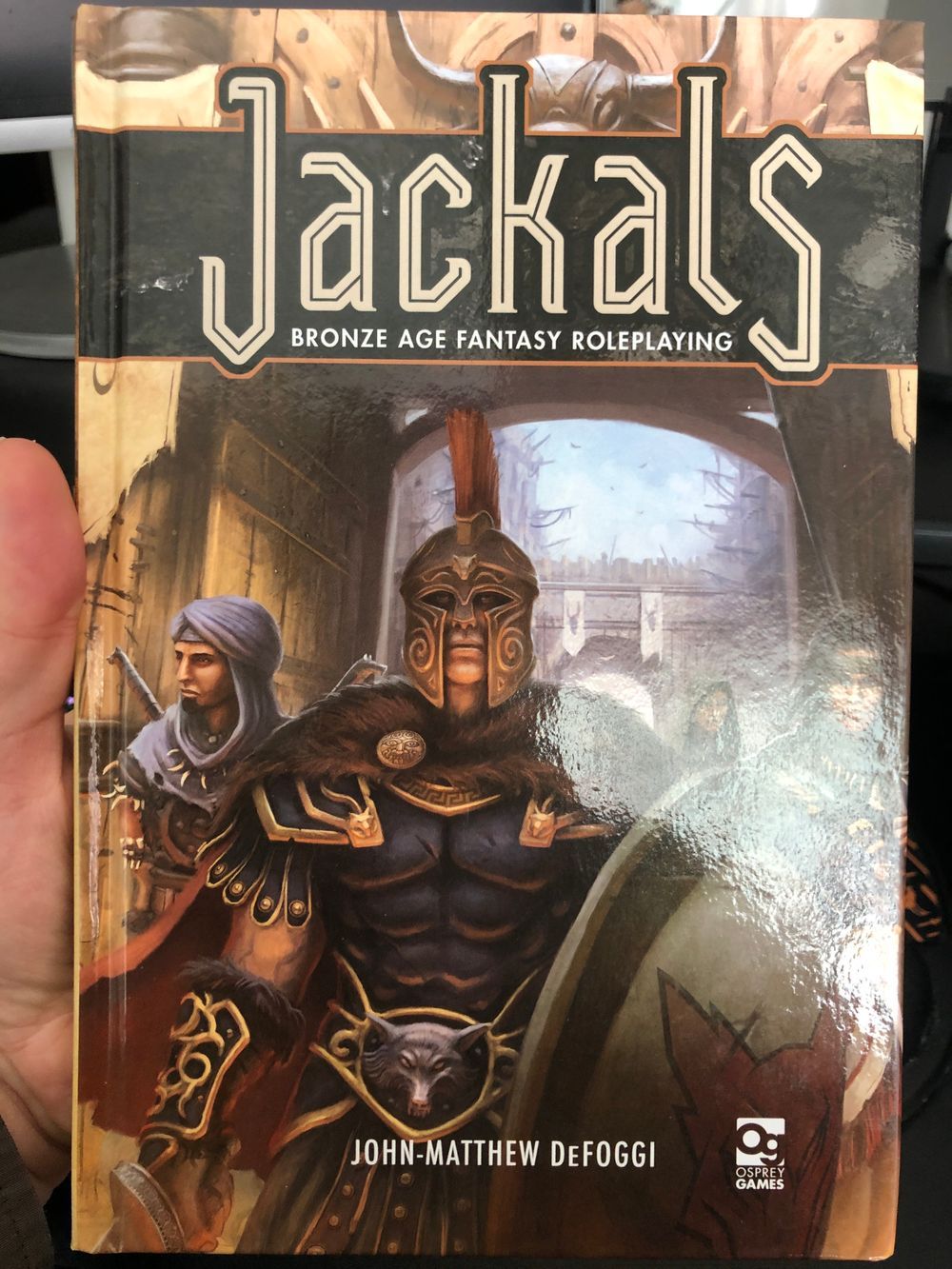
It is always difficult for me to discuss the quality of an English text, but failing to offer a formal perspective on it, I am happy to report that my read was fast and steady (2-3 sessions of a few hours), proving not only that the text reads quickly, but that it flatters the imagination enough to leave you wanting more. Admittedly, a handful of typos mar the picture somewhat, but nothing that strikes me as truly disqualifying.
Layout example. Clean, professional work, nothing to complain about.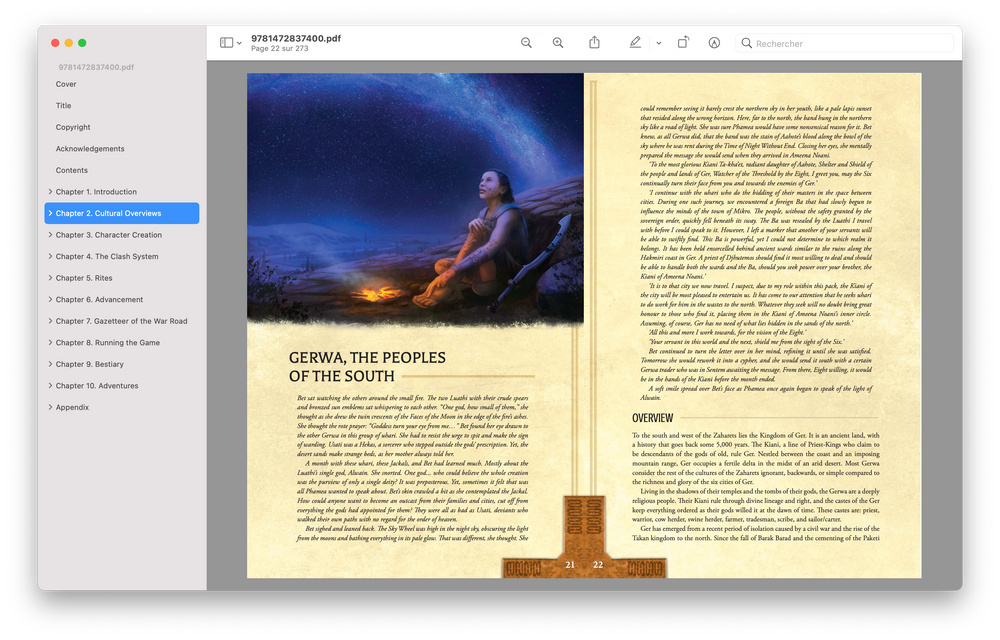
The biggest caveat concerns the organization of information within the books, which legitimately fails to win readers over. The author frequently puts forward cultural terms whose meaning is not immediately obvious, often forcing the reader to extrapolate, to consult the glossary at the end of the book, or to strike a bargain with their understanding of the text. As an example, take the term "Hulathi": it is introduced as early as page 15, where we are told that "Hulathii" is the language of the "Hulathi" (nothing to do with the "Luathi", mind you!), only to be reused a dozen times over the 140-odd pages that separate it from its definition. The same criticism could be aimed at the rules, since some concepts mentioned in a given chapter are sometimes only introduced many pages later. A slight "beta version" feeling therefore escapes from the book, all the more so as some NPC names come back several times for different characters, and some mentions of the calendar are inconsistent — in short... be ready to tweak a few details here and there if you take the plunge. Honestly, it would be unwise to hold it against the game. We have seen far worse.
The game's universe
The universe of Jackals sees human life painfully reclaiming its rights. Arid lands, inhospitable places laden with traces of ancient humanity, monstrosities swooping down on the unwary where nobody will hear them scream: the Jackals of the Zaharet must push back these threats and open new horizons for their fellow humans, in the name of Order and progress, even though their status as outcasts often earns them the distrust of the common folk as much as of the powerful. As you will have gathered, the Jackal's life is meant to be hard, and your characters will rarely get to rest on comfortable pillows or taste a life of luxury. And since blasting away is part of their daily grind, it quickly struck me as difficult to envision a purely intellectual or social PC. This impression was confirmed over our 25-odd sessions, in which the least min-maxed character of the group suffered quite a lot until his retirement (by "min-maxed", understand "who did not invest all their points in the survival, perception, 'raising hell like a villain' and willpower skills").
In the game's era, the Zaharet has freshly freed itself from the yoke of the Takan, a gathering of grotesque and (generally) humanoid creatures. Throughout their reign, they toiled to destroy every trace of human history in the territory, in particular that of the Luathi. One uprising later, the now-freed Luathi are working to rediscover their past in order to rebuild their present. Today, the Zaharet counts four distinct and still-active human ethnicities:
- The Luathi, strongly inspired by the Bronze Age Canaanites, who make up the bulk of the local population, spread around two metropolises to the south and to the north of the War Road;
- The Gerwa, strongly inspired by the New Kingdom Egyptians, who rule a rigid, time-honored kingdom, entrenched in the south of the Zaharet, with which relations have always been difficult;
- The Melkoni, strongly inspired by the Mycenaean Greeks, who establish colonies in the northwest of the Zaharet, driven by their heroic myths and the desire to grow rich;
- The Trauj, strongly inspired by the nomadic tribes of the Arabian peninsula, who fiercely defend their desert, in particular against the marauding Takan.
While the PCs descend from one of these ethnicities, other human cultures have left their mark on the region and continue to do so despite their disappearance. The mysteries of their collapse are quickly sketched in the core book, and the archaeology-minded Packs will find plenty to work with among the ruins.
If we stick to the core book, the description of the various playable cultures remains somewhat sketchy, leaning more readily toward American fantasy than toward a historical reconstruction of the Bronze Age. Yet I am one of those players who needs more than commonplaces to enjoy a universe, hence a certain disappointment. You will have to delve into the supplements for richer information. Festivals, history, beliefs — they go over quite a few subjects that give more flavor to this fanciful Canaan, even if the "everyday life" information is rushed through too quickly. Despite everything, you get almost enough information to bring a more or less credible Zaharet to life, and nothing prevents you from using information drawn from the historical cultures they are inspired by to fill in the gaps (one player rose beautifully to the occasion with his Gerwa farewell poem, for example). Here again, for a small American production, the work deserves praise.
The rules system
It seems clear to me that a great deal of work went into the rules system, christened the Clash System by its author. To describe it in a few words, the system leans heavily toward gamism (according to Ron Edwards' theory, still useful whatever its detractors may say). It favors tactics and character growth, which is organized essentially around their abilities, the martial ones in particular. The game contains little material to encourage roleplay (narrativism), apart from a few questions to ask at character creation, as well as an incentive to plan your "retirement" after a certain number of sessions (see below). A few more or less light mechanics garnish the basic system, to handle forging, haggling, or travel, but we are talking about a handful of dice rolls — nothing as elaborate as Rêve de Dragon, for example. No, fundamentally, in Jackals, you bash monsters. Everything revolves around that.
The basic mechanic couldn't be simpler. Your skills are rated out of 100, although they can exceed that threshold (in which case they gain various and sundry special talents for each additional 20% bracket). To make a test, you roll 1d100 and must get a score equal to or lower than your skill. The GM can impose a penalty (or, more rarely, a bonus) to fine-tune your chances of success. Doubles (11, 22, 33, 44, etc.) are criticals: a critical success if your skill score is higher than the die result, a critical failure otherwise. Some special abilities allow you to roll 2d10 and keep the one that suits you best, or to shift your result "one notch" in your favor (failure -> success, success -> critical success). For combat, all characters (allies and enemies) get "Clash Points" that can be used to perform special actions, or to enhance basic ones. This "meta-currency" is thus the sinew of war (in every sense of the term). Some people dislike meta-currencies. Me, I like them well enough, all the more as the Clash System is not particularly tedious to manage.
Pack life is built directly into the system, since each season, the Jackals are each entitled to a seasonal action, which simulates their activities between two adventures. Gathering rumors, researching a subject, spending money, commissioning a custom-made item, buying a house, buttering up a patron... so many fairly varied activities which, again, are dispatched with a spend of money and a quick dice roll. Feel free to expand on these actions. After 25 sessions, I am pleased to note that these little sequences effectively set the pace of the Jackals' adventures, and that they naturally lead to "light" scenarios to slot in between the official campaign's adventures. The more the Jackals evolve, the more their reputation grows: while the "good folks" will be more cooperative, the forces of evil will see them as an ever more pressing threat to eliminate. Thus, the brutality of encounters will increase, based on the most experienced Jackal of the group. The idea is that after many adventures, the characters will eventually want to "settle down" from their nomadic existence and move on to something else (for those who survive long enough). Thus, retired Jackals offer advantages to their successors, especially if their player dedicates an adventure, a text, or a poem to their character's departure.
I was surprised by the tactical breadth of the combat system, which manages to renew itself even after 25 sessions of play, for a minimum of effort on the GM's part. Of course, we are very far from mastodons like the D20 System, Pathfinder, Tales of the Valiant, or even Savage Worlds. Let's keep in mind that the author is essentially on his own working on the Clash System (which he also spun off into a tabletop RPG inspired by Streets of Rage, Urban Decay). It is therefore a fine success, even if I have one major criticism to raise: clearly, the characters are there to blast things. Yet the system behaves as if they had a choice. It is possible to ignore the game's fundamental survival skills in favor of others, some of which are not as prominent. You immediately feel the difference between a character optimized for brawling and one designed for intrigue or infiltration, whereas the official scenarios generally rush through the investigation parts to focus on the confrontations and the loot. In addition, the system offers fairly few combat variants, unlike the D20 System and its many classes and specializations. It falls to the players to create differences in approach for their characters, which the system struggles to convey.
The "Fall of the Children of Bronze" campaign
The first campaign published for the line is titled Fall of the Children of Bronze. While it lays the groundwork for a sequel, I am not sure we will ever see it. I hope I am wrong!
WARNING: the following paragraphs moderately spoil the campaign under discussion. I try to limit the indiscretions as much as possible while staying informative, but I advise against reading this section if you want to experience the campaign from the Jackals' side.
Be that as it may, Fall of the Children of Bronze unfolds like a "river of a campaign", a story flowing on over a good many years, during which your players' Pack will pick up contracts in the North and in the South of the War Road. After a few years, one very particular event will change the "long quiet river" of the Jackals' life — a conflict that quietly works its way in as the seasons go by. The rather epic finale has the potential to change the face of the Zaharet for centuries to come. If you count the three scenarios of the core book, one of which clearly serves as an introduction to the campaign, the whole comes to more than fifteen fairly short scenarios (about 3 to 6 hours each). The campaign is clearly designed to let your players weave in their own adventures, OSR-style, to flesh out content that is already substantial. Thus, as the stakes rise over the course of the plot, players will want to take initiative more and more often to wrap up this or that (apparently) neglected story thread. In parallel, each year offers a series of hooks that are just begging to be developed. Usually, such lazy paragraphs are dashed off to give their authors a clear conscience, but here, some threads will alter the scenario framework quite deeply, to the point that they naturally inspired complications which I hope are gripping.
Fall of the Children of Bronze therefore seems largely designed to be played over a long period, "in real life" included. Because of our somewhat overbooked RPG schedule, I find myself almost "forced" to limit the off-the-beaten-track adventures somewhat, which strikes me as almost contrary to the game's philosophy. So be forewarned: we are looking at a long-haul, highly customizable campaign. I am planning another ~10 sessions on our side, for a total of 35 sessions of about 3 hours each. Something very similar to Masks of Nyarlathotep, then, keeping in mind that we are the ones rushing. Not bad, for a small 240-page book!