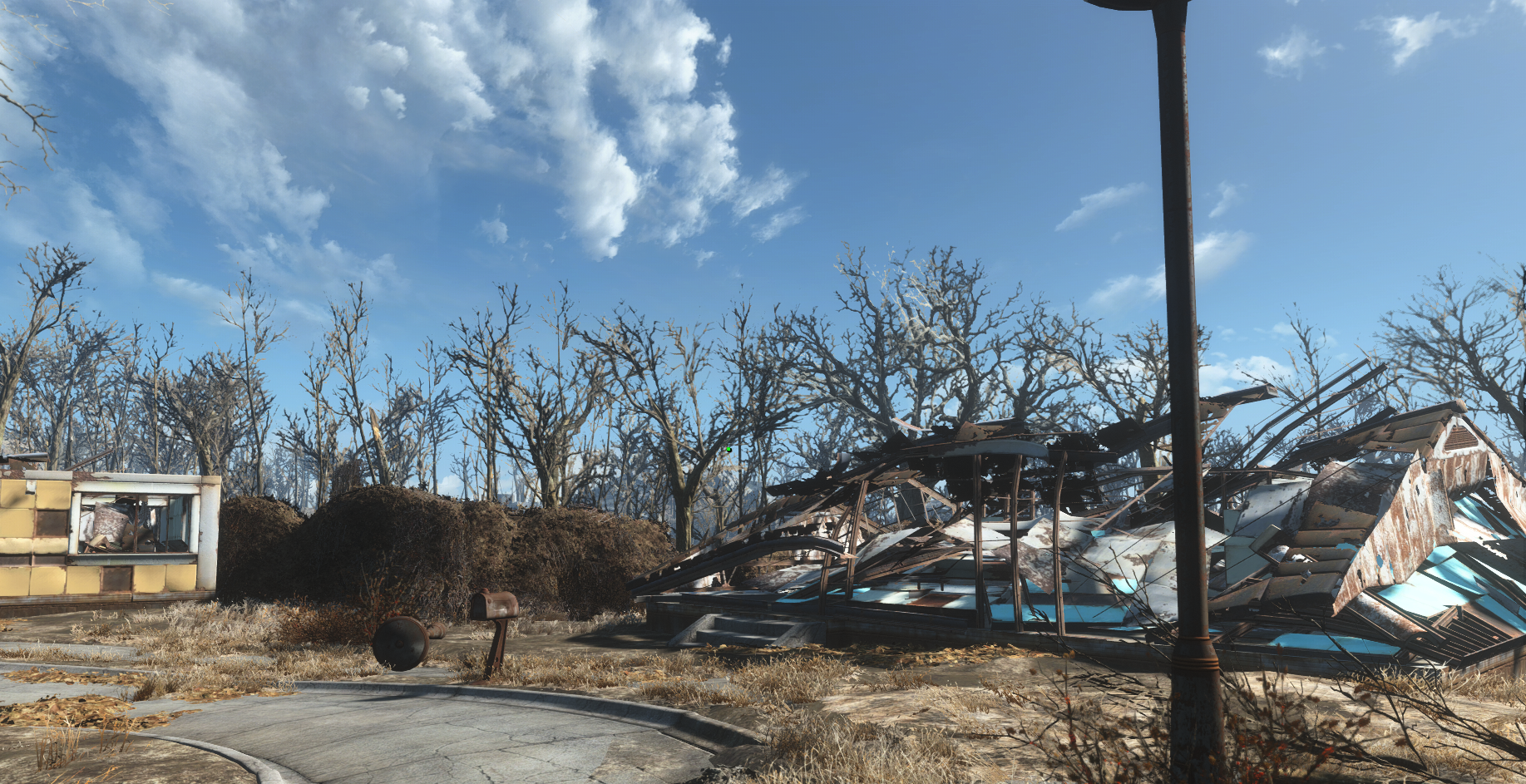
Review
Fallout 4
the cheap victory
ludique · Review · mercredi, 18 novembre 2015 à 11:02:01 · 8 min
With more than 100 hours on my meter, I can hardly accuse Fallout 4 of being a failure. Masochism has its limits. And yet, I feel like it. How can that be?
The "Fallout" series ranks among the great legends of C-RPGs [1]. It is renowned for two things: the absolute freedom it offers and its "Wild-West-Coca-Cola-can" post-apocalyptic universe.
This reputation was forged on the first two episodes [2], developed by the dearly departed "Black Isle Studios" (why an "s" on Studios? We'll never know). When Bethesda Softworks (or "Bethesda") took over the license, many feared the arrival of a new Fallout, a bastard child between its official ancestors and the flagship series of its new creators, "The Elder Scrolls". In 2008, the fears were confirmed. While Bethesda managed to pay homage to the saga's visual aspect, the latter's soul had clearly flown away. The Maryland company manifestly has neither the transgressive, sharp wit nor the gameplay ideas needed to reproduce the qualities of the Fallout games. The result split the gamers into three groups: those disappointed Elder Scrolls fans, those disappointed Fallout fans, and the "we'll make do" crowd. Judging by the ultimately rather flattering average score of Fallout 3 on senscritique, one can say the majority nevertheless enjoyed the experience. Personally, I found the game bland and unimaginative.
Following Fallout 3, the people at Bethesda did something quite unusual: they entrusted the development of a Fallout 3 spin-off to Obsidian Entertainment [3] and focused on "The Elder Scrolls 5: Skyrim", in which all their know-how could express itself without the baggage of a series they did not master. It was as if they had acknowledged their own limits. "Fallout: New Vegas", said spin-off, met with a rather unexpected critical success among C-RPG fans. Its technical base rested on Fallout 3, but its ludic approach was laced with a freedom of action typical of the first two episodes. For me, it was the ideal deal: everyone their domain, everyone their talents. Unfortunately, Bethesda's greed and "a strange stroke of bad luck" at Obsidian led to strained relations between the two studios. Result: it is highly unlikely such a collaboration will happen again.
At E3 2015, Bethesda sprang a surprise by announcing "Fallout 4". Given my renewed respect for the studio after a very well-mastered Skyrim, I saw there an interesting opportunity for redemption after an off-topic Fallout 3. Had they hired a writer worthy of the name? Had they learned Game Design lessons when Obsidian showed them the way on their own game engine? I had some hopes on that front. In the worst case, I would end up with a "proto-Elder Scrolls", and that is always "acceptable".
Too bad that in the end, the game never rose above that stage.
Everything starts with an out-of-context video, far too serious: a good American soldier tells us the background of the Fallout games. Despite the tone, I must admit this presentation of the series' founding events is truly welcome. The first minutes of play are similar to those of Fallout 3, in that character creation is contextualized [4] and you are harangued with a family story. Playing for a few moments in pre-2077 America has its charm, but one still senses a repeat compared to the previous episode.
Once the tutorial is over, the sad truth does not take long to jump out: not only is the rehash of Fallout 3's and Skyrim's mechanics complete, but Bethesda does not even bother to imitate Fallout anymore. To summarize the problem, I could only quote Goodlifer's excellent comment, on Factornews:
[...] Thinking about it, I think Bethesda is quite comfortable with having gotten rid of what was specific to Fallout. You wanted humor? Instead, you get a settlement-building simulation (and besides the fact that it's shit on keyboard/mouse, the point of these camps is a bit obscure to me). You wanted somewhat moral choices? Let's rather remove karma and have you clean out OVERCROWDED raider factories. You liked the start of a Fallout where you struggle a bit to off giant ants and rats? We hand you a suit of power armor within the first 20 minutes of the game to gun down a Deathclaw with a gatling...
Oh, and don't bother balancing a negotiation/luck/shooting build, it's useless because 1/negotiation is pointless 2/weapons work like in an FPS without taking SPECIAL skills into account. - Goodlifer
The brute-force gameplay quickly reaches its paroxysm (especially if you team up with the Brotherhood of Steel and its Damn Pahwer Armors !!!): you spray bullets left and right, only slowed down by the maximum weight of the junk our character can carry. Note that for once, taking out your trash pays off, since any object can potentially be used to build structures (or weapon and armor modifications). As for the companions, they range from "transparent" to "fine, no more". Not really enough to spark the desire to discover their background. Same for the factions, too caricatural and impossible to influence, unlike those of New Vegas. But since the power progression proves thrilling and the wasteland is ultimately rather pleasant to explore, you let yourself get taken in despite everything. The hours fly by naturally, as with any good "Elder Scrolls". At this stage of the reading, an essential question arises: how can one love Skyrim while finding Fallout 4 as flat as a Brahmin crushed by a Super Mutant? Formulating an answer is difficult, so much do the two games look alike on the surface. And yet, the devil is in the details! Skyrim has a varied topography (mountains, tundra, verdant plains, snowy area, ...) and 9 cities, the smallest of which is at least as big as Fallout 4's two poor towns. Exploration and "social relations" thus take on more depth in the latest Elder Scrolls. Conversely, Fallout 4's first steps amount to shooting insects, leaving the area, shooting insert the name of a generic enemy here, pushing through to a "point of interest" indicated on the map, shooting *insert the name of the enemy squatting the "point of interest" (Ghouls or Raiders, generally), reaching Boston, shooting insert the name of a random enemy, leveling up, entering a random building and shooting its inhabitants. The few stopovers in Goodneighbor or Diamond City do not weigh much against all these hours of mindless blasting.
It is around 40-50 hours of play that Fallout 4's interstellar emptiness imposes itself, far more than with any other Bethesda game. This time, we are not merely clearing out locations that look alike. Oh no! We clear out the same location several times, recycled to death. The game so often sends you twice to the same place so quickly that the enemies do not have time to "respawn": you will then merely rush to the objective and click on the NPC to free / the lone monster to gun down. In these situations, you will spend more time in front of loading screens between two fast-travels than actually playing. What? Yes, there is a problem. A big problem. The promises of power progression, which sparked so much enthusiasm at the beginning, now ring hollow. Fallout 4 has moved from the "Burger King" stage to the "old chewing gum" stage: you chew on something tasteless, vainly hoping to find some satisfaction in it. In despair, you dive back into the main quest, to discover with surprise that its final short stretch works completely differently from the first (dozens of) hours: all the important NPCs can be eliminated at will (rushing the end of the game, generally), alliance games are possible, and completing certain quests before others opens up new possibilities. It is as if this part of the game had not been written by the same people. Too bad it only lasts a few hours: here again, not enough to counterbalance all the time lost on the "perpetual battlefield".
Even the dialogs have been Mass-Effect-ified. For better and for worse.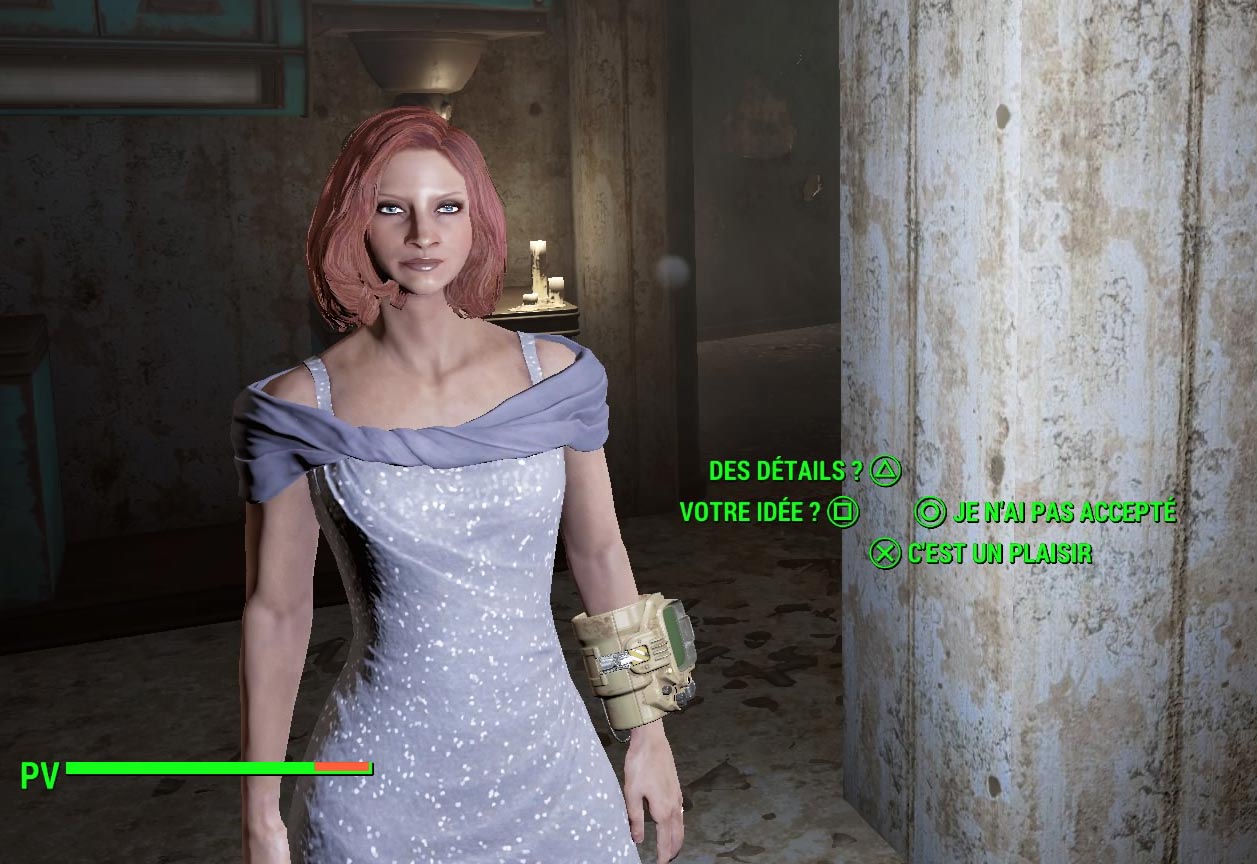
A studio going astray, glowing reviews, commercial success to boot, all at the expense of a grumbling fan base: these are the elements that plunged Bioware into a cycle of mediocrity around late 2009. Bethesda could well follow the same path. I call it the "Mass Effect 2 syndrome". This surprise bioware-ification even touches the dialogs, since the system has been reworked to resemble Mass Effect's: you select concepts rather than complete answers, and the protagonist (fully voiced, a first!) indulges in a theatrical improvisation vaguely related to the chosen answer. Mass Effect, that was 2007. Back then, it could impress. Today, Bethesda looks like a latecomer sneaking into the party on the sly.
I sincerely hope Bethesda will realize its mistake before going through a phase as grim as Bioware's between 2009 and 2014. Failing that, mods will - once again - be able to compensate for the weaknesses of the "Elder Scrolls" Fallout series.