Review
Dragon Age Inquisition
the redemption of Bioware
ludique · Review · samedi, 19 septembre 2015 à 23:04:27 · 18 min
Monday, December 1st, 2014. I'm taking advantage of a relative lull to buy a game I was hoping to immerse myself in for a long time. Its name? "Dragon Age: Inquisition", the third child of a controversial series of role-playing games, signed Bioware. I only emerged from it yesterday, after a number of hours I'd rather not reveal right away: you'd take me for a cave-dwelling bear... and you'd be right.
The venerable Confucian sages assert that spending this many hours on a game is a good sign. On this point, they're not wrong, for "Dragon Age: Inquisition" is an excellent vintage. Debriefing.
Bioware, from Downfall to Redemption
Bioware is a long story! Since its acquisition by Electronic Arts, this studio once renowned for its legendary "C-RPGs" ((Acronym for "Computer Roleplaying Games")) has compromised itself in numerous dubious projects. The crème de la crème of single-player RPGs toiled away on "Star Wars: The Old Republic" while people from "Bad Company" brought their "expertise" to the Mass Effect saga. As for Dragon Age, the second installment had been rushed out the door to release a little over a year after the first: this poor strategy very nearly signed the license's death warrant.
The timely release of a certain "The Elder Scrolls: Skyrim" forced many studios to question themselves, to seek inspiration in order to improve. Among them is obviously Bioware: shortly before his departure, Ray Muzyka ((Co-founder of Bioware)) admitted that the studio was thinking about how to bring a bit of "Skyrim" into the next Dragon Age. A statement that made me believe in a possible return to grace for the studio — not because it was drawing inspiration from a title I loved, but above all because it was admitting its mistakes.
Dragon Age, the Origin
As usual, let's situate our subject. "Dragon Age: Inquisition" (DA:I) is the third opus in the "Dragon Age" series, whose founder ("Dragon Age: Origins" — or DA:O) saw the light of day at the end of 2009 after a long gestation ((DA:O was first shown publicly at E3 2004. 10 years already!)). The ambition of the series: to reconnect with the complexity and richness of the "C-RPGs" of yesteryear.
But this return to its roots was not the only promise Bioware made. At the time, "Dark Fantasy" was in full swing. Between Game of Thrones and The Witcher, disenchanted universes were gaining ground over traditional HeroKitsch Fantasy. DA:O wanted to surf this wave, imitating the form without understanding the substance: for two years, the studio churned out countless trailers, each more ridiculous than the last, where armies of knights in spike-covered armor were bled dry by demons to a "Gothic Metal" soundtrack. Blood, sex, violence: a rebellious teenager's fantasy that almost dissuaded me from heading to the checkout. Fortunately, I took the plunge, and despite a rather dispiriting first few hours, the final assessment proved very positive. The combat demanded a good tactical sense, party management opened up many possibilities, and the story's modularity still stands as an example today.
The Story
The "Dragon Age" series takes place in the world of Thedas, a not always particularly subtle potpourri of various Dark Fantasy influences. You'll find, all jumbled together: dangerous magic, dominant and racist humans, obscure political conflicts, and recurring demonic invasions. Among other things, the lands of Ferelden and Orlais (where the action takes place) strictly regulate the use of spells by locking away magic-sensitive individuals in "Circles" watched over by the Templar Order. This third installment takes place shortly after the events of the second title: at the start of the game, the open conflict between Mages and Templars is about to be resolved during a conclave supervised by the supreme religious authority, Divine Justinia. After a first installment lacking personality, "Dragon Age" has finally managed to find a distinguishing factor in its game world: religion plays a predominant role there, and many questions revolve around the relationship between the Sacred and the common.
Map of Thedas. [source: Wikia, GameInformer. Copyright @ BioWare, under Fair Use.]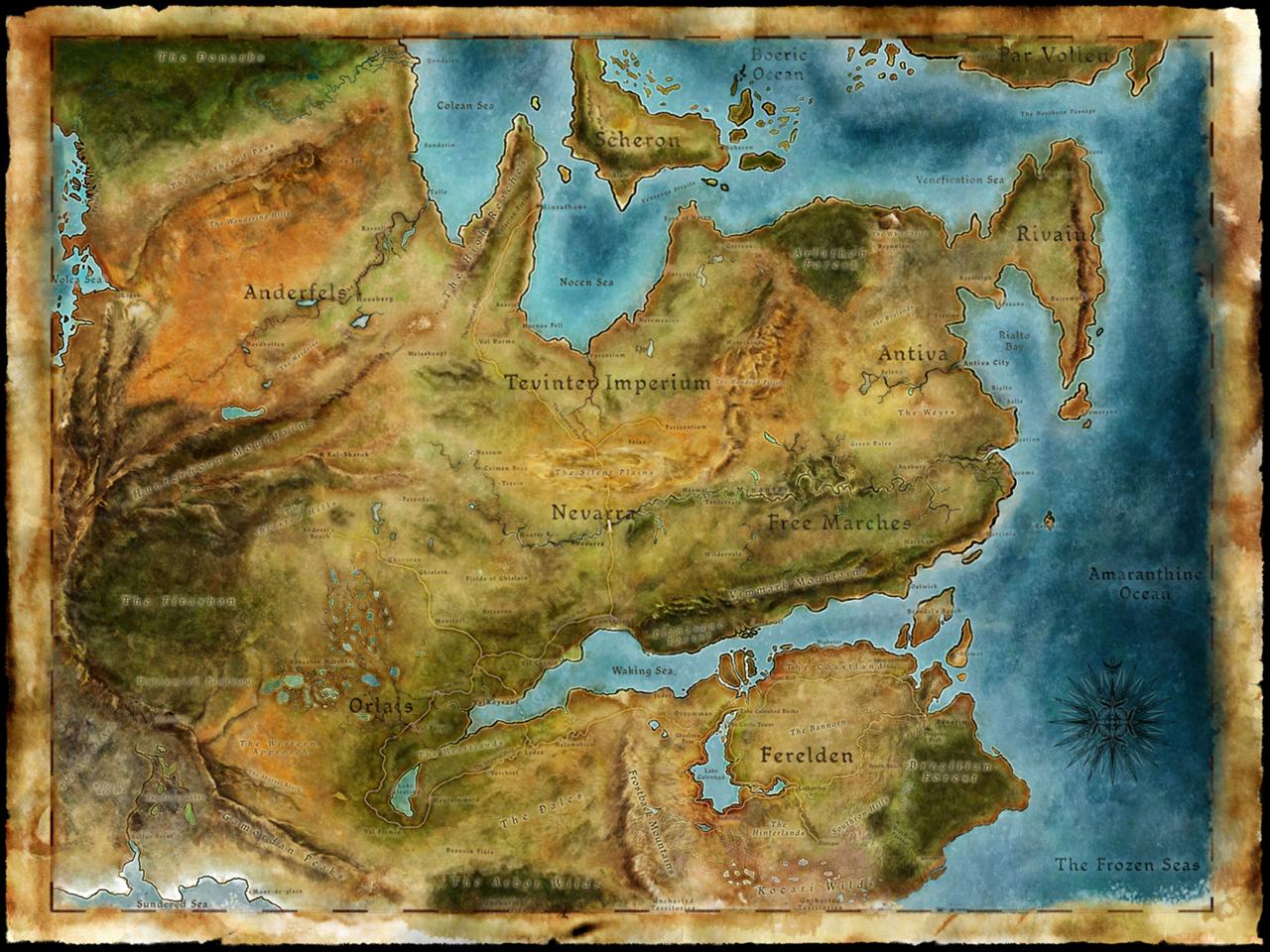
The negotiations barely begun, the temple where they were to take place explodes, leaving only a single survivor: your character. Simultaneously, a huge dimensional tear appears in the sky and threatens to swallow the world, followed by a rash of smaller rifts joining the party to "puke up demons" (copyright "Iron Bull"). Initially a suspect, then cleared, your hero stands out through their ability to close these rifts: this simple fact earns them the founding of the Inquisition with the help of a handful of other characters. From then on, the task will be to win the trust of Orlais and Ferelden, to identify the one responsible for these tragic events and, if possible, to calm the political tensions that keep growing despite the crisis.
Story-wise, this is pure, unfiltered Bioware: a threat to the world, an induction into a very special organization, a rise to power, the final struggle. The universe revolves exclusively around your person, and you're offered glory and recognition, sometimes without it seeming justified. Fortunately, the whole is a notch above "Dragon Age: Origins". Unlike DA:O's archdemon, DA:I's main antagonist is a rational individual, despite his inhuman appearance. Facing an "understandable" enemy gives the story more substance. I would nevertheless have appreciated a more intimate story, since saving the world is a terribly overrated task. Too bad Bioware decided to stick to its favorite domain — the epic narrative — rather than exploring the bold direction taken with "Dragon Age 2": the studio tends to fold too easily in the face of criticism.
While the narration is fairly traditional, the philosophical and political stakes depicted by DA:I are far more original: should you accept to pass for a saint in order to win the people's respect, or is truth the better counselor? Does faith find a form of legitimacy in its ability to unite people? These questions can tear you in two — provided you're willing to dive into the densest recesses of Thedas' history. Fortunately, Bioware has planned a nice surprise for those who want to jump on the bandwagon without having played the previous installments...
"Dragon Age Keep": the common thread between the "Dragon Age" games
An example of a fresco narrating the events of Dragon Age: Origins, in Dragon Age Keep.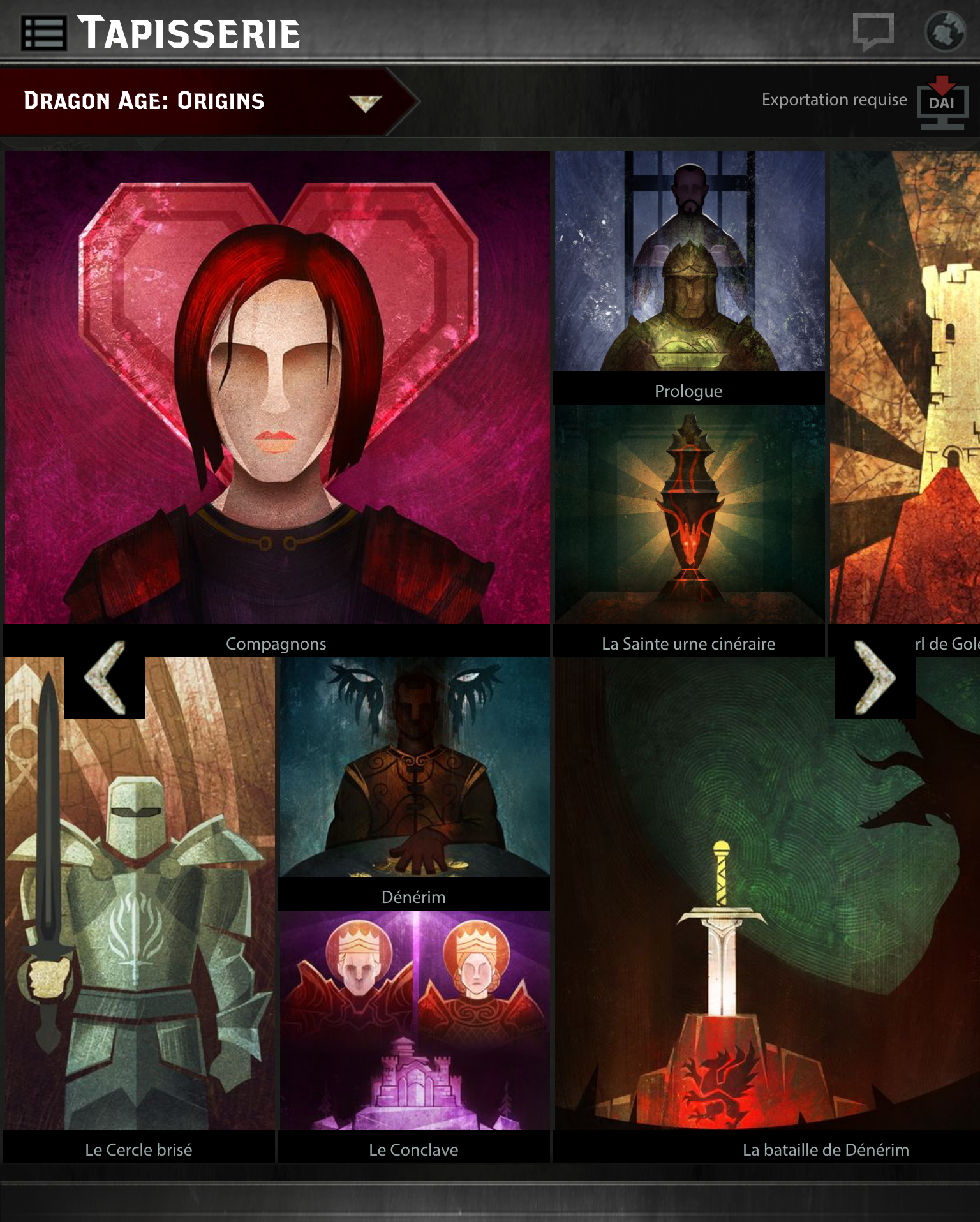
"Dragon Age" is a series built on choices and their consequences. Such a promise takes on its full flavor when you can carry your story decisions from one game to the next. To do so — but also to avoid losing newcomers — Bioware set up Dragon Age Keep, a complete website summarizing the games' events. In fact, the initiative is far more ambitious than that : this website lets you decide for yourself how the previous installments played out. Once your choices are made, you can import them into DA:I. The game's context will be noticeably altered: who is the King of Ferelden? Did your DA:O character survive? All these choices will get, at the very least, small references during your DA:I playthrough.
Dragon Age Keep is a surprising initiative that fulfills its brief very well. Let's hope it inspires imitators.
Protagonist and Party
Protagonist creation was a rather unpleasant surprise. You choose one of the three available classes (mage, rogue [ranged or melee], warrior [shield or two-handed weapon]), then your character's race (human, elf, dwarf, Qunari), and that's about it. No point distribution, no more detailed background choices: it's better than many other games, but it disappoints after a DA:O that focused precisely on that. So be it. As for physical customization, disappointment again. No freedom is granted regarding your protégé's physiognomy (nor their outfit). Worse still, the many sliders available to change the character's face almost systematically lead to hideous results, bordering on the ridiculous. It's a problem that already occurred in the first Dragon Age, and even in the Mass Effects: the facial expressions don't adapt properly to the heavy modifications of the default faces.
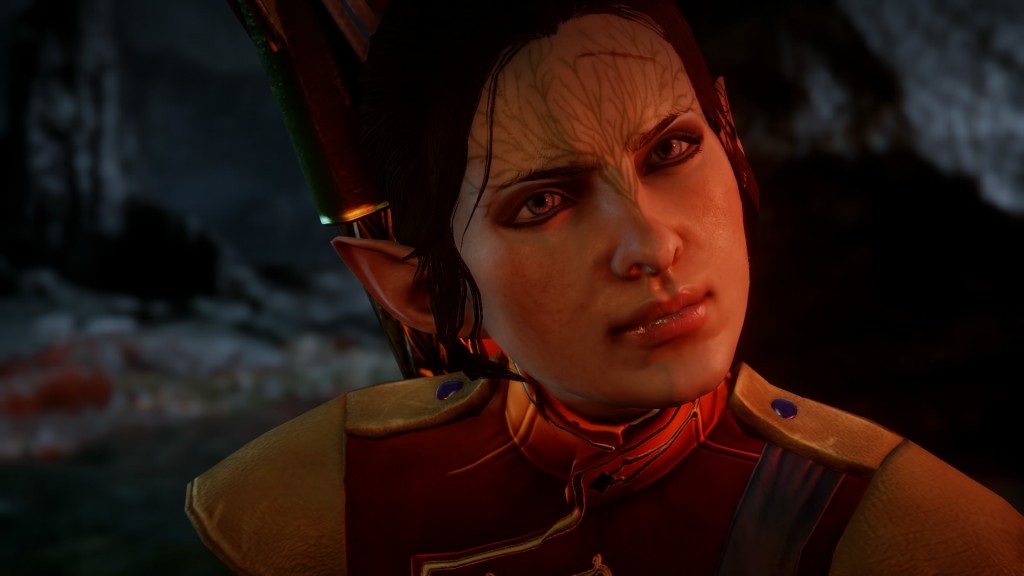
Lady Lavellan, Madeleine Lavellan. Elf mage and future head of the Inquisition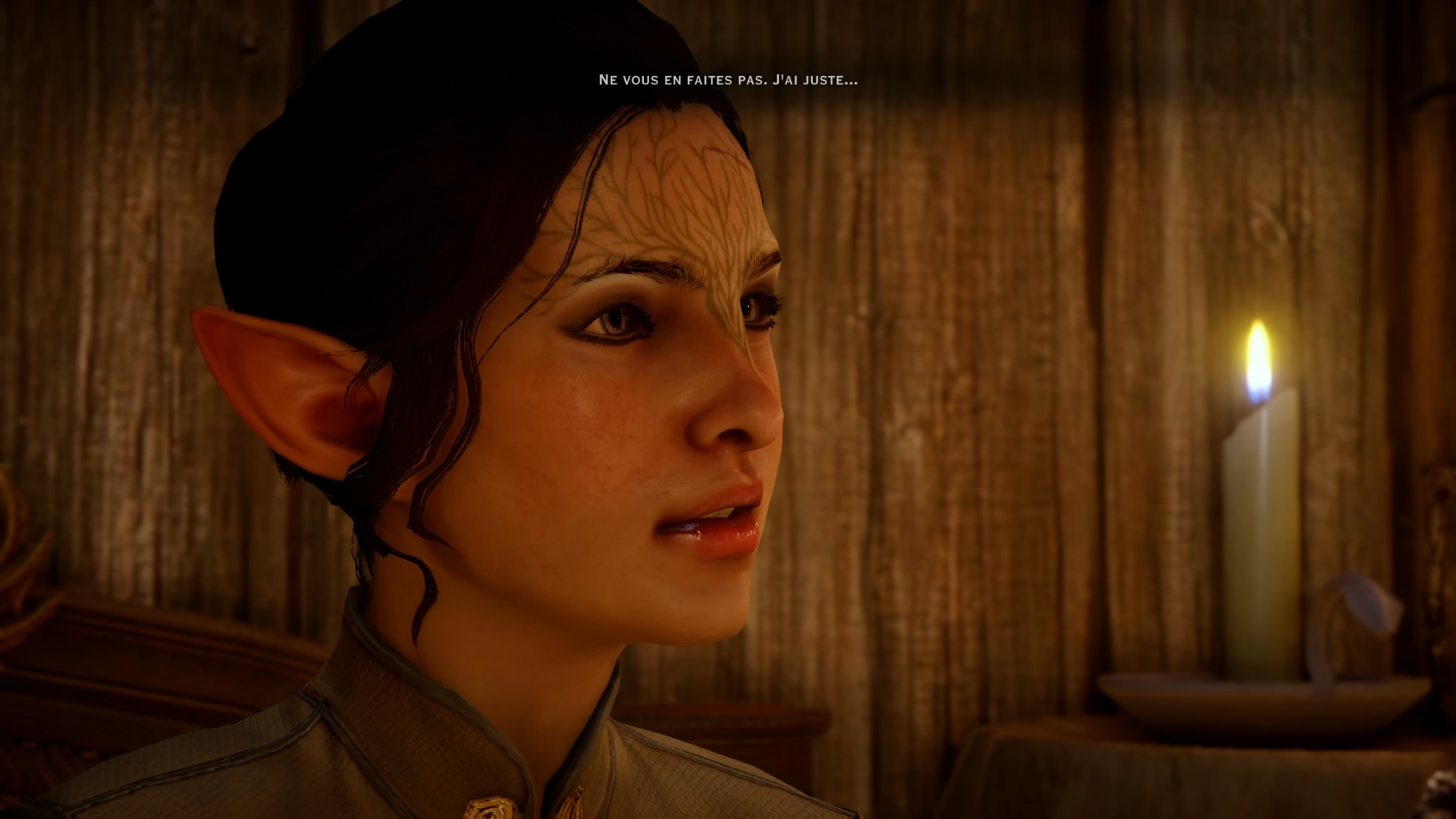
The height of it all lies with the hairstyles: Bioware isn't renowned for its hair genius, but here we reach a level I would never have thought possible. The blame lies with the game's 3D engine, Frostbite, which was originally designed for Battlefield: when you're modeling Marines, body hair doesn't count. As a result, a good half of Thedas' inhabitants suddenly decided to shave their heads completely bald. Even the Court of Orlais, that temple of fashion, has adopted the trend: duchesses adorn themselves with a vulgar tuft of hair atop the skull as a hairstyle. It's almost hilarious.
In short, the result is so horrible that I gave up on the idea of recreating my RPG characters. Instead, I settled for a mage elf very close to one of the default models. With a bun, for lack of any hair worthy of the name.
Bioware's reputation for creating unique casts of characters is unmatched. One can speak of a true tradition: between well-drawn companions (without sinking into easy caricature), philoso-political clashes, and the many possibilities for forming romantic or antagonistic bonds, there's always plenty to have fun with. Dragon Age: Inquisition is a good vintage that, here again, doesn't reach the level of the series' founder.
Figure — Varric, the storyteller dwarf. Can you get more iconoclastic than that?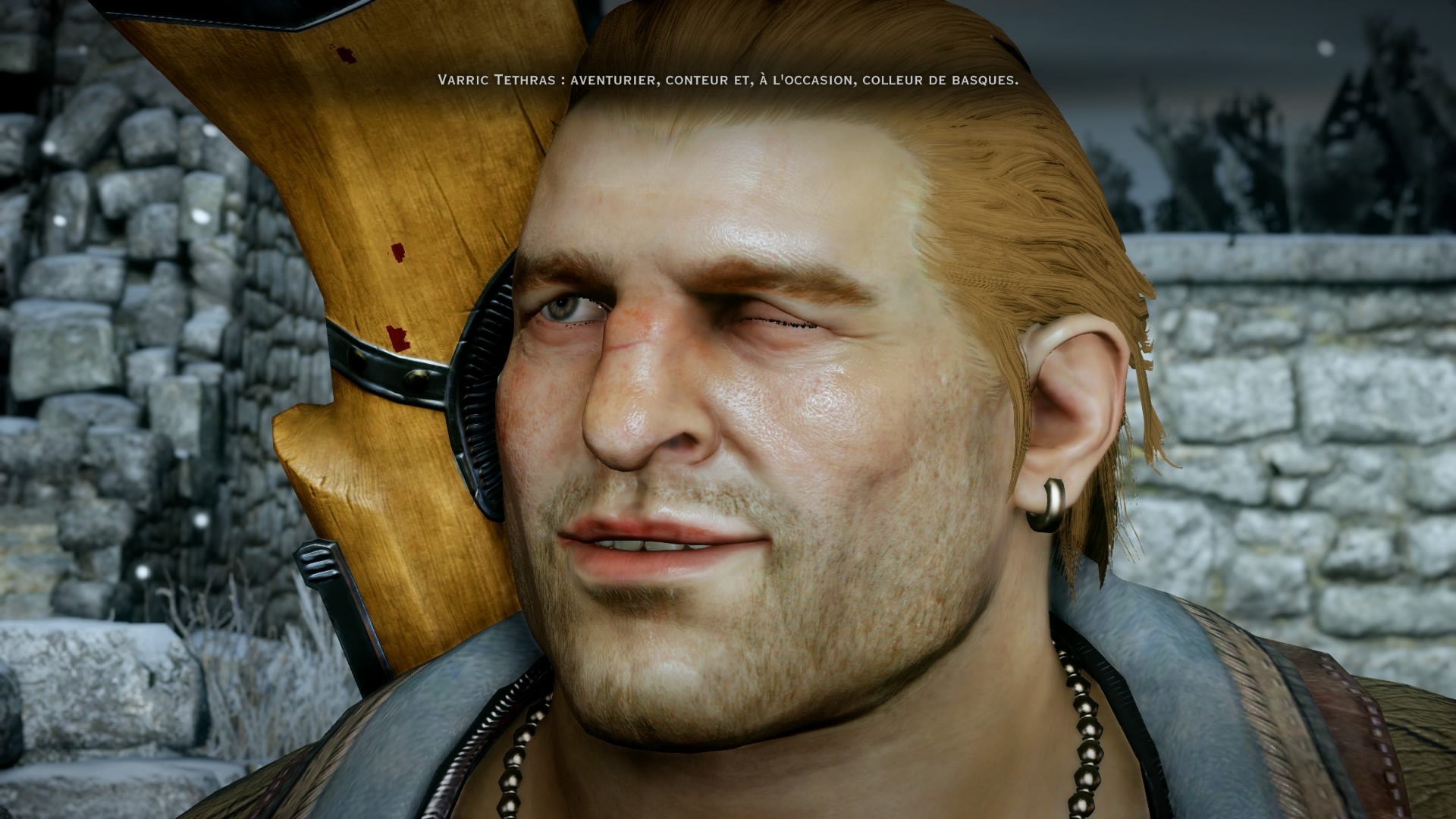
This time, 9 traveling companions can join your team:
- Cassandra, romantic Paladin
- Varric, Dwarven writer
- Solas, elven Mage
- Blackwall, Grey Warden
- Iron Bull, the resident Qunari meathead
- Sera, the pointy-eared Robin Hood
- Cole, the... poltergeist kid
- Vivienne, the fashion-victim Mage
- Dorian, the Dandy Mage
To these, one must add the Inquisition's three advisors: Leliana for espionage (back in "dark religious" mode), Cullen for the army (again, a familiar face), and Josephine for diplomacy. Although these éminences grises don't directly accompany the hero on his travels, they've been given the same care as the other NPCs.
Darth Leliana. Gone is the frisky bard of DA:O!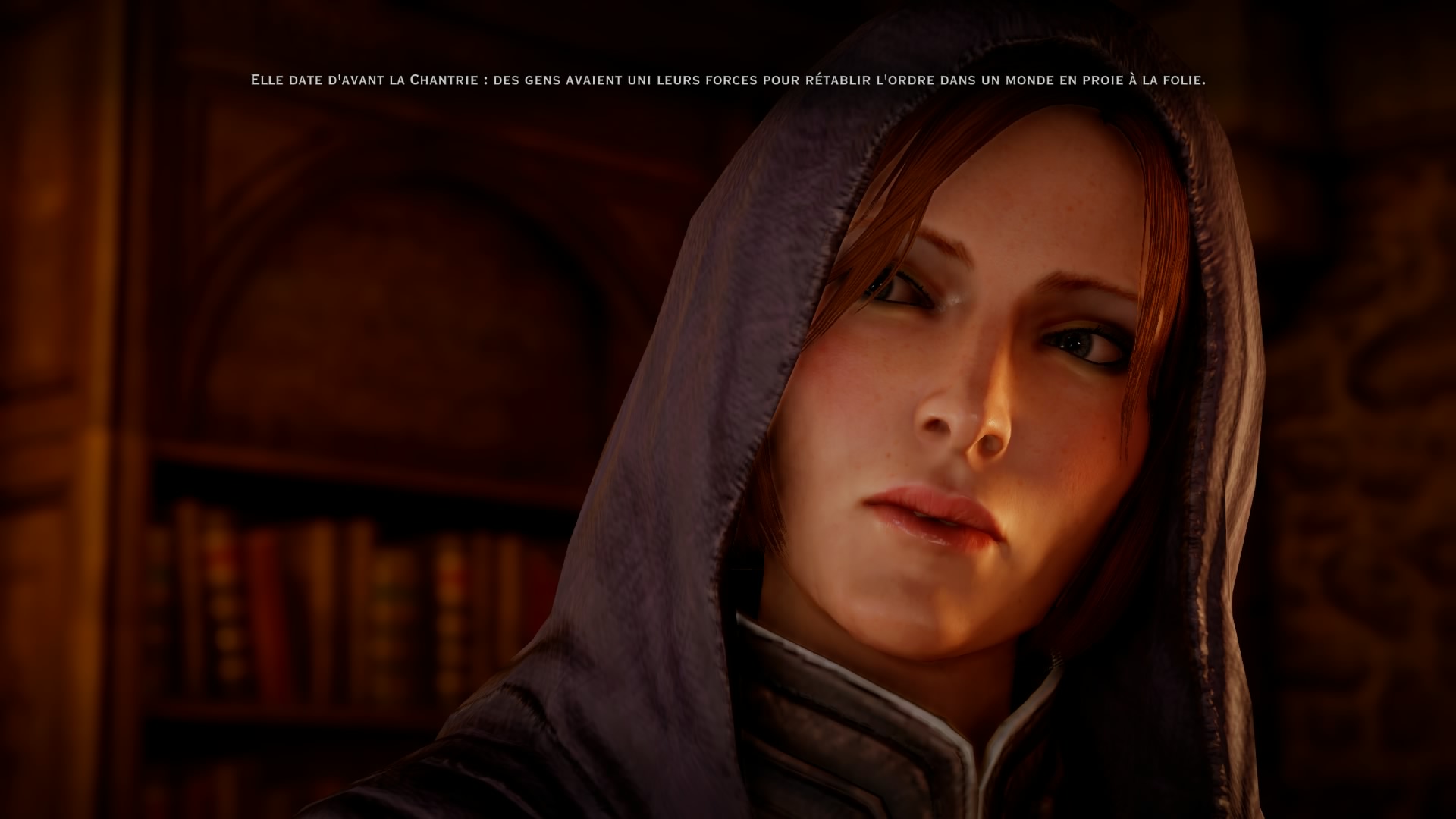
Although Vivienne and Cole are underused, there's not a single complete failure in the batch. When finishing the game, I even felt a small pang at the thought of leaving this band of merry rascals behind: an unmistakable sign that the team is endearing. In any case, each of these secondary characters has at least one personal quest, along with fairly firm opinions about the story's development. Unlike in Mass Effect 2, their reactions aren't completely mechanical either: a companion may suddenly disappear over a pressing matter, or decide to leave the group if they strongly disapprove of your actions. So their behavior will sometimes surprise you, even if they remain well-behaved compared to the Baldur's Gate cast. On the other hand, the internal conflicts are much less intense than in DA:O: I never came across a situation where two NPCs were ready to come to blows. And yet, opportunities wouldn't have been lacking...
Story Modularity
A good C-RPG story is a modular one, in which your combination of choices considerably changes the ending. At this little game, DA:I achieves a good result: decisions to make come up frequently, and their consequences are sometimes immediate, sometimes delayed. At one specific point, you'll be asked to choose between two factions that will follow you for almost the entire game ((A choice fairly close to the one in The Witcher 2.)). There are also some very fine moments, like this memorable passage of diplomacy at the Court of Orlais, from which you can emerge with a good ten different outcomes. To top it all off, the various characters frequently refer to your attitude and decisions, giving the whole a feeling of coherence.
It must be admitted, however, that here again, DA:I does a hair less well than its elder: in DA:O, the order in which and the way you resolved certain chapters drastically influenced your options ((A good example: Connor in Redcliffe, whose survival depends on your actions with the Circle of Magi of Ferelden.)). Here, it's more tenuous: the consequences often remain cosmetic.
Gameplay
On the gameplay side, lovers of Bioware games will find an experience finally quite close to the studio's previous productions, though diluted across vast zones to explore. Your character will progress over some twenty levels and can choose martial talents from 4-5 skill trees per class (including a "prestige" tree to choose based on your base class, unlocked halfway through the game). Alongside this, the Inquisition's power will also grow, granting you perks generally less "combat"-oriented. The combinations are thus varied and promise fairly different play experiences depending on your preferences. Note that everything isn't especially balanced: certain powers / classes are far more effective than others (try the "Knight-Enchanter" specialization for Mages if you want to solo practically the whole game).
Combat
Combat plays a big role in Bioware games, so we might as well make sure it's quality. Compared to the average of games in the same genre, the fights sit at the top of the basket. It's tactical on the whole, and certain opponents (like Dragons) require real preparation and a real strategy. But it's also below what DA:O offered. As the guilty party, first cite the interface: the tactical camera ((The overhead view, which the PS3/Xbox 360 versions were deprived of for DA:O)) is too close to the action and bumps into walls instead of flying over them. A real chore to use. Alongside this, the indications about the effect of certain skills leave something to be desired. You never quite know the exact range of a melee area attack, for example. All of this gives a somewhat unpleasant random feel for fans of hair-splitting strategy. Not to mention your companions' AI: overall, it gets the job done, but certain basic reflexes are missing ((Such as Mages and Archers not retreating when a Tank charges them.)), which forces you to maneuver each character too frequently. I played on PS4 with a controller: it seems the keyboard handling is even worse ((Bioware released a patch this very day and seems to be focusing on this point in particular.)).
Ultimately, the great originality of the combat lies in the absence of healing spells: you have 8 healing potions that refill on their own every time you pass through an Inquisition outpost or use fast travel, and that's it. Consequently, avoiding injuries becomes paramount, and you quickly find yourself calculating your moves to make sure you have enough supplies at the most important moments. Often frustrating, this mechanic nevertheless paces the expeditions in an unexpected way.
Open-World
Now that's class!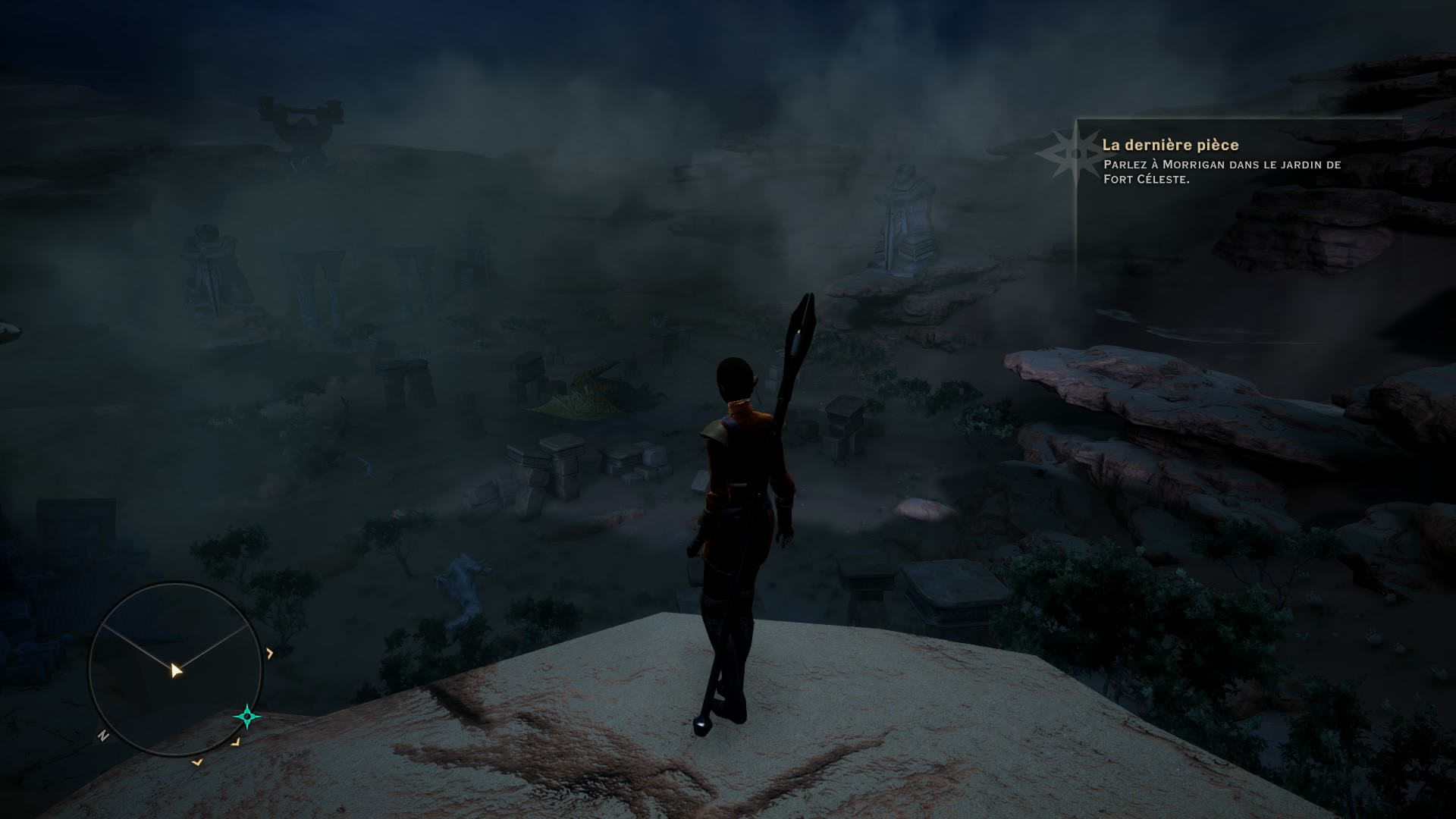
Up to this point, you probably have the impression that DA:I is a lesser version of DA:O. That would be the case if we ignored all the innovative aspects Bioware breathed into its title. This is precisely where the famous "Skyrim" inspiration comes in, even though DA:I is closer to a "Kingdom of Amalur" than an "Elder Scrolls". Let's be frank: we're far from Bethesda's incomparable maestria ((The studio behind the "The Elder Scrolls" series, of which Skyrim is the fifth installment.)) when it comes to deepening an atmosphere: Skyrim could have settled for being a snowy land, but the studio managed to portray an unmatched variety of landscapes around a coherent theme. Bioware settles here for the worn-out trio "Snow-Plains-Desert". Fortunately, even amid this dispiriting classicism, the art direction and level design remain of good enough quality to dazzle the eyes. We can also (re)mention the Frostbite engine, which works genuine miracles: the draw distance is incredible, the lighting drops jaws, and the faces don't lack richness — you'll even get to admire the pores of your interlocutors' skin.
Officer Lavellan, Canadian mounted police, Department of Santa Affairs.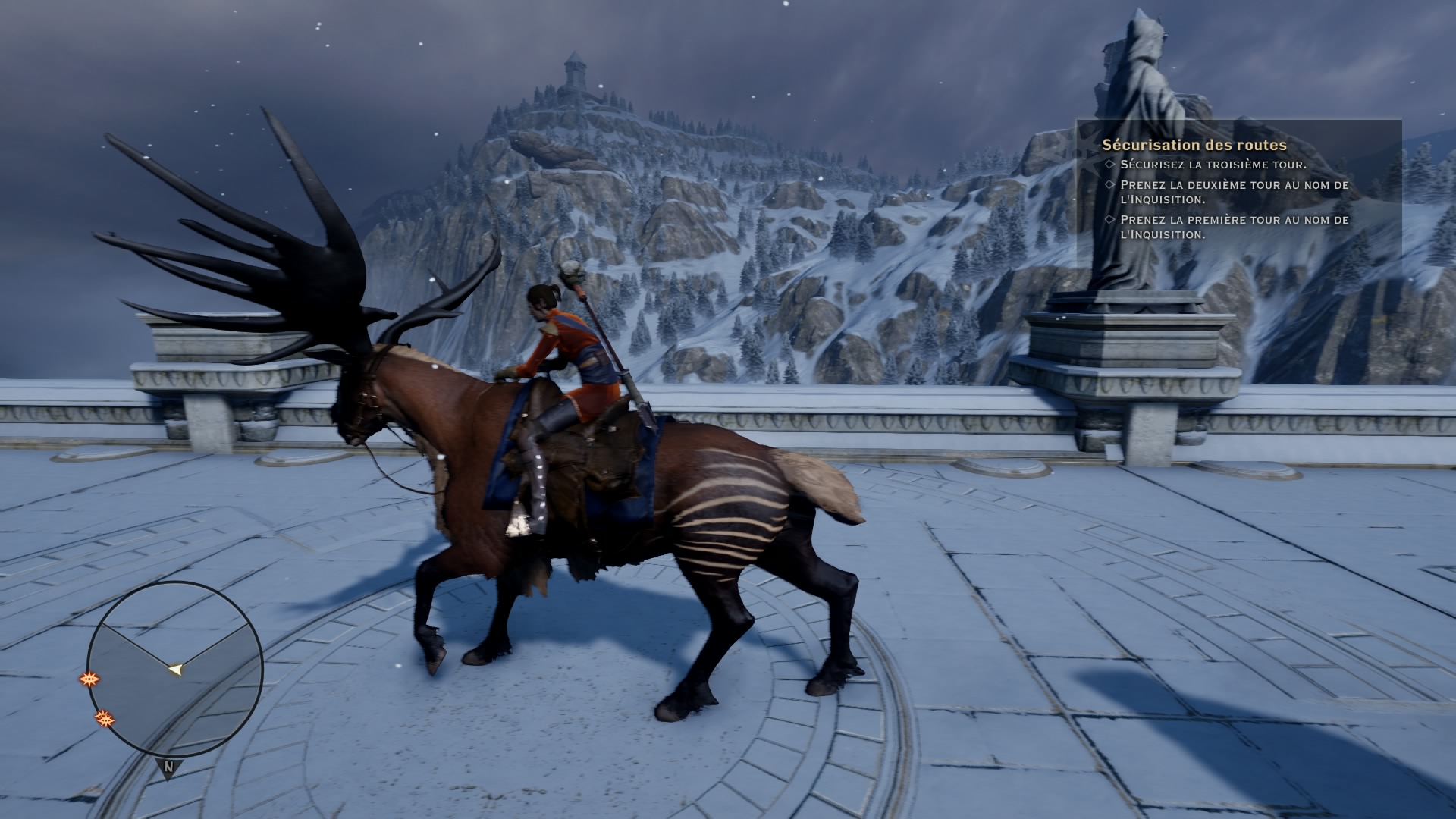
The title offers a good ten or so relatively vast zones to discover. It will take you many hours to explore them all the more since the geography is worked enough to prevent you from wandering in a straight line. Aware of this strength, Bioware took the opportunity to deliver zones that are all about verticality. Expect a few climbing stretches followed by an admiring contemplation of the panorama. For example, I have rarely been so gripped by the exploration of a desert plain: when you find yourself climbing to the top of a hillock, at night, to locate enemy campfires in the distance, it means the game has achieved something unique and admirable. "Open World" also means "plenty of rather dumb little quests", and DA:I has no shortage of them. Ingredient gathering, bonus objects unlocking an abandoned temple — you can see Bioware looked to the competition for inspiration. If that's not your cup of tea, you can skip nearly all of these passages. On the other hand, those who love losing themselves for hours in gorgeous scenery will enjoy it. I'm one of them.
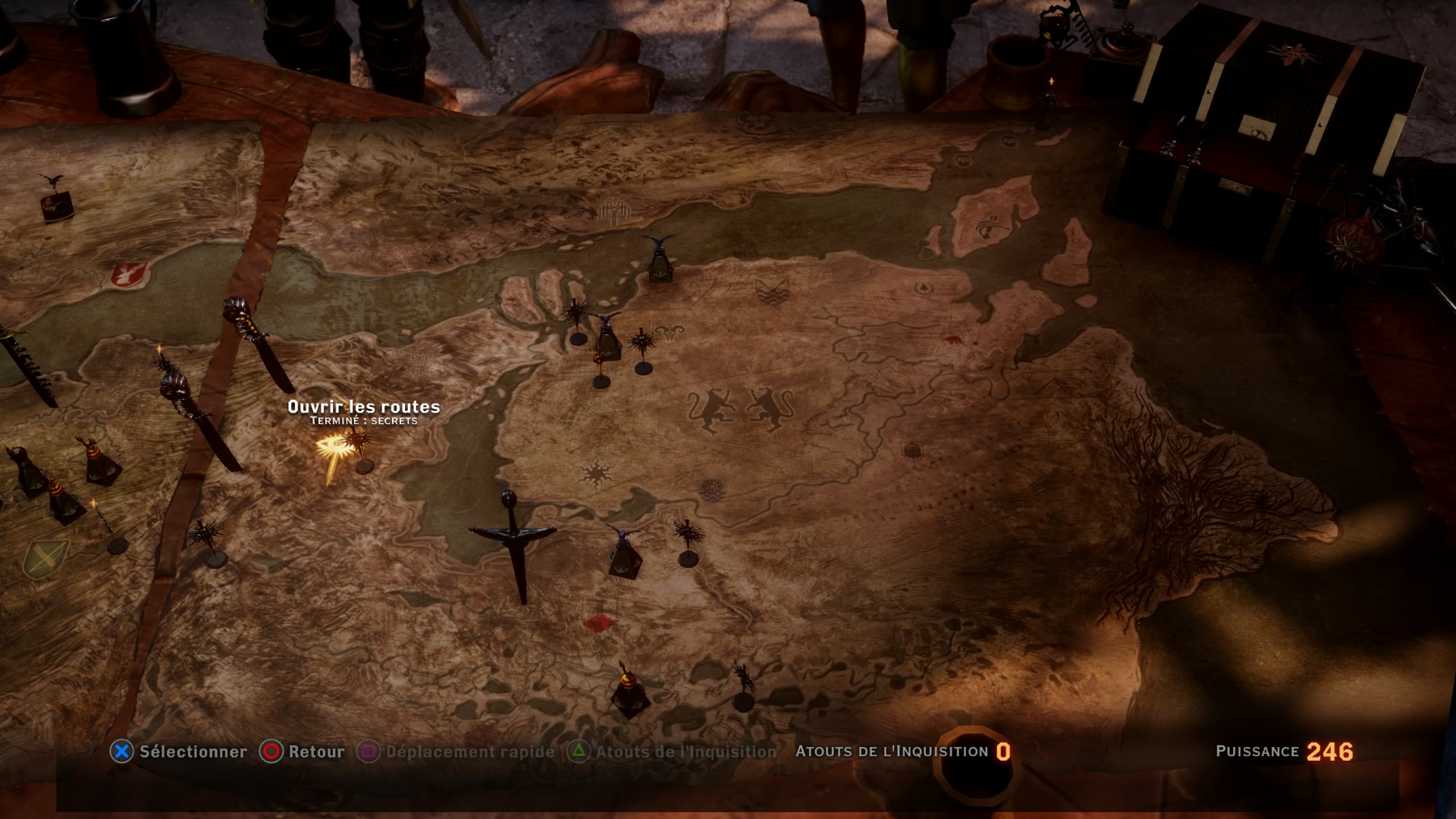
The mission selection interface
Navigation between these game zones happens mainly through the famous war table, around which your protagonist and advisors gather to discuss the Inquisition's progress. An opportunity for a fairly simplistic management mini-game, but sufficient to create the feeling of running a real organization. The Holy Inquisition grows in power as you complete your quests, in exchange letting you perform tasks that can unlock new zones to visit.
An example of an end-of-mission report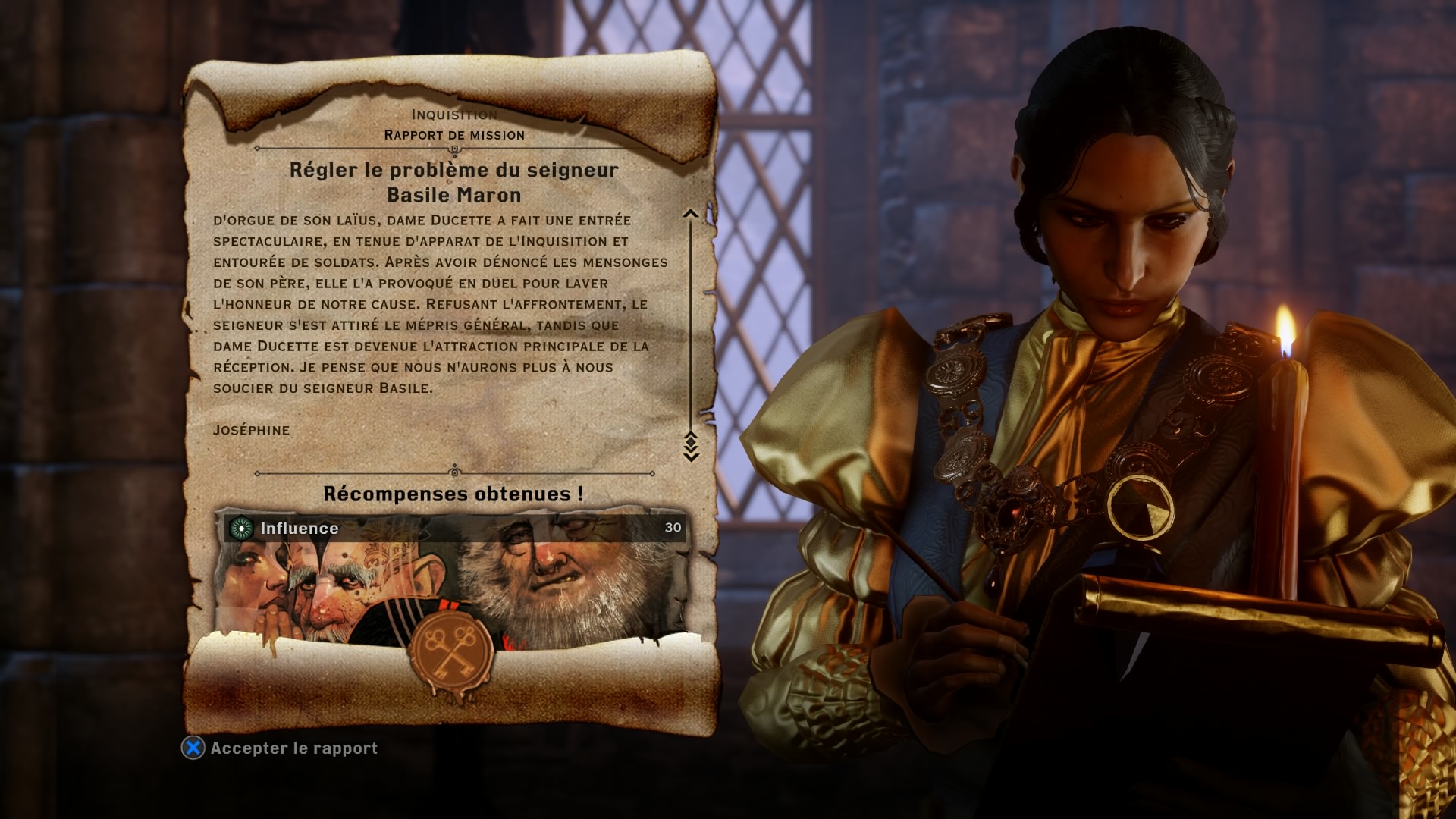
In parallel, you can ask your three advisors to run missions (a huge number of missions) to bring you back resources: the choice of which advisor to send sometimes dictates the story's outcome and the nature of the reward received. These little tales can't be considered gameplay proper: it's simply a matter of selecting the objectives that interest you, sending one of your three advisors, and waiting for the result. This waiting time — which ranges from 10 minutes to 24 hours — counts down even when you're not playing. An interesting way to push you to pace your gaming sessions!
Expect a good forty hours to wrap up the game if you're rushing. If, like me, you like to wander off and complete everything, easily count double. And add a good ten or even twenty hours if you play in Nightmare mode ((I only half recommend it: the important fights undeniably become more epic, but every little skirmish also requires much more attention, to the point of becoming tiring. To be reserved for patient people...)).
"Dragon Age: Inquisition" is a real success. It fulfills its contract at the RPG level, bowing only to its elder while remaining above the genre's average. It's when you consider its "exploration" side that the game takes on an unsuspected scope, which sets it apart from direct comparison with "Dragon Age: Origins". Given that the content is gargantuan and the story holds up, here's an objectively attractive title.
For my part, those 80-odd hours spent on DA:I more than did their job. I wanted to be carried away for a while: I downright moved to another dimension for a week. Now that everything is over and dear Inquisitor Lavellan can do little more than wander around an empty castle or complete a few insignificant little quests, I already sigh with nostalgia at the memory of this beautiful adventure. Another playthrough? Maybe, when I have more time on my hands.
In the meantime, it goes without saying that I warmly recommend this worthy "Dragon Age: Inquisition". Just plan for a solid time budget, if you have an active professional and family life!