Review
Bloodborne
ludique · Review · vendredi, 18 septembre 2015 à 16:52:15 · 8 min
Everything is a matter of balance. Everywhere. All the time. We tend to overlook it, but a few drops more or less in a recipe can turn a nectar into a vile gut-rot. Bloodborne illustrates this concept perfectly.
Bloodborne is the unacknowledged latest-born of the "Souls" family, by From Software. I had struggled mightily with the two elders of the family, but what tempted me about Bloodborne above all was its atmosphere, one could describe as "Filthy Victorian steampunk gross ew". The promises of a snappier gameplay and my wife's generosity got the better of my apprehension.
I came out of this experience with a smile on my face and a respectable number of gaming hours on the meter. A success I feel like sharing with you.
The "Souls"
The Souls series is named thus because the founding episode - Demon's Souls - belongs to Sony. Then, from the second episode onwards, From Software wanted to emancipate itself from the Japanese manufacturer and was forced to change its protégé's identity: farewell "Demon's Souls", hello "Dark Souls". Fortunately for the small studio, its rather dedicated audience did not lose track along the way: among the fans, everyone knows that "Demon's Souls", "Dark Souls" and "Dark Souls 2" are more or less official sequels. With Bloodborne, From Software returns to Sony's fold: hard to understand why, but the team gives the Playstation an exclusivity that makes many jealous. Be that as it may, despite its exclusive status, Bloodborne sold particularly well. We are talking about a million copies in players' hands after just two weeks on sale. Quite a success, for a title that does not aim at the general public!
To explain the "Souls" concept, a few lines suffice: oppressive "medieval fantasy" adventure games, in which failure is frequent and harshly punished. No information about the gameplay mechanics, devious level design, unforgiving timing, experience lost upon death: the list of horrors offered by the Souls does not stop there. The only glimmer of comfort in the darkness, asynchronous online play lets you cooperate with other players, in three different ways:
- As a ghostly silhouette representing another player in real time
- As a blood trace retracing the last moments of a player who recently fell
- As cryptic messages anyone can leave along the way
These ingenious mechanics work better than one might think. Advancing down an anxiety-inducing corridor and finding a "BEWARE OF THE AMBUSH" message surrounded by several bloodstains is a unique experience that only a "Souls" can provide.
One can classify people's attitudes towards the Souls into three categories:
- those who appreciate what the series has to offer
- those who are not drawn to the concept, and finally
- those who would have liked to love it, but were put off by specific points.
I belong to the third category.
Despite all their good sides, I did not like Demon's Souls and Dark Souls. The problem appears once the fascination of the first hours of play has passed. The Souls suffer from long stretches of parasitic non-play that the worst MMORPGs on the planet can only envy.
Take the boss "Chaos Witch Quelaag" in Dark Souls. She is about 2-3 minutes away from a bonfire (the place you are sent back to upon dying). If you play your cards right, the fight should last 5 minutes. Obviously, it can also be much shorter if you do not have the right strategy (2-3 minutes before dying stupidly). A simple calculation suffices to explain why this phase of "play" is enough to disgust: spending 2-3 minutes to reach a difficulty spike you grind away at for 2 to 5 minutes works out, roughly, to losing 50% of your play time. Even stupid farming sessions are better than that, since by farming, you (slowly) get closer to a goal.
Some excuse this weakness by arguing that every failure carries a lesson, that one improves with every attempt. In a turn-based strategy game or similar, one could indeed think so. But despite its measured pace, Dark Souls remains an action game suffering from its share of imprecisions and janky collisions: too often, failure teaches nothing at all.
During my playthrough, this kind of situation arose too often. There comes a moment when, despite the remarkable addiction Dark Souls generates, one asks oneself whether playing is still a pleasant act, or whether it would be better to stop and do something else.
Bloodborne
Bloodborne's loading screen. You risk seeing it often.
Dark Souls marked me badly enough that I steered clear of its sequel. Yet some reviews indicated that maybe, it could have suited me. A missed opportunity?
[...] But unlike the first opus, Dark Souls II opts for a quite particular system for balancing difficulty, one you will have to submit to with varying degrees of pleasure. On the one hand, environmental traps are rather rare, resting places are less spread out, often closer to the bosses, systematically restore equipment durability, make the surrounding enemies progressively disappear when you die too often, and allow you to teleport from the start of the game to any other lit bonfire. In addition, you can now equip up to four rings at a time, have three weapons, shields or spells in rotation in each hand, and place a maximum of ten items in quick access. [...]
- Boulapoire, for Gamekult
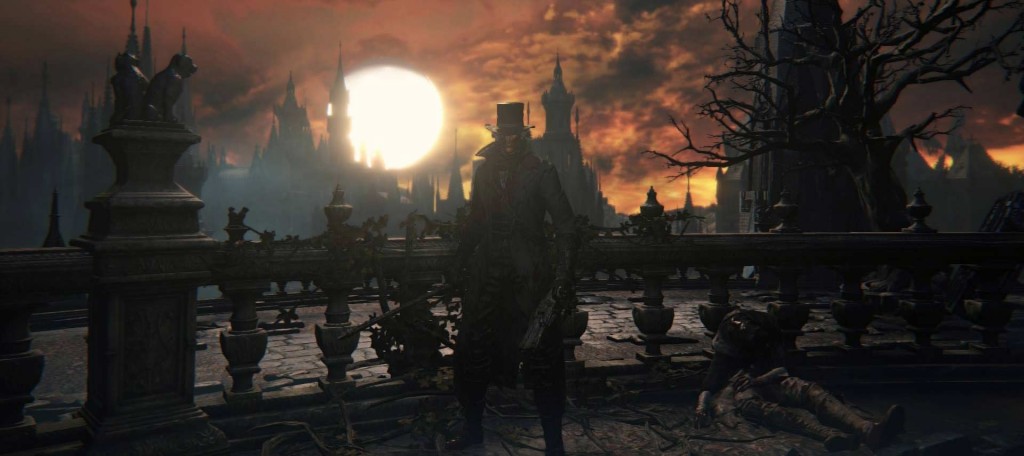
On the other hand, Bloodborne tempted me from its reveal: combine the anxiety-inducing atmosphere of the village from Resident Evil 4, the Victorian/gothic class of the Castlevania games and the nightmarish shapes of Silent Hill, bind it all together with flawless consistency, and you will get the game's inimitable art direction. In this respect, Bloodborne's contract is completely fulfilled. Its ancestors already shone through their atmosphere; this one goes even further while standing out with a more modern universe, far from the clichés of medieval fantasy.
Vlad Tepas in Steampunk mode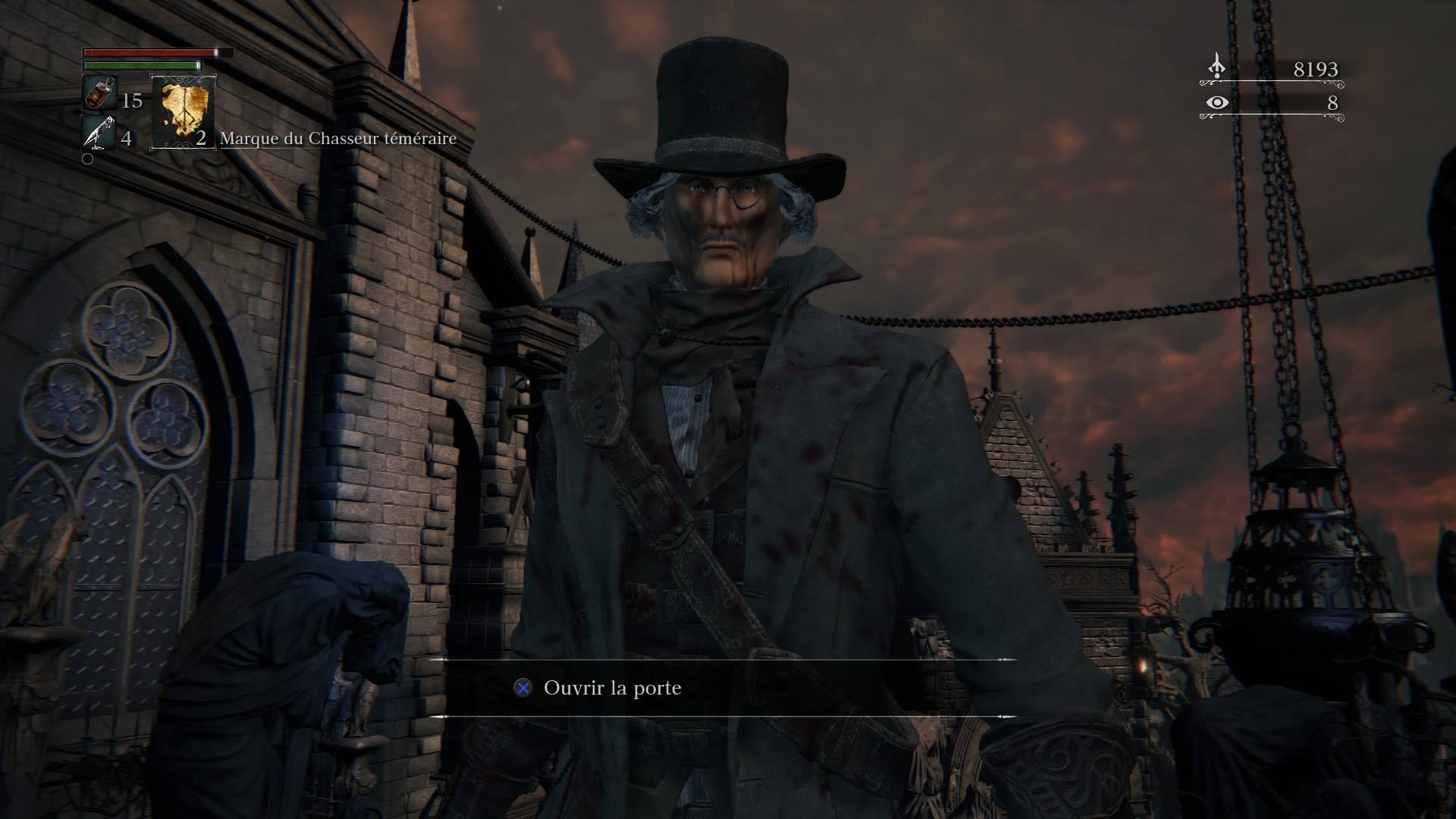
This argument alone could already have tipped the scale to the right side. But fortunately, the good points do not stop there.
The first steps in Yarnham, the city where Bloodborne takes place, are extremely close to those of the other Souls. Once again, you will die at the start of the game. Once again, you will easily dodge the first ambushes. Then, as usual, you will discover the first notes left by your fellow unfortunates, and finally, you will let yourself be taken in by the oppressive atmosphere and the fear of losing all your unspent points with each new confrontation. All the fundamentals of the Souls are there, though sometimes diluted: environmental traps are rarer, for example.
Some differences make themselves felt quickly, however:
- Instead of bonfires, there are lamps that teleport the protagonist to a Hub with all the conveniences. This Hub also allows you to teleport directly from one lamp to another from the start of the adventure.
- The world opens up quickly; you will have plenty to see and several forks to explore.
- There is no longer any status distinction, as between alive / undead in the Dark Souls games. You will not spend half the adventure with a weakened protagonist.
- As promised, the fights remain deadly but much faster. In this respect, confrontations against hunter adversaries (bosses, sub-bosses, other players) give rise to a whirling ballet few games manage to equal.
These changes defuse most of the tedious situations I mentioned above: from the very beginning of the game, the passages where you are stuck can be set aside in favor of parallel exploration. Death is also less punitive, encouraging you to take more risks. One may just regret that healing items work as consumables rather than refilling automatically at each lamp/bonfire, as in Dark Souls: it only takes 5-6 failures to empty half of your stock of blood vials (healing potions), so much so that farming is sometimes needed to refill it. Nothing that truly ruins the pleasure, all things said.
The only real shadow on the picture: fans of the series mention a lack of depth once you get past the first part. The content is substantial, but does not match the density of the Souls games, in which there was always something new to see or try. Not having explored Dark Souls enough to judge, I remain more than satisfied with the ~60 hours spent (two playthroughs) in Bloodborne's company.
Conclusion
The detail of the clothes is still rather staggering.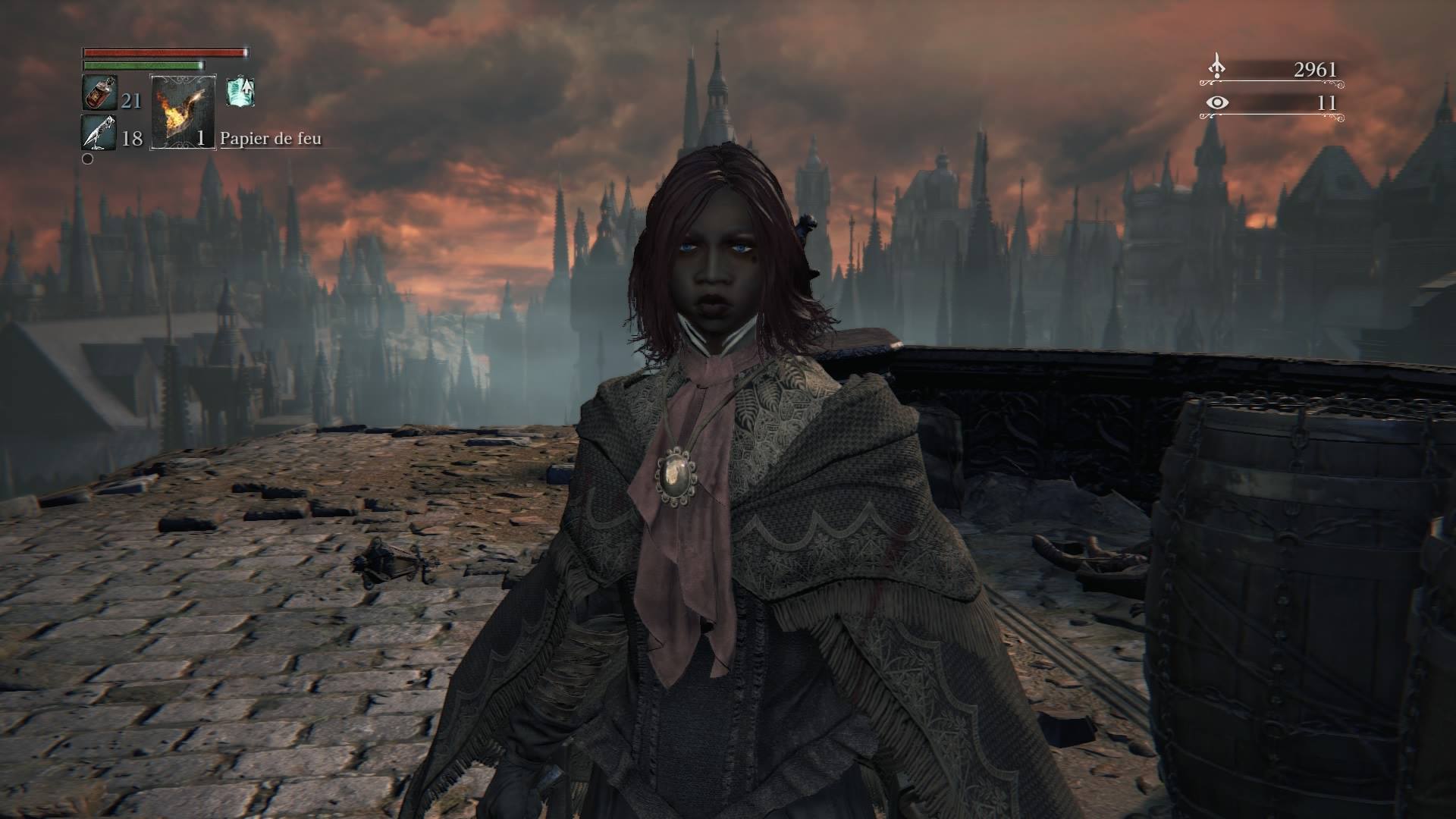
Bloodborne admittedly suffers from the same flaws as its ancestors, but in lesser proportions. What was enough to disgust me in Dark Souls is barely more than a mere inconvenience in Bloodborne. To top it all off, the newcomer arrives with many qualities of its own: faster gameplay, a more quickly opened progression, a to-die-for atmosphere.
It is these few differences that turn a frustrating experience, bordering on a waste of time, into a thrilling adventure. A recipe that was enough to take me from the camp of "I wish I could have loved it" to that of "I love it". Proof that a good balance between several elements can change everything!