Qin - Tianxia
The Treacherous Prince
ludique · Article · lundi, 14 janvier 2019 à 16:05:26 · 16 min
Seventh session of our campaign, played on July 10, 2007. "The Treacherous Prince" sees the world of the Wuxia shift, as they are a hair's breadth away from pulling off a feat that will carve their fearsome reputation in stone. All the same, the situation is not yet won: they still must gather intelligence on the Prince of Qin, Cheng Jiao, and find a way to reach him...
- Introduction post
- Previous: "The Prisoner of the Desert"
- You are here: "The Treacherous Prince"
- Next: "The Treacherous Prince (2)"
Characters Present
- Cheng Minh, the Snake
- Tian Zaisheng
- Zhang Wulin, Snowflake
The Session
Armed with Insightful Brush's information, Cheng Minh thinks of taking advantage of the city magistrate's discontent to serve the group's interest. In the morning, he makes the rounds of the inns in the poor quarter to siphon off a few bits of information. He first strikes up with a bystander who knows little about the city's political activity, before coming across another man, even less reputable, who points him to a way to get a conversation with Magistrate Fen Shu-Di: speak to the head of the poor quarter.
Meanwhile, Tian Zaisheng and Snowflake exchange their Daos for Sapèques: Zhao currency is indeed not very useful in a Qin city, even close to the borders. They then head to the rich quarters of the city and fish out a few pieces of information about the famous stranger causing so much trouble for Qin high society. Supposedly, the man has a rosy complexion and speaks in an elevated register, but struggles to understand the common vocabulary. He is also accompanied by two bodyguards wearing impressive armor made of iron scales. At noon, our heroes meet up at the Hospitality of the Steppes, where they share their information. The Snake, Liu Mei Shan and Guo Ts'ai-Ja decide to pay a visit to the poor quarter's magistrate, while Tian Zaisheng and Snowflake prepare for the evening's terrible rhetorical joust.
The poor quarter's magistrate shows little interest in the Wuxia's presence. Cheng Minh first tries to gauge the vision the magistrate holds of his superior and of Prince Cheng Jiao, to which the man placidly retorts that Fen Shu-Di is a capable man and that the Prince does his job well. Although he suspects his interlocutor of delivering a nasty dose of canned official-speak, the Snake reveals that he holds information of the highest importance for Magistrate Fen Shu-Di; this information concerns the prince, whom he confesses not to hold dear. His interlocutor promises to pass the message along. After this discussion, the Snake pays a bystander from the poor quarter to wait in his stead in his inn room. He then takes position in a park not far away and waits for any reactions.
Wulin and Zaisheng leave a little early. They reach a park in the noble quarter, "the Cherry Tree Garden", where several philosophers can be counted, a few guards, and a "jury" of five people. The latter includes Magistrate Fen Shu-Di, whom the rest of the team is trying to contact. It falls to Zaisheng to shine! At the appointed hour, the stranger makes his entrance, accompanied by his two bodyguards and a young man, apparently his intermediary with the authorities of the Zhongguo. The latter introduces him under the name of "Lulius Cassus Plaetarius, the perfect cretin", which does not seem to faze the man himself, but triggers a few giggling smiles in the assembly. Courteous beyond all measure, Tian Zaisheng does not see it the same way and shoots a stern look back at the young whelp, whereupon the debate begins.
As an introduction, Lulius makes a few miffed remarks about the presence of Zhang Wu-Lin — a woman! — in a philosophical debate, and judges Tian Zaisheng's appearance, a little too spartan for his taste. The two rhetoricians engage the heart of the debate, starting with the claimed unity of the Zhongguo. Indeed, Lulius shares with the assembly his commercial troubles when he had to cross the kingdom of Chu and then that of Qin. The currency used in Chu, the Yibi, is content with a crude appearance worthy of some old barter object; it is not even accepted within Qin, a kingdom that is nonetheless part of the Zhongguo. What is more, exchanging it incurs scandalous taxes, which break commerce and disturb foreign travelers. Tian Zaisheng, poorly versed in economic necessities, struggles to contradict his interlocutor's arguments, much to the dismay of the officials present. Worse, he stresses several times that he cannot deny Lulius's claims, notably because of his philosophical convictions, as he himself ardently wishes for the union of the Zhongguo. The jury, a little ashamed of having hired a Mohist to defend them, can only bow in favor of the foreigner. Lulius follows up with the art of war. Upon arriving in the Zhongguo, he was struck by the poor quality of the soldiers' equipment: barely-covering leather aprons, iron struggling to spread everywhere when it comes to weaponry, to the detriment of bronze, etc... Lulius implies that the armies of the Zhongguo sorely need to compensate for this manifest lack of technology with their numbers. But Tian Zaisheng, far more at ease in this domain than in economics, invites his interlocutor to turn to the fortifications of the Zhongguo rather than think about individual equipment. Indeed, the genius of the Zhongguo's architects is undeniable, without even mentioning the long tradition of bold strategies handed down by brilliant generals, backed by their numerous treatises on war that any good officer must know. The logistics and discipline required to keep the Zhongguo's armies in good order cannot but impress a foreigner for whom a mere thousand soldiers already counts as an army. On this point, Zaisheng brings everyone together and Lulius seems to slightly lose his footing. As a finale, Lulius criticizes the "scattered" philosophy of the Zhongguo. The opposing schools are numerous, it would make a cat lose its kittens, so much so that even the Legalists, supposedly dominant, struggle to impose their ideas. Worse, they claim to inherit from Kong Fu Zi despite diametrically opposed ideas. Tian Zaisheng's answer holds in two points: regarding the plurality of philosophical movements, he throws the question back at Lulius. Indeed, he rightly suspects that the situation cannot be much different back home. Lulius, a little sheepish, admits that Rome — the name of his land — is likewise plagued by very different schools of thought. Secondly, Tian Zaisheng points out that, as this very debate bears witness, the different philosophies of the Zhongguo can perfectly well coexist and produce value, rather than oppose each other and self-destruct. Examinations are an integral part of Legalist philosophy, but they take their source in Mohist thought. What is more, all these schools flow from the same base, guaranteeing a deep unity to which foreign philosophies cannot lay claim. These fine words win over the jury, and Zaisheng takes this third round.
The jury thus declares Tian Zaisheng the "winner" of the debate. Lulius acquiesces grudgingly, but nevertheless wishes to test the Mohist in one final trial. Indeed, the latter had claimed to be a warrior philosopher. If his philosophical talent has been demonstrated, he still has to prove his superiority in the field of arms. To this end, Lulius proposes to master Tian a duel against his best bodyguard. Athletic, equipped with a small iron sword and a large tower-shaped shield, the man indeed seems well-versed in combat. Our Mohist takes up the challenge and the two duelists take position in a cleared space of the Cherry Tree Garden. Nimbler, the Roman rushes in first, but pauses in the face of his opponent's impenetrable guard. He is looking for a weak point. Sensing the hesitation, Tian Zaisheng delivers a quick and precise strike that hits the Roman's forearm, concluding this rather quick duel at first blood. Twice victorious, Zaisheng is showered with praise by the Legalist philosophers. They must have been quite desperate to resort to a Mohist, but the affair was well worth it. Unfortunately, Fen Shu-Di quickly takes his leave of his peers to return to his business: hard to know whether he was personally convinced.
Night falls, and Snowflake and Tian Zaisheng return to the Hospitality of the Steppes. When she learns that the Snake is waiting for a sign from the magistrate in a nearby park, Wulin joins him and keeps watch over the inn for several hours. This wait is broken when a hand lands on the Snake's shoulders. A hooded man, clearly well-informed, asks him to call his Mohist comrade and follow him to Fen Shu-Di's offices. Cheng Minh complies, leading the group to the magistrate. When the latter questions them about their motivations, the heroes hold nothing back and narrate the whole story, from the princess's kidnapping to their arrival in Quzhi. Though he cares little for the future of Zhao and Yanshan, Fen Shu-Di lays his cards on the table by revealing his desire to eliminate Cheng Jiao. He even declares himself ready to help them, offering them a unique opportunity: Cheng Jiao is expected to attend a public hanging the next day at dawn. Magistrate Fen proposes making the administrative quarter's guards disappear, with a simple little diversion. The three pals hash out a plan: Guo Ts'ai-Ja will taunt the Roman legionary to trigger a brawl in the rich quarters, Sargaï and soldier Sun will stand with bows in support, while Cheng Minh and Zhang Wu-Lin will do their worst in melee. As for Tian Zaisheng, he will pass for a Qin lieutenant, thanks to the appropriate uniform generously provided by Fen Shu-Di, to fool the guards if necessary.
Once the plan is set, the heroes return to the inn, but the Snake is stopped on the way by a man: Insightful Brush. By obscure means, he seems aware of the events being hatched and expresses sympathy for this noble cause, which he offers to support with equipment. He leads the Wuxia to a public park and unveils a small trapdoor very well hidden in the shelter of a tree, from which he pulls arrows of the local guard, which he offers to his new allies. His intention is crystal clear: he wants to prevent Qin's wrath from falling upon Zhao or the Xiongnu after the assassination. Furthermore, he also offers them poison and a few daggers free of charge. As his only payment, he asks Cheng Minh to help him escape from Quzhi. To this end, the Snake steals a horse, which he loads with several layers of cloth to simulate a humanoid shape, then gallops through the city's East gate. Taken by surprise, the guards react a beat late, allowing the scribe to flee. Unfortunately, Qin's crossbows are famed for their deadly accuracy, and the volley loosed by the soldiers does not belie that reputation: the Snake finds himself riddled with several bolts. Wounded, he heads for a nearby bamboo forest and hides there until the next day.
Dawn breaks. Hastily, the Snake presents himself at the city's south gates. He passes himself off as a merchant and rejoins Snowflake at the agreed spot as quickly as possible. As planned, the prince and his personal guard attend the hanging. The guard is thin on the ground. Everyone is in position; the assassination attempt can begin.
Yet Liu Mei Shan does everything she can to cancel the operation, bearing alarming news from the front. She warns Zaisheng that Fan Yuqi's entire army is falling back on Quzhi. Quickly, master Tian moves toward the administrative quarter. For their part, Minh and Wulin swing into action. The Snake hurls a poisoned bishù at the prince, but it is intercepted by one of the prince's elite guards. The dagger plants itself in the wooden platform on which Cheng Jiao stands, who can be seen sweating great drops. The crowd panics as the two assassins weave as fast as they can toward their target. Now protected by his praetorian guard, Cheng Jiao seems out of reach. Sargaï and Sun Keng Wai try to thin the ranks by riddling a guard with arrows, but he can thank his thick reinforced armor, for he comes out unscathed. Like a bear tearing hives apart with its heavy paws, Tian Zaisheng bursts at a gallop through Cheng Jiao's circle, breaking the guards' cohesion. With her frail hands, Snowflake strikes the platform, which instantly comes apart, throwing off the warriors standing on it. The Snake takes advantage of the general commotion and finally finds himself face to face with the prince. The latter, more skilled than expected, parries his attack and cleverly ripostes. The Wuxia were wrong to underestimate him. On the verge of giving up the ghost, Cheng Minh delivers one last vain attack before slipping away as fast as possible under what remains of the platform. The guards set their sights on poor Wulin, who throws several of them to the ground before an unlucky move gets her impaled on a saber. The shock is so violent that she falls to her knees, mortally wounded.
Fighting with all her strength, she pulls herself together, pins one last assailant to the ground, but her heroism is no match for the mass of trained soldiers who soon subdue her. Tian Zaisheng continues his equestrian harassment: he threatens the prince several times, who dodges the charges and blows as best he can. Exhausted, he can however do nothing when the Mohist looses his horse in his direction, heedless of the danger. The mount sends him flying to the ground, and Cheng Jiao sees his whole life flash before his eyes. What should have been a quick and surgical assassination has turned into a dismal circus with the Wuxia's lives at stake, as they spot Fan Yuqi's army invading the central square through the north gate of the administrative quarter. The general, for his part, cuts through the crowd like a bat out of hell to save his lord. Forced to flee, Tian Zaisheng shows courage and rescues Wulin during his mad escape. The Snake had already fled the area and finds Liu Mei Shan at the city's south gates. They are soon joined by Tian Zaisheng and Snowflake, dragging riders and chariots in their wake. Once outside the city walls, the heroes leave the main road to shake off their pursuers, but they have barely ridden a few li before they run into a gigantic Qin army. Stationed south of Quzhi, it stretches as far as the eye can see. A troop of twenty crossbowmen emerges from the camp and orders them to surrender, in which case no harm will come to them. Refusing to believe them, the heroes try to skirt around the camp, but their horses are immediately cut down by a rain of bolts. With no alternative left, the Wuxia let themselves be captured. When their pursuers finally reach the camp's perimeter, they demand that their compatriots hand the prisoners over. This unexpected tension between the two Qin armies takes a strange turn when the southern officer retorts that the prisoners are now his. The pursuers return to Quzhi empty-handed and annoyed.
The officer invites the Wuxia to enter the camp. Polite and surprisingly benevolent, he leads them to a vast tent and warns them that they will have to surrender their weapons to him. Indeed, someone important would like to speak with them, and it would be ill-mannered to threaten him in any way. While healers tend to Snowflake, the Snake and Tian Zaisheng are received in the tent. There they discover two men: the first, so majestic that he eclipses his interlocutor, is endowed with a magnificent chang pao, tailored in the most expensive silk there is. The other man is smaller, plainer, and more discreet.
Right off the bat, Tian Zaisheng greets the first individual by the name of "Master Lu". Indeed, the latter identifies himself as the Prime Minister of Qin, the legendary Lu Buwei. Teasing as usual, the Snake tests his interlocutor's limits by pretending to be nothing more than a hapless merchant involved in this affair against his will. Lu Buwei demonstrates his shrewdness by retorting that his guests may speak frankly. He adds that he is keenly interested in the story of these famous troublemakers who harass Prince Cheng Jiao to the point of unleashing his war chariots against them. Thus, once again, our heroes find themselves explaining their whole story. Once he grasps the situation, Lu Buwei apologizes on behalf of the Kingdom of Qin for all these misfortunes. Apparently, they have stepped into a story that is beyond them. The truth goes beyond a simple war of conquest: Cheng Jiao is a treacherous prince, who decided to profit from his position to rebel against the King and declare his independence. He had counted on the regional conflicts — that of the Xiongnu and Zhao, and that of Qin and Zhao — to survive in this hostile environment. However, thanks to the bravery of a band of vagabonds, the greater part of the prince's plans fell through, and he now finds himself in an unenviable position. Lu Buwei then submits to them a mutually profitable collaboration, since their goals converge. Cutting the discussion at its most interesting point, a messenger warns the Prime Minister that Prince Cheng Jiao has reached the camp and wishes to speak with him in person. Lu Buwei therefore temporarily takes leave of the Wuxia to join the prince in a neighboring tent, leaving the group to mull over the situation. The interview seems heated, however, since in barely a few minutes the prince storms off, loudly uttering threats, in the face of a pale Lu Buwei. Apparently, he is about to execute Sargaï in Quzhi. The heroes had indeed abandoned him there, thinking he would be able to escape on his own. He will be boiled alive tomorrow at high noon, or even sooner if ever a Qin soldier shows his nose in Quzhi. When the prince leaves the premises, Lu Buwei suggests the characters act without delay. If they want to save their companion and avert a disaster for Zhao, they will have to move very quickly.
Lu Buwei. Copyright éditions du 7ème Cercle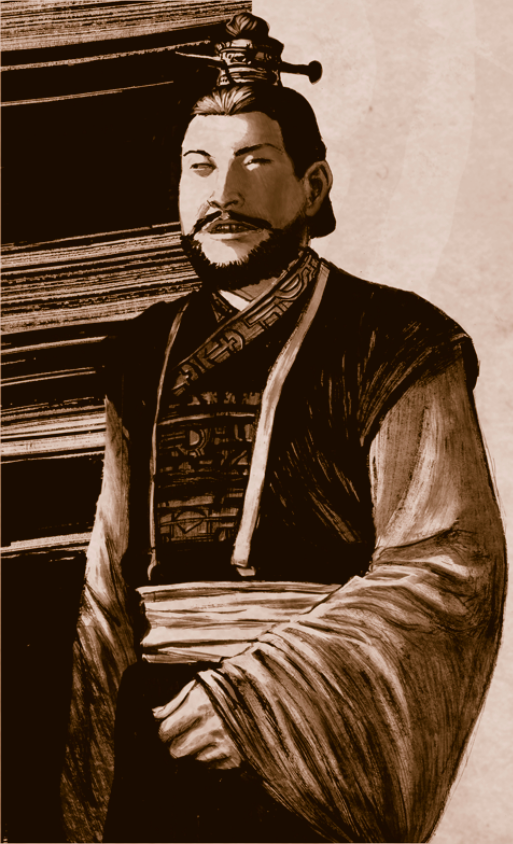
How will they manage to get past Quzhi's reinforced guard to save Sargaï? What happened to the others? How will they make it back to Zhao after this battle?
Looking forward to the next Qin session, when everything will finally be revealed!
The illustration depicting Lu Buwei belongs to éditions du 7ème Cercle. The cover and the other character illustrations come from the game Romance of the Three Kingdoms 10, by Koei Ltd.