Post-Mortem
Kémi
"Que vive son Kâ" and "Amat"
ludique · Post-Mortem · lundi, 5 février 2024 à 16:56:33 · 11 min
Time flew by. Between the discovery of Kémi: Adventures in Ancient Egypt and our sessions, 4 and a half years elapsed. The adage however proved true: all things come to those who wait. In September and October 2023, we completed the two official scenarios offered for Kémi, Que Vive son Kâ and Amat. A peculiarity of our sessions: I swapped the game's official system for Fate, the famous generic narrativist system, both out of fear that Kémi's proposal might be too simple for veteran players, and out of a desire to finally test this much-praised gem. The result below.
Kémi - calm and well-structured investigations
This post-mortem offers you a concise synopsis of our sessions, along with a few personal comments. For more details, you can find below the summary of our adventures on PremDAT.
Que Vive son Kâ
As it should be, we first played Que Vive son Kâ, since it is the scenario presented in the rulebook. Our table consisted of an orphan hailing from Ouaset, a muscleman turned scribe somewhat despite himself, and a corrupt architect inspired by Amonbofis. This mismatched team had been assembled by Nesamon to investigate the sabotage of Nehitor's sarcophagus, at Ikeni's request. Two 3-hour sessions were necessary to wrap up this affair.
The group followed the workshop's trail until finding Nehitor with Kherset. They however delegated the search for the ingredients to merchant NPCs in order to concentrate on the investigation. Nehitor's wife pointed them towards Houni, whom the group managed to save. Indeed, the characters created with Fate being a shade more heroic than those of Kémi's system, it was relatively easy for the group to intervene during the assassination attempt on Houni and to wound Merymes, even slightly. On the other hand, my players feared the attacker-assassin might come back to settle the score with Menkhaâré - they spent more than a day standing guard at Set Maât her imenty Ouaset (Deir el-Medina), a period during which I should probably have had Merymes act. When the players finally took an interest in Neferka, they were promptly turned away. They needed a second attempt the next day to get to the bottom of things and have Merymes arrested.
Que Vive son Kâ is a well-crafted adventure, which leaves the characters a fine margin of maneuver. Most of the situations can be handled without violence, with the possible exception of the final chase (though Ouaset's guards can take care of arresting the fugitive, if the PCs have handled things well). The scenario also illustrates a series of peculiarities of New Kingdom Egyptian society: belief in the infallibility of Pharaoh and his hierarchy, beliefs about the afterlife, the social organization of the artisans, etc. In this respect, Kémi's didactic contract is fulfilled.
The characters were easy to illustrate, even though I resorted for that to work "stolen" from image-generating neural networks.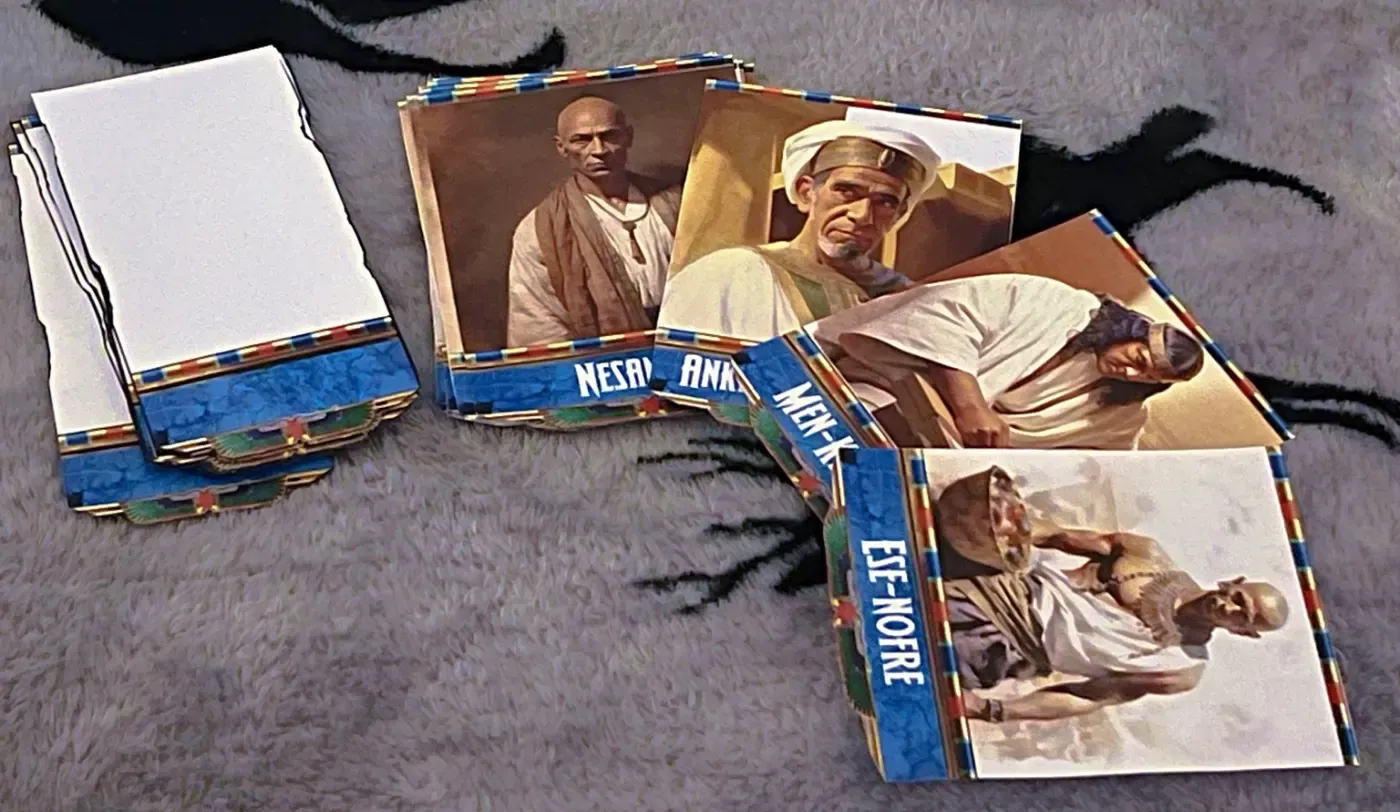
My players sometimes acted in surprising ways, as with Menkhaâré, and you will probably also have to improvise certain NPC reactions, in particular those of the madman. The visit to Neferka's residence is probably the scenario's most delicate point, since the slightest misstep precipitates the end of the investigation in a potentially dramatic fashion. On the one hand, any "stealthy" infiltration involves disproportionate risks for the group: should they ever get caught, the PCs become de facto criminals from whom Nesamon must distance herself. On the other hand, any "legitimate" entry into the residence leads the group to Merymes, who is supposed to react at the drop of a hat as soon as he senses someone is on his trail. During their first visit, my players only wanted to gather some information for their investigation, so I preferred to delay Merymes's abrupt decision, while explicitly warning them that they had triggered an event leading to the end of the scenario. They were thus able to react accordingly, wrap up their investigation and follow the murderer in his attempt to leave Ouaset. In any case, if you feel events are spiraling out of control, do not hesitate to do the same. Merymes may need time to manage his expedition to the Valley of the Kings without attracting attention...
Amat
Amat followed Que Vive son Kâ, with the same team of PCs still Nesamon's clients. At her request, the trio investigated Sabni's suicide, a distant cousin of her family. Since the scenario was designed for initiation / one-shot play, it indeed fit in a single well-filled session of almost 4 hours.
To save time, the players chose to follow the first leads offered by Nesamon while splitting up (the Temple of Amon, the inspection of the body, and Sabni's residence). This idea slightly backfired when the autopsy of "Sabni" ended in a partial success: two, or even three pairs of eyes would not have been too many to find all the clues. The "Didia" trail thus took time to reveal its full meaning. They however quickly understood that the body had been moved, for obscure reasons. At Sabni's residence, the group handled the tensions with Tadukhepa quite diplomatically, then discovered the hideous experiments harbored in Kanefer's chamber. From there, the players formulated the right hypothesis (Sabni is alive, someone else was killed in his place), discovered that Kanefer's tomb had been desecrated, investigated Didia, convinced Tadukhepa to reveal Sabni's doings, then reached the pool of Osiris. There, the guards previously hired by the team took care of the action, subduing Sabni, then rescuing the poor wretches held captive by the mud torrent. When Seger appeared with her team, the group did not wait around before scampering off.
Reading Amat left me puzzled, first because the didactic aspect seemed less present than with Que Vive son Kâ ("the eye of Osiris", that is not very serious), but also because of its tapered ending. It seemed to me ill-advised to suddenly introduce Seger, a character breaking with the game's realistic side, whose attire and manners belong more to fantasy (albeit tinged with "authentic" Egypt) than to History. In the end, this scenario pirouette does not have much impact on the scenario per se: the players were mostly happy to survive the mud torrent, and seemed rather intrigued by Seger's appearance. In fact, they would gladly have continued with a sequel, but the line's future seems a bit uncertain at the moment (cf. conclusion below). As for the scenario's structure, we remain at the same quality level as Que Vive son Kâ: the very numerous leads allow approaching the plot from varied angles. The sinister atmosphere of Sabni's residence, and in particular of Kanefer's chamber, gives the tale a mysterious, twilight tint. Even more than in the previous scenario, one remains in doubt about the investigation's nature - is this "supernatural" defying our modern logic, or does a "rational" explanation exist for all these events? Despite a few negative prejudices on reading, Amat turned out to be a nice surprise, which I therefore warmly recommend.
Fate - an opinion over 3 sessions
Fate had been catching my eye for a while, as this generic system was considered a benchmark of narrativism in the 2010s, without being as "divisive" as its neighbor Powered by the Apocalypse. To define narrativism quickly, start from the principle that the systems claiming allegiance to it encourage interpretation and arbitration, rather than the application of well-delimited rules. Concretely, one of the most recurrent points of these systems consists of relying on short descriptions, rather than on fixed characteristics. Thus, instead of a Strength or Wisdom score, a character might "have surprising strength for such a small size" or "benefit from an encyclopedic memory". When it comes to using these descriptors in an action, the players enjoy more latitude, at the cost of a potential loss of rigor in the application of the rules that the GM must constantly balance (hence the pronounced "arbitration" part).
Among others, a Fate character is defined by a "Concept" aspect, a "Problem" aspect and three free aspects tied to their past.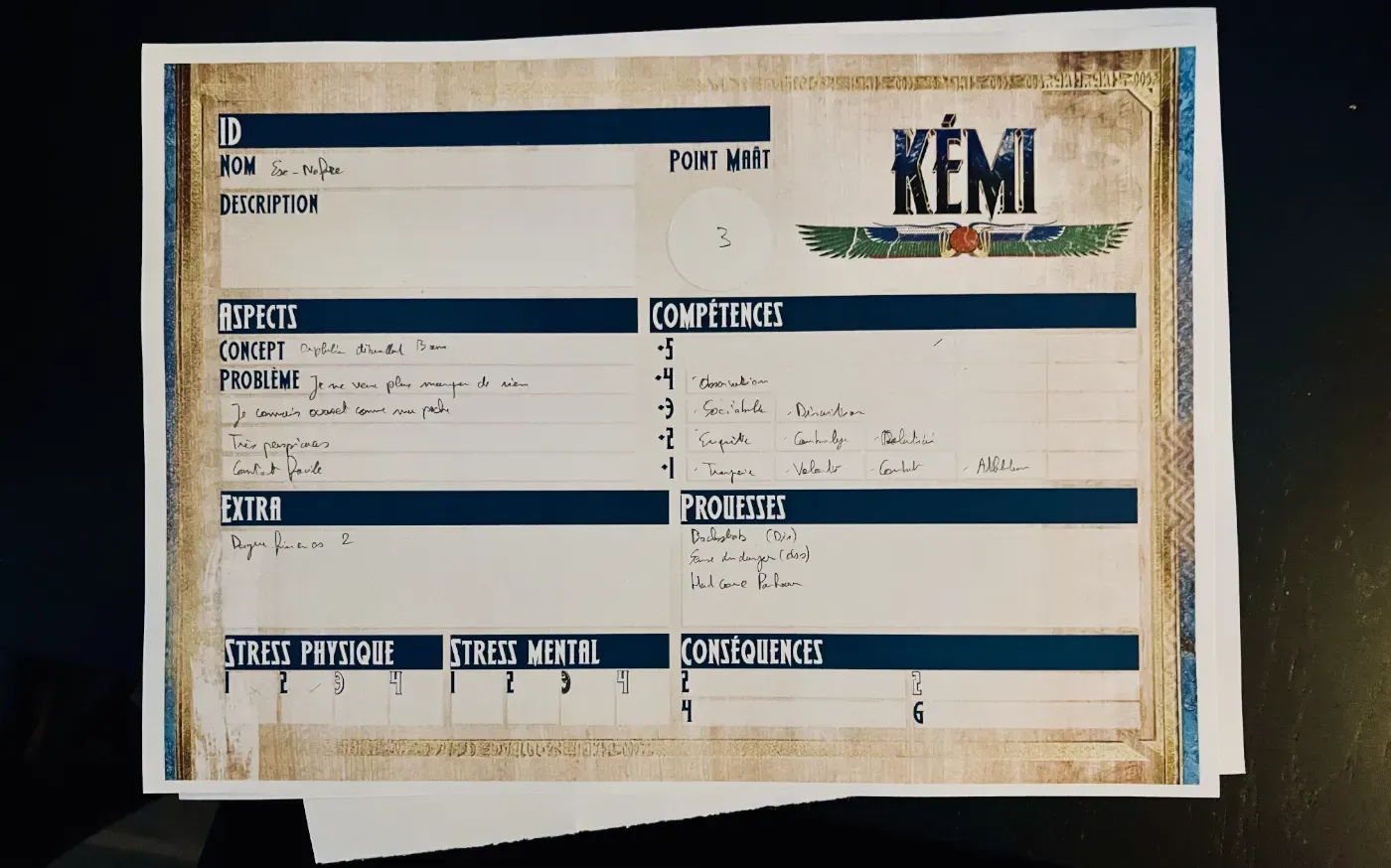
With Fate, narrativism is embodied first in the aspects, descriptors of varied nature that apply to characters (PCs and NPCs) as much as to places, situations or objects. To invoke an aspect capable of helping them during an action, a player can come to an agreement with the GM on the subject, then spend a "Fate point" from their character. The invocation allows rerolling the dice, or adding a bonus to the result. Recovering Fate points mainly requires suffering setbacks, such as the use of an aspect against a character. The system thus rewards the portrayal of characters' flaws. Another peculiarity of Fate: the die rolls have a zero expected value. To succeed at an action, a character must exceed a difficulty threshold using a skill that serves as a base score, which the dice can decrease as much as increase. In Fate, the key to success therefore consists of creating aspects (and profiting from them directly, in the form of "advantages"), in order to invoke them and improve one's odds of success. To me, this is a clever incentive for creativity, pushing the players to narrate the manner in which the aspects can support them.
All these distinguishing points globally bore fruit. To my surprise, however, my table had a bit of trouble getting used to the concept of advantages and benefits during the first and third sessions. I imagine the time spent between the two scenarios was enough for my players to lose the reflex of creating advantages, which no doubt explains why the mud whirlpool of the pool of Osiris was so dangerous (good thing the guards were there). With more sessions under their belt, the players would probably have made more use of the system to get out of trouble. On that subject, "long-term" play is conceivable thanks to a rather slow character evolution, but do not expect a rich progression as in a denser game. The system does not seem to me designed for a PC to go from "total noob" to "invincible superhero" in about twenty sessions.
Ultimately, converting Kémi's original system to Fate was relatively easy, since the success thresholds are not too far apart. One simply needs to keep in mind that Fate's narrativist flexibility, coupled with the characters' few specific "powers", considerably increases their chances of success. If you wish to embark on a Fate version of Kémi too, you can find a character sheet specially designed for this purpose below. It is fundamentally a simple Fate character sheet whose aesthetics are based on the game's visuals.
If Fate seems to be losing some steam nowadays, it remains perfectly playable, pleasant and globally balanced. One can perhaps find nowadays other narrativist proposals better suited to certain types of universes, or more or less crunchy variants fit to please other audiences, but if you are interested in systems of the genre, give it a look anyway. As for Kémi, what becomes today of this little gem of historical role-playing? Hard to say. In late 2022, Éditions Sethmes let it be understood, on their Discord, that a somewhat more alternate-history and fantastical sequel was going to see the light of day: Noun, named after the primordial chaos in Egyptian mythology. And yet, this project seems called into question today. The author of Kémi, Cédric "Lazarbaruk" Chaillol, recently left Éditions Sethmes, taking his games with him. I cross my fingers that this decision is the sign of a future for the line, even though it seemed more reassuring to me to have a publisher's support than to venture into self-publishing.