Post-Mortem
Conan
Shadow of the Sorcerer
ludique · Post-Mortem · lundi, 10 juillet 2023 à 06:54:35 · 18 min
Early 2022, I feel the urge to run a well-paced campaign, free of organizational headaches, with a small "agile" group — few people around the table, weekday play to dodge the weekend rush, a refreshed group dynamic, and so on. A recent read keeps running through my head: the Shadow of the Sorcerer campaign for Modiphius' Conan: Adventures in an Age Undreamed Of (better known as Conan 2d20 among aficionados). Everything suggests it is the ideal companion to meet my goals.
⚠️ Obviously, this being a report on our campaign, you are invited not to read it if you are about to play it as a PC.
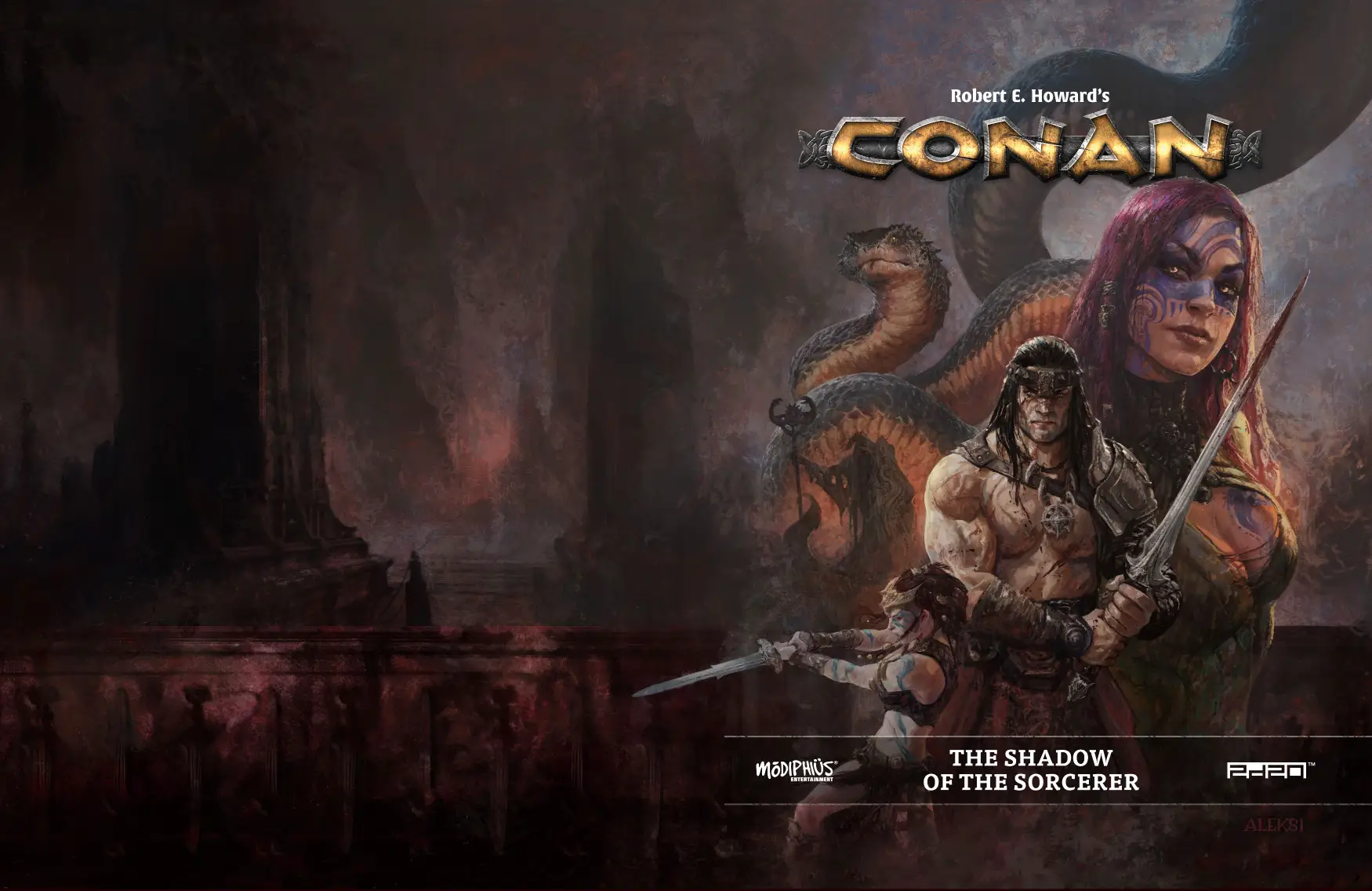
Shadow of the Sorcerer is the second full campaign published by Modiphius for the game, after Waves Stained Crimson. Traces of this campaign can be found almost 20 years back, when Mongoose still held the license. My assumption is that Modiphius picked up the work done back then to modernize it and adapt it to their game system, much like the late Éditions Sans-Détour's work on the Cinq Supplices campaign for Call of Cthulhu. The adventure starts in Messentia, the capital of Argos, then leads the PCs all around the Western Sea in a bid for self-preservation. Their souls are at stake. A jewel they steal from a scholar's home hurls them into a chthonic, dreamlike world where they follow the funeral procession of a fearsome Acheronian sorcerer, who turns out to have been imprisoned inside the gem for millennia. His spiritual awakening is taking him toward the weighing of his soul, but thanks to a mysterious ally in the real world, he fully intends to make it through and reincarnate. Naturally, the characters' fates are bound to his, so they have no choice but to commit to this escapade.
Our adventure stretched over 14 sessions, from May 2022 to June 2023. Playing on weekdays definitely helped our regularity, even if prep is sometimes grueling alongside a full-time job. The campaign remains modest in size, but the throughline packs so many twists and so much action that we were left wanting for nothing. You are of course free to expand certain passages, at the risk of diluting the action and eroding the sense of urgency bearing down on the characters — a cardinal sin for a Conan-esque adventure. The table's three players attended every session — a necessity for a small group — and no PC deaths are to report, even though some sequences could easily have ended fatally.
Unlike my previous Post-Mortems on this blog, the summary of our adventures will not be laid out here. I will settle for a "backstage" commentary on each scenario. For more details, you can find a succinct summary of each of our sessions on premDAT, as well as all of our complete write-ups on the Organisation Très Secrète forum.
The campaign comes in 7 "chapters" (scenarios) spread across 3 "books" (acts). Before that, the book opens with a clear presentation of the events leading to the PCs' involvement. Thus we learn the story of Xhosāth, an Acheronian sorcerer so powerful that the whole Court — up to the King himself — trembled with jealousy. From his spiritual imprisonment in a jewel specially designed for him — the famous Eye of Acheron - to its discovery by Antaeus millennia later, the plot positively reeks of pulp. In fact, the introduction is not unlike that of the 1999 film The Mummy, in its staging of an upstart's downfall. That was all it took to win me over!
- Short summaries on premDAT
- Full summaries: The Fall of the House of Antaeus
- Full summaries: The River of Souls
- Full summaries: The Black Wings
So the adventure begins in Messentia, where the group must infiltrate the scholar Antaeus' residence. A relatively short scenario, it still sprawls across 40 pages (the book runs ~200), a good ten of which are taken up by hooks and improbable what ifs. I see this as the consequence of one of tabletop RPG's aging trends: heaven forbid we force anything! The authors are so terrified of imposing a script that they strain, sometimes to the extreme, to invent every possible alternative to the PCs' actions (the trend fades as the pages go by). Happily, everything lines up to launch the plot in fine style: the discovery of the artifact, the plunge into the Acheronian world and the mysteries it reveals, the Stygian intrusion, the first contact with Thyra and Semerkhet, the discovery of the curse weighing on the characters. I also appreciate the detailed, almost systematic, description of Antaeus' manor, which makes it easy to adapt to any approach the PCs take. For once, this information is genuinely welcome!
The second scenario takes the group from Messentia to Asgalun, in search of information about Baruch, Antaeus' last known contact. **To my mind, this is the weakest scenario in the campaign, **without being outright bad. The description of Asgalun lacks substance and the journey can easily drag. Here again, the authors try to anticipate: the trip comes in two mutually exclusive parts, one by sea and one by land. With a merchant captain among the PCs, I thankfully didn't have to rack my brains over which route my group would take. The description of Asgalun is probably too limited to do it proper justice, and the references to other books in the line don't help, as they contain scarcely more information. I thus found myself with a very Coriolis-esque feeling of improvisation to stage one of Shem's most important cities, right up to the final showdown with the Stygian mercenaries in Baruch's home. It was our team's first large-scale fight — a few quick, deadly blows sufficed to end it. The discovery of Antaeus' remains, the handling of the sneaky Yarosh and the revelation of the prophecy remain the high points of this adventure.
⁉️ The famous "prophecy" offered by an old lady is supposed to come from the old sage M'Wangele, who urges the characters to join Odaka and follow his daughter after his death. An inconsistency, to my mind: M'Wangele is supposed to meet the characters before they come across Odaka. He could just as well convey this information to them unambiguously at that point. Another inconsistency: he doesn't seem aware that Odaka will die during the following scenarios. Then again, my players took the message as an invitation to follow Semerkhet: knowing he was of royal blood, they did everything they could to spare him during the adventure, while wondering whether he was indeed the right "King" to follow… which made my job much easier!
The third scenario takes the group to the pastures of Pelishtia, where Baruch hides in his country residence. Very short, the plot ultimately boils down to reaching Baruch, parleying with him in an atmosphere of distrust, facing the surprise attack of the demon harpy sent by Serothos, then submitting to capture by the pirates allied with Semerketh. This condensed blend of mystery and action suits a Conan tale rather well - your table will at last discover Xhosāth's past, and is quite likely to shudder at the Harpy's power. On that last point, I can only advise you to let the Harpy decapitate a few Asshuris in front of the PCs, and to roll your dice in the open while you're at it. My playtests showed that this critter can easily cut down a character in a handful of attacks, and it seems only fair play to let your fellow players grasp the gravity of the situation.
⁉️ Here again, the authors flatly apologize for imposing the scenario's outcome. They specify that for the campaign's sake, the characters must be captured by Gaal-Arvad's pirates. In truth, it would seem more logical for the characters to try reaching the island of Tothmekri on their own if they ever escape Gaal-Arvad: after all, they must find the Stygian prince's remains in hopes of stopping Xhosāth. So don't stress too much if your characters defy the odds.
- Short summaries on premDAT
- Full summaries: The Sea of Black Wine
- Full summaries: Purple Jewels in the Twilight
- Full summaries: The Paths Beneath the Earth
The fourth scenario is a sea voyage, in the hold of the Calypso, where the characters are free to distinguish themselves among their captors and position themselves as valuable allies. Even though freedom of movement is confined to the ship, negotiation opportunities are legion. My group played both sides, convincing Semerkhet to let himself be captured while promising to smooth his release later on. Naturally, the shipwreck somewhat thwarted their plans. This scenario also gives new scope to the two scenes in the Acheronian world, with their fights against Anubians and a giant crocodile... which my players preferred to dodge. Not a very Conan-esque attitude, but our relative mastery of the game system nudged them toward prudence.
I chose to introduce the name of Serothos — the brain behind the whole affair — as early as this scenario. Convinced by the PCs' proposal, Semerketh let the name slip while explaining his ambitions. Granted, the scenario states that the Stygian refuses to give his "ally's" name, but unless I'm mistaken, that information is never actually offered to the characters. It falls to you to pace the revelations across the scenarios, failing which your group risks reaching the Valley of Set and sheepishly discovering the "big bad's" double identity there. I should have revealed even more, right from the meeting with Baruch, since this name apparently never entered my players' heads until the final scenario.
⁉️ For reasons that still escape me, the abrupt disappearance of Sarayene, Captain Gaal-Arvad's lover, piqued my players' curiosity. Until they left the island at the end of the sixth scenario, they kept expecting a follow-up about her (she could have survived the shipwreck, for example). On a narrative level, Sarayene's disappearance mostly serves to demonstrate the episode's gravity and violence, and to make sense of the shipwrecked Gaal-Arvad's emotional distress. But who knows? There's material here to invent something…
The fifth and sixth scenarios form the campaign's peak, as the characters wash up on the island of Tothmekri before discovering the Stygian prince's offspring. The two adventures flow into each other so naturally that they're hard to tell apart. Between the muscular action scenes, the pulp exploration of a dangerous island with a loaded history, a good dose of diplomacy, a substantial margin of maneuver for tackling each phase, a Dantesque finale with sacrifice, heroic fights, memorable NPCs… in short, everything is there to close the second third of the campaign in style and launch the final scenario.
The soul-weighing scene has the potential to go wrong: if your players choose to send both Semerketh and Meketre to the gibbet, it does indeed seem a bit far-fetched that all these sacrifices aren't enough to "offset" the sorcerer's black soul. Thus Antaeus' voluntary damnation — necessary to inject dramatic spirit into the rest of the campaign — could feel arbitrary. Happily, my players promptly refused to damn anyone, so Antaeus' action felt to them like a natural consequence of their choice. If, in your campaign, your PCs choose to sacrifice both descendants without blinking, you might insist that their souls will join him regardless. The Acheronian gods are cruel; they will deem that a band of nihilists who toy with others' souls deserves to burn in Hell too.
As for the final fight, the PCs cut down Tothmekri, but I preferred to spare them Apophis. We had already crossed the hour-and-a-half threshold of combat, so it seemed wiser not to stretch it further than necessary. If your table loves combat, or if you want to play out the "purge" the pirates conduct after their exploit, go for it. Otherwise, keep in mind that showing an Odaka victorious over Apophis, without the PCs' help, will bolster his aura of seasoned hero from whom the protagonists still have much to learn.
⁉️ Here too, don't feel compelled to impose Odaka's assassination: if he survives, the campaign's plot will change but little. Just bear in mind that Heqet is a cunning opponent and ultimately more dangerous than her father. Unless you shout "Ka nama kaa lajerama" 10 times a minute to unmask her (a measure my group put in place after the assassination, just in case), she has every chance of pouncing on her prey.
- Short summaries on premDAT
- Full summaries: The Wrath of Serothos
The seventh scenario wraps up the campaign — a whole chapter unto itself, which we played over three packed sessions. The sea transition let us use Conan's "carousing" rules for the first time, and improvise an enemy for one of the PCs into the bargain. Good fun — a pity the campaign doesn't carve out more spaces of this kind! Since the characters explore Kush, then Stygia, you'll have ample opportunity to expand the adventure with short excursions, small side quests, or simply more detail when visiting certain cities. Unfortunately, the very "flyover" descriptions of locations across the whole line won't help you much with that task. It's up to you to flesh them out, either by researching in advance or by improvising, at the risk of sinking into clichés (always a risk when you pull ideas out of a hat on the fly).
My players didn't choose the most direct route to the Valley of Set
The campaign provides two possible paths: either leave straight from Kush for the Valley of Set, or first reach a Stygian city before exploring the desert. My table preferred a third way, namely sailing up the river bordering Shumballa to Lake Zuad, so as to gain a few kilometers eastward without venturing into Stygian territory. In the end, they traded a trek through the savanna for a river cruise, all to land in a fishing village poorly stocked for their desert journey — nothing that was hard to improvise on my end, thankfully.** The crossing offers a fine opportunity to appreciate the characters' power growth over the course of the campaign**, if they choose to massacre the Stygian soldiers patrolling the desert. As for the meeting with Harkouf the "quasi-Fremen", it provides welcome help to characters in enemy territory, but at this late stage of the adventure, it's too late to forge genuine bonds with this NPC and his companions.
⁉️ I chose to let the players temporarily play Thyra, "Serothos's" prisoner. It seemed improper to hand my table all the campaign's information on a platter, so I preferred to let my players discover it through the eyes of an NPC. A good idea, but the meeting between Thyra and the wives had to be "forced", since my group had no plans to visit Xhosāth's tomb before departing.
The finale of finales had its intended effect. Initially daunted at the prospect of facing Thoth-Amon, his hellish harpy, Xhosāth and his wives, my group quickly understood this would in fact be a "Mexican standoff": on one side the Stygian and his Harpy, on the other the Acheronian and his ghostly wives, and in the middle… the protagonists. Triumph therefore consisted in knowing whom to strike and when, but Thoth-Amon's powerful spells somewhat limited the characters' options: with enthrall, Conan's Nemesis could easily control the PCs and force them to fight on his side.
Wishing to avoid weighing down the antagonists' turns, I chose not to play the eight wives of Xhosāth — they were only there to take the blows meant for him. This protection proved quite unnecessary, by the way, since at this stage of the adventure spending two points of Momentum to reach a target is no longer much of an issue. Result: Xhosāth didn't last long against the combined forces of Toth-Amon and the PCs, though he twice came close to slaughtering a character with his attacks. If I had it to do over, I'd play the wives as two "squads" of 4, enough to noticeably reinforce the Acheronian camp. Likewise, I chose to go all-out with Xhosāth and use sorcery with Toth-Amon, but the Acheronian could just as well have (and perhaps should have) bewitched the PCs to turn them against each other — an epic finale where the protagonists would have had to break free of both sorcerers' grip and, why not, strike them down by cunning while the two believed they had them under control.
In the end, the group cuts down Xhosāth, then, thanks to a few providential dice rolls, breaks free of Thoth-Amon's influence and threatens to slay him in turn. I take the opportunity to spend my remaining Doom points to resurrect the harpy — previously felled with a single sweep a few rounds earlier — to let the sorcerer escape. Alive he may be, but he won't forget this stinging defeat in a hurry!
A quick word on the system: I was looking for something "rich" — one where my players could invest themselves, develop their characters, thrill at seeing them evolve. This 2d20 System delivered on that contract, despite a complexity we're probably no longer used to. Alongside our campaign, I was unfortunately spending too much time reading / playing other systems to invest as much as needed in this one, so we took a long time to get to grips with its technical subtleties. One piece of advice on that front: make sure to simulate the trickiest sequences (be it combat, infiltration or diplomacy) before each session, to better understand the system's finer points. Some innocuous-looking changes, like raising a roll's difficulty from 2 to 3, or granting certain qualities to an exceptional item, can radically shift the odds for or against the characters.
⁉️ Conan 2d20 doesn't work like Dungeons and Dragons: there are no real "tanks" capable of soaking dozens of attacks before collapsing (never mind the plentiful magical healing). Make sure your players understand that a single powerful blow can be enough to put a character down, or even kill them outright (whether PCs or important NPCs). Xhosāth's attacks are a case in point, particularly the "Incandescent Blast of Sorcery" boosted with "White Demon Fire". With its spread quality, it can very easily dish out a good 20-odd damage. Even sacrificing armor, a character taking such a hit will be badly handicapped for the rest of the fight. And nothing stops Xhosāth from firing off several per turn, if you have enough Doom...
The good news is that even with minimal investment, neglecting the system's details takes nothing away from the merit of its "core". In particular, the positive dynamic between Momentum (Heroism) and Doom (Fatality) points lets characters succeed at almost everything they attempt, at the risk of inflaming things over the longer term. I have rarely met a system this "generous" while staying balanced in its success odds. A point in favor of the game mechanics, then, even if everything isn't completely rosy.
Nearly half a year after our campaign, I already feel a twinge of nostalgia thinking back on it. Although some details require adjusting and the authors' obsession with apologizing for their "railroading" is a bit disheartening, I found the plot truly engaging and respectful of the license, light-years away from the filler scenarios and ChatGPT-style aperitif synopses we encounter far too often in RPG books. Its size is also an advantage: it won't chain your table to the game for years, without ever giving the feeling that the adventure is short. As for the 2d20 System, deemed too complex, it proved sufficient to keep the group on the edge of their seats and let them act without fear, without making things too easy either.
If today's gaming landscape weren't so abundant, I might have already launched into a second run. Failing that, we'll wait for our other adventures to end before thinking about it again!
Thanks for reading. If you have reactions, feel free to stop by the forum to discuss it in an open space!