First Look
Eternal Lies
a campaign for Trail of Cthulhu
ludique · First Look · lundi, 16 novembre 2015 à 12:03:58 · 9 min
There exists a horde of different games dealing with the Lovecraft Mythos. The best known is of course the "Call of Cthulhu" (the RPG where investigators dig... sometimes deeper than this joke). Thirty years old, this game defies all predictions: it ignores every fashion and remains hugely played today. Suffice it to say that over such a lifespan and despite a release schedule that is nothing revolutionary, the Call (that's its nickname) has so many scenarios and campaigns that even a bottomless pit could not contain them. But here is the thing: some of them are clearly dated: despite the prodigious efforts of the publishing houses in charge of the licenses, playing these relics systematically leaves an aftertaste of old age.
Following the Call, many derivatives were born. "Delta Green", a sort of "X-Files" version using the same game system. "Cthulhu D20", a major insult to RPG players' intellect. "CthulhuTech", an improbable cross between a Mecha universe and that of the Mythos. "Cthulhu For President", whose motto "Why choose a lesser evil?" hit home with so many hotdog-eating voters. "Achtung! Cthulhu" and its pulp atmosphere where investigators may prefer the great Tentacled one to the Nazis. Hello Cthulhu, finally, even though it is not an RPG.
Trail of Cthulhu cover. Copyright Pelgrane Press Ltd
None of these variants, however, fixed what the authors of Pelgrane Press considered one of the big problems of the Chaosium system: the randomness of investigations. How many groups were blocked because of a clue that escaped them? One failed "Find Hidden Object" roll, and there you are, looking for an alternative way to get the clue that slipped under your nose. Yet, as the Pelgrane Press authors put it so well, the pleasure of investigative scenarios does not come from collecting clues, but from interpreting them. Thus they gave birth to "Trail of Cthulhu", published in French as simply "Cthulhu" by the publishing house 7ème Cercle (Qin, Kuro, Yggdrasil). The universe is strictly identical to the Call's (although the game is mostly oriented towards the "1930s"), but the system aims to be completely different. The archaic and mature Chaosium system is replaced by the Gumshoe system, where investigators automatically collect basic information provided they have the right skill. If they want more details or other advantages, they can then make "spends" that automatically give them access. Gumshoe is above all a resource management game at the expense of luck: despite the panic this might trigger in quite a few GMs, it makes sense and ultimately comes rather close to what I had experienced (and enjoyed) with Qin (a system where the die has little influence, the players being called upon to use their Chi points judiciously to make sure they succeed at the important actions). "Trail of Cthulhu" was born in 2008 and already counts some fifty books to its name, many of them scenarios. Suffice it to say, the little guys at Pelgrane Press are prolific! The competition between "Grandpa" Call of Cthulhu and "Kid" Trail of Cthulhu ultimately goes quite smoothly, since the supplements - which rarely deal with mere rules points - are interchangeable. We are thus witnessing a virtuous dynamic rather than a fight to the death.
Campaign cover. Copyright Pelgrane Press Ltd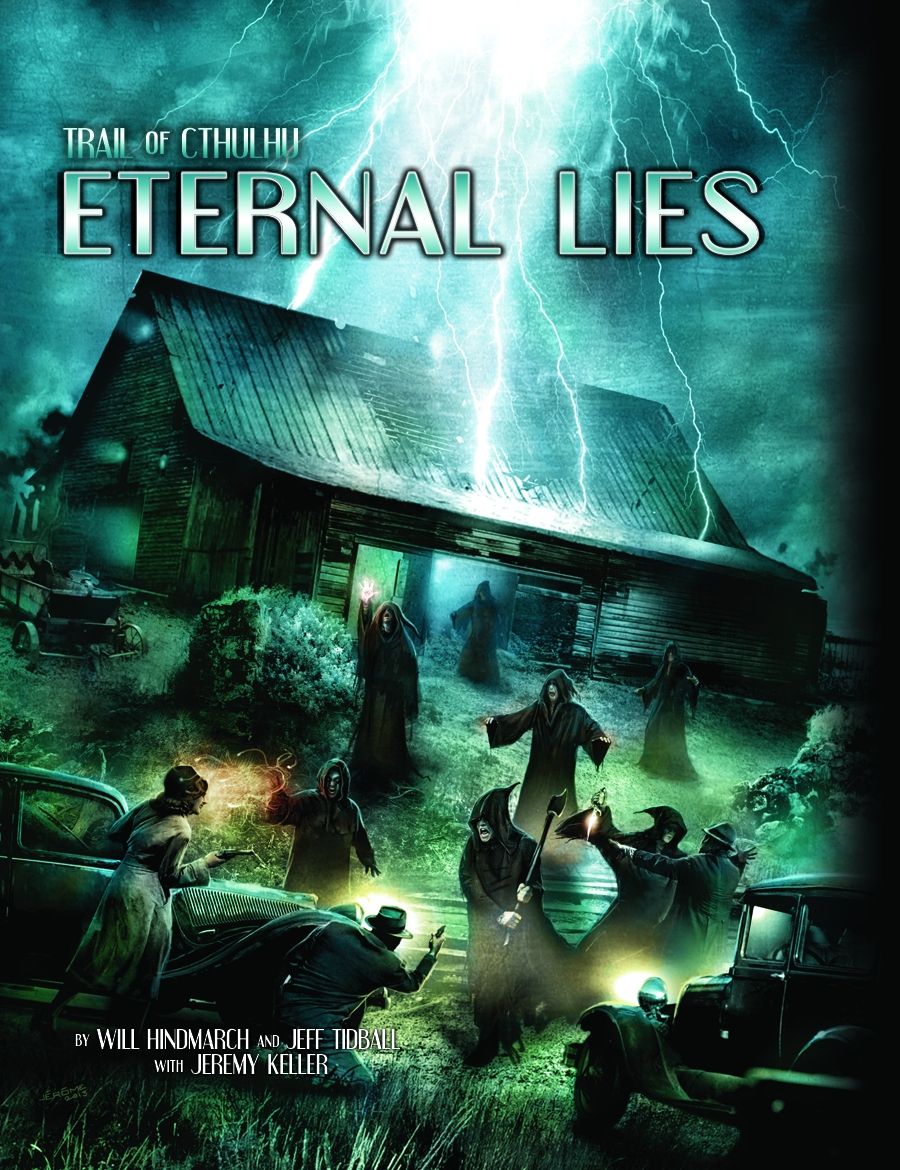
Pelgrane Press wanted to offer its baby its "big campaign", one that could live on in memories the way "Masks of Nyarlathotep" did for the Call. Thus was born the Eternal Lies project, whose release was planned for early 2011. As usual in the RPG world, delays ensued, and the definitive version was only published in August 2013: the campaign has thus barely come out of the oven, and few groups can already give a practical account of it. I bought the whole thing as a digital download, and after two nights of intensive reading, it is time to report my immediate impressions.
On the form side, "Eternal Lies" is offered as a 400-page campaign, accompanied by a dedicated soundtrack (which came out in 2010, while the authors thought they could publish the book on time: as a result, they re-released an album with a few additional tracks to accompany the actual release). People who have already read a book from the line will not be surprised: same layout, same typeface, same sidebars, so we remain within good quality. Illustrations are rare, and the appendices / background information are decent without reaching the level of what Sans-Détour does. On the other hand, it means the campaign's 400 pages effectively represent scenarios, whereas the Call's books are 50% game aids. We are thus looking at more than a substantial campaign. The book contains a first chapter aimed at players, explaining how to create their characters so that they have their place in the campaign, and what to expect. A surprising initiative! The rest is more classic: a presentation of the campaign for the GM, then the campaign proper, divided into three major acts.
The soundtrack - "Eternal Lies Suite" - has also been looping on my computer for two days. On the menu, 2h13 of music spread over 78 tracks sorted into three functional categories: "Ambience" (to be left playing during most of the sessions), "Action" (for scenes where tension rises) and "Stings" (to musically illustrate certain passages, like the start of a session or the investigators' failures). In addition, there are a few vocal recordings by Wil Wheaton, throwing out a few quick sentences from Lovecraft's novels, for atmosphere. The Suite consists of a main theme whose goal is to soak the campaign: after two years of play, odds are the players will have internalized its rhythm along with their adventures, as one does with video game music. It is therefore an excellent idea in substance, an idea becoming more and more widespread. However, after the relative disappointment that the Deadlands Noir soundtrack was for me, I almost expected to set this suite aside to pick my own tracks. And yet - and this is the opinion of a musical novice - I found the ride pleasant, if not consistently inspired (especially those damned Latin choirs, clichéd as can be, enough to make you sick): the main theme goes down well, the melodies set the mood while knowing how to be discreet. A success!
The substance, now.
Let us set things straight right away: "Eternal Lies" is a pulp campaign. But a pulp campaign that fully assumes it, unlike the Masks, which thirty years on still ride a usurped reputation as the "creamy cream of Lovecraftian gaming". So we get a planetary-scale threat that the investigators are called upon to blast to bits. Yet the introspection proper to purist mode is not completely absent (the campaign plays heavily on the sources of stability, the human bonds proposed by the Gumshoe system through which the investigators can try to reassure themselves), and the action remains manageable: there will be deaths, but not by the truckload as too often in the old Call campaigns.
In the book, the authors have specifically asked to avoid spoilers on the Internet. I will do my best not to go against their wishes. The campaign starts in an ultra-classic and direct manner: a character arrives and hires the PCs to investigate a dark affair. We are even spared the traditional "you receive a letter from your cousin": the players are free to explain why they are being called upon, but it can also be limited to the strict minimum. This aspect is entirely claimed by the authors, who wanted to get the campaign on track quickly. What follows is a quest that will lead the PCs to the four corners of the world, a bit like in the "Masks", in search of crucial information. The campaign is very well structured: the acts have different goals and moods, and so do the sub-acts. It would almost look like the "Biowarian" scheme, to be honest. Above all, modern campaign obliges, it has a beginning, a middle, an end and substance worthy of those names, not to mention a few well-placed twists. The plot itself seems interesting to me, but that is the kind of thing that can only be verified in practice, not by reading.
The NPCs are not left behind: I would rate them at the level of those of the "King's Rags / Oripeaux du Roi" (perhaps the finest compliment one can pay a Lovecraftian campaign). The Mythos entities the investigators will confront are also very well crafted: I will say no more, but after the "Masks" (yes, another reference to that campaign) which turned Nyarlathotep into a snickering-devil-mwahaha, "Eternal Lies" presents its deities with originality and respect for the source material.
As a good little student, I will end this article with a school-like conclusion: Eternal Lies seems to me to succeed in its wager in terms of quality: ambitious, inspired and modern, it truly made me want to take the plunge (maybe after the Masks, assuming we do not go for the "Oripeaux du Roi"... if there is a second campaign, of course). However, I doubt it can rival the "Masks" in terms of hype: not only is the latter overrated, but above all the competition is much fiercer today than back then. Hard to stand out!
The final word is: if you are a Cthulhu GM, have no ongoing campaign and feel like playing one that can stretch over several years: do not hesitate, go for "Eternal Lies". The stars are favorably aligned, it cannot fail! Iä!