Review
Anima: Beyond Fantasy
the RPG
ludique · Review · lundi, 21 septembre 2015 à 10:16:07 · 8 min
The Anima: Beyond Fantasy line is a complex subject. Anima Studio has ambition, and that is a pleasure to see: rare are the people who launch a miniatures game (Anima Tactics, now abandoned), a non-collectible card game (Anima: The Card Game) and a role-playing game at the same time. That is without mentioning the novels and the two video game projects launched afterwards, Anima: Ark of Sinners and Anima: Gate of Memories. Unfortunately, only three people are involved in all these projects: it shows in the quality and the follow-up of their productions.
This article deals with the Anima: Beyond Fantasy role-playing game, with which our group spent about fifty sessions spread over two years.
Stacey at a Waterfall, by Wen M. A fine example of the kind of illustrations the Anima line benefits from. [Image by © Wen M, under Fair Use]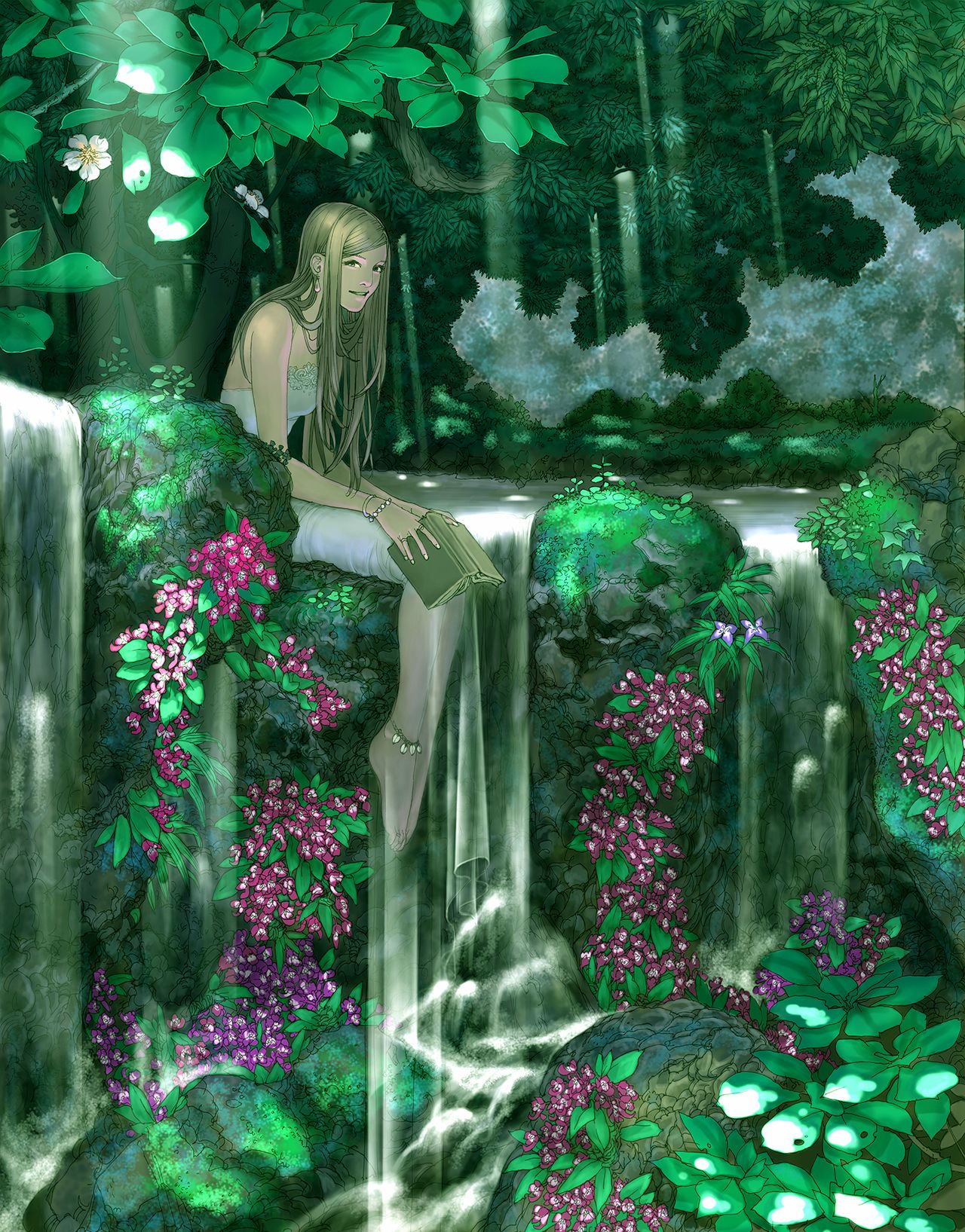
The form
Regarding the RPG, more specifically, the basic idea is to revive the good old Rolemaster system, spiced up with a few innovative ideas and a "manga" / "superheroic" aftertaste. Although the rules are presented as potentially generic, a very Final Fantasy-friendly universe is also offered, with its gigantic kingdom, its oversized cities, its variable technological level and its secret factions manipulated by guys manipulated by other guys.
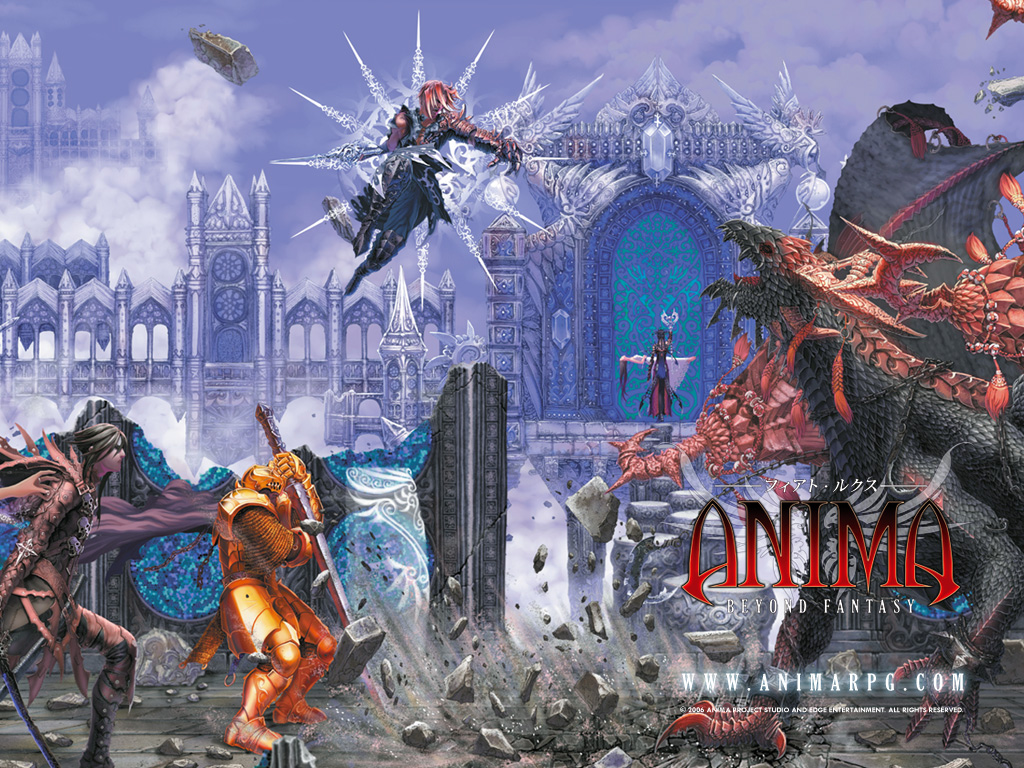
As for the book itself, we get a big tome that is anything but sober. Glossy paper, generous with illustrations, globally very busy. While many love it, some find it "too much". Personally, I appreciate the care, even if a humbler layout would not have been a luxury. On that topic, the main illustrator of the Anima: Beyond Fantasy line is called Wen M. He offers many deviations on his DeviantArt account.
The system
You guessed it: the big chunk of the book is the game system. The latter is frequently criticized by many RPG players, notably because it goes against the grain of "rules are evil" - the fashion that has prevailed for quite a while in the wonderful world of role-playing games. On the menu, we find exactly what the authors had promised: Rolemaster made lighter, sprinkled with ideas and rules of its own to convey a Saint Seiya or Final Fantasy atmosphere.
Concretely, Anima: Beyond Fantasy offers a classic D100 system, with classes and levels. Players create their characters using the twenty pre-established classes (including hybrids), although these do not lock them into a predefined role (even if it is hard, a character can always invest their points in disciplines poorly suited to their class). Nearly half the book is devoted to describing the various supernatural powers that PCs and their opponents can call upon. We are offered four types of powers: Magic, Invocation, Ki and Psychic Disciplines. It is copious, all the more so as the mechanics vary a lot from one type to another: sorcerers store power to cast their spells, which succeed every time; mentalists use "anchors" to trigger their powers, with a die roll sealing the degree of success; Ki adepts boost their physical attacks by focusing their internal energy. In short, every character cooks their own little soup. A delight for players, a hell for GMs. On the margins of powers, Anima: Beyond Fantasy aims to be simulationist, with rules for pretty much anything one can imagine (falling, electrical damage, breaking down doors, parrying, martial maneuvers, ...).
If you set aside the absolutely undrinkable damage table, everything ends up running rather well after 3-4 sessions. I found the Anima system far from being as frustrating as its main inspiration. It allows players to create likeable PCs with monstrous powers, without restricting them in the name of a sacrosanct "balance" that only exists in its designers' heads. The fact that each type of power is handled differently gives them a unique flavor, all the more so as their description is broad enough to allow both martial and out-of-combat use.
Ultimately, I really liked the system, and my character - the most omnipotent I have ever portrayed - will probably be missed quite a bit.
Gaia
It is when tackling Gaïa - the game universe - that things go wrong. Behind a veil of "mysterious mysteries" all "more obscure than the others", one realizes there is ultimately not much to chew on: the factions are so secret and so powerful that PCs will struggle to influence anything, important NPCs are driven by motives that are never explained (we are just told "careful, this guy is a big shot, he has a grand plan for Gaïa, but nobody knows what it is!") and the lovely gaggle of cities and regions would have gained from being better developed. As it stands, one cannot even say we have a skeleton on which to build a world: it would be more accurate to say we have the epidermis without the bones.
Alongside this, there exists only one official scenario and no campaign at all. Fortunately, one can rely on the very active Anima community to compensate for this lack. The authors explained their position by stating that not developing the universe "lets GMs create their own Gaïa". In my opinion, this is a (grave) mistake: providing a reference context imposes nothing on game masters. Role-playing game books are, by definition, toolboxes from which one can choose not to take everything. One might think this is an outstretched hand towards novice GMs, presumably not used to selecting the relevant information, but the latter will anyway get nothing out of such a stunted context.
A rather unusual end result: a system I liked and a universe unfortunately hard to make use of. Thankfully, with an imaginative GM, there is still plenty of fun to be had, as evidenced by the roughly 50-session campaign my group has just completed.
Campagnus... nostrum. Or nostrus.
The OTS group initially included Izanami, Eagle, Flix and myself. Lucille and PicaLudica later joined the group. Ddril was at the helm.
Two particularities for this campaign:
- It took over from our tests on Contes Ensorcelés. Ddril therefore had to juggle to justify how the World-Coin existed in the Gaïa Universe. In our campaign, the World-Coin took the shape of a secret organization funded by Abel to train children gifted with particular predispositions towards the supernatural.
- The PCs were designed from the start for superheroics, hence very high characteristics for the characters. Our group played the only official Anima scenario, then Ddril had us roam a good part of the Old World. The finale staged the fall of the World-Coin, the target of a Wissenschaft conspiracy. Once the treachery was exposed, our group allied - reluctantly - with the Azure Alliance to attack the County of Lucrecio. Lucanor negotiated the possibility of retreating to the New Continent in exchange for his efforts to help us rebuild the World-Coin.
Second edition
In 2013, a new edition of Anima: Beyond Fantasy was published. It contains, among other things, revisions to the combat system. If the game has not changed much, is this new edition an essential purchase for those who already own the V1?
Answer: no. For two reasons.
- The book's content is 95% identical: the background information has not budged an inch and almost all the rules remain valid.
- The changes to the combat system rid us of the dreaded damage table. Admittedly, that table constituted the worst aspect of Anima. But in doing so, the new rules impose an extra mental calculation on us. It will have to be tested in action, but I have the feeling we lose on the exchange. Rather than focusing on hunting down the "cursed table", it would probably have been more relevant to focus on the heaviness of the overall calculation.
The conclusion imposes itself: if you already own the first edition of Anima: Beyond Fantasy, there is no reason to pay for this new version. As for those who have not yet tried the experience, this new edition is as recommendable as the previous one.