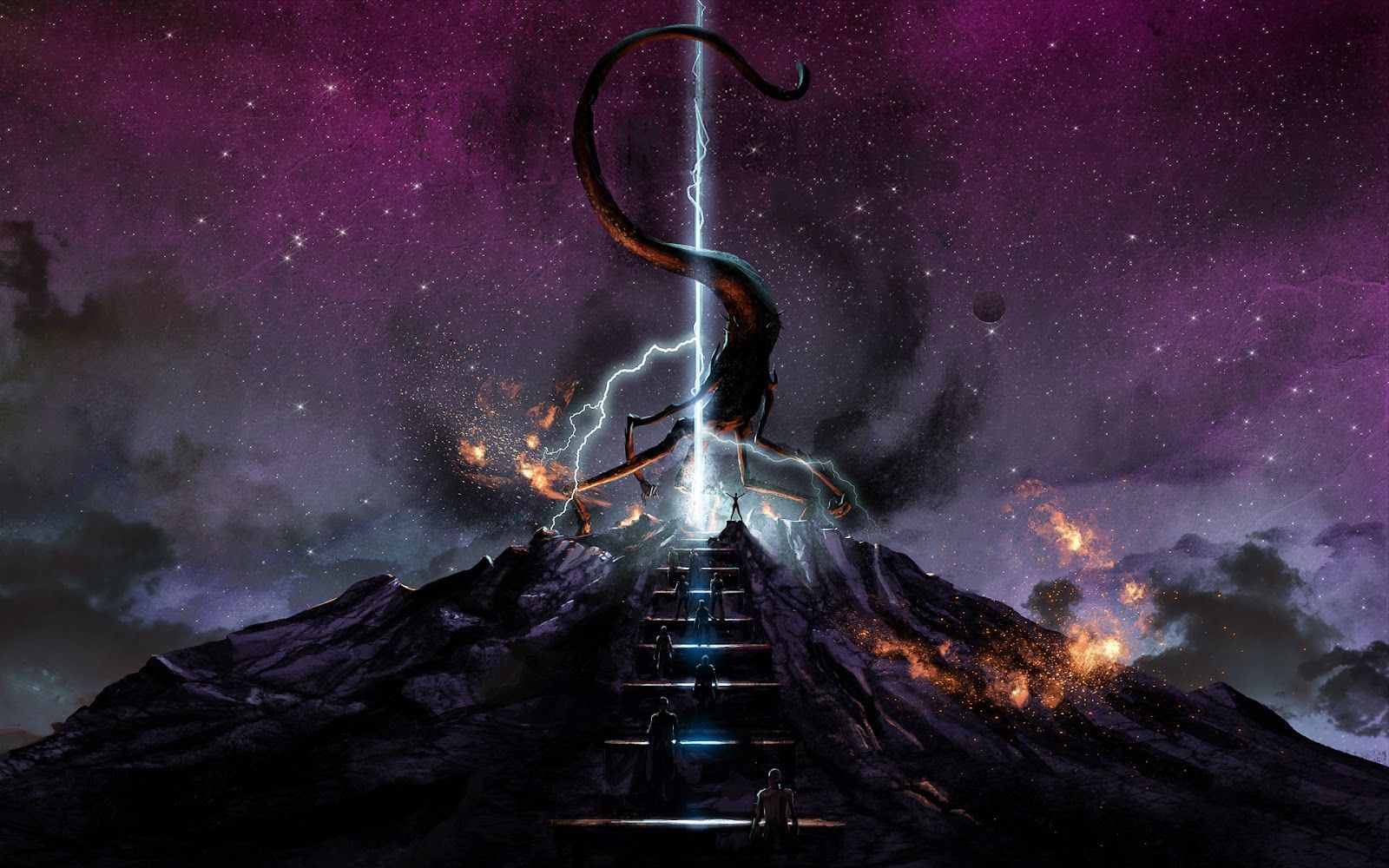
Review
Masks of Nyarlathotep
ludique · Review · mardi, 22 septembre 2015 à 11:28:04 · 8 min
June 2012. Sans-Détour, the French publisher of Call of Cthulhu, releases a remastered version of the legendary campaign "Les Masques de Nyarlathotep". In the following months, hundreds of dice-rolling cultists sink into a long-anticipated madness. At the Organisation Très Secrète, two of our tables were hit: one run by Hoth, another one by your humble servant.
- Masks of Nyarlathotep: Post-Mortem, an in-depth review after we finished the campaign.
- A first look at "Eternal Lies", a campaign "on the scale of the Masks" for Trail of Cthulhu
A year and fifteen sessions after the campaign began, our group has just left its fourth destination and is heading back to the third (which it had wrapped up a bit too quickly). We are thus at the campaign's midpoint, and as the GM, I am starting to see how the rest will unfold.
This review is not completely spoiler-free. If you wish to spare yourself all the campaign's details, avoid reading what follows. For my players: there should presumably be no problem or big revelations...
"Masks of Nyarlathotep" is a campaign that saw the light in 1984, at a time when most of today's RPG players were - at best - playing house and still regularly wetting their pants. It strongly marked minds through its exoticism, its "Lovecraftian" atmosphere, its epic sweep and its plot - then judged as far above average. Since then, the campaign has undergone many re-editions, each bringing its share of novelties - some occasionally unwelcome. And while "the Masks" achieved myth status, the observation also imposed itself that running this quagmire had become practically impossible. True to its reputation as a top-tier publisher, Sans-Détour therefore decided to dust off this ancient RPG fragment and finally make it playable.
The iconic image of the "Masks of Nyarlathotep", which first appeared in the 1996 English re-edition.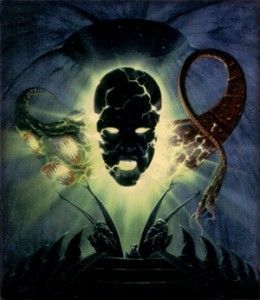
In parallel with the evolution of Call of Cthulhu, the role-playing world experienced its own little revolutions. One of the most important took place in the early 90s, notably with the arrival of White Wolf in the international RPG fold. These players, in search of maturity and roleplay more than dungeons and XP, found at the white wolf's games emphasizing plot and character depth (note that certain games had already invested the niche successfully, but White Wolf managed to gather an unprecedented number of players). The RPG went from "board game" status to that of an indescribable hybrid. RPG players then discovered ever more abstract, narrativist games, to the point that rules almost became has-been. Faced with all this modernity, were the Great Old Ones of the RPG still up to the task? And what if the legendary "Masks of Nyarlathotep" campaign owed its reputation only to the fact that it was very rarely played, because it was very rarely playable?
Obviously, the answer will differ for everyone. As for me, over the last six years, I have run the Tian Xia (Qin) campaign and the Cinq Soleils one (Pavillon Noir, first part only). Those two are unforgettable because they center on a strong plot and colorful NPCs. Having amassed a considerable number of Call of Cthulhu V6 books, I decided to take the plunge and run the Masks (come on: at this stage of the post, we are close enough friends to drop the quotation marks), without quite knowing what to expect.
As usual with Sans-Détour, the presentation is careful. We get a good big box decorated with an exclusive, quality illustration. Inside, 8 booklets - one introducing the campaign and providing general information (including a who's who), 6 for the locations to visit, and a last one gathering all the game aids. Suffice it to say, we are spoiled...
Source: Sans-Détour shop. Every time I go there, I discover new supplements that trigger a compulsive urge to buy. 5/D100 SAN loss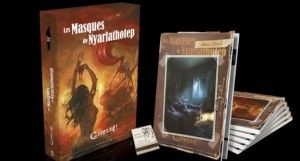
Reading this campaign frightened me, for several reasons:
- ** The scenario framework is flimsy**. For some players, the "substance" of an RPG scenario holds little interest: when you play, you have neither the time nor the desire to do philosophy. That said, working on one's scenario's meaning, especially in a game inspired by a literary universe, is an aspect that turns the "pleasant" into the "memorable". Here, the authors chose the potentially most "human" god of the Mythos to make a classic "God of Evil" out of him, close to the big bads of B-movies. Consequently, the PCs take on the posture of heroes (willingly or not), who must save the world from a snickering demon with tens of thousands of minions at his heel. Everything, from beginning to end, reinforces this idea of "fight against the forces of the Apocalypse". Brutal, lethal, not subtle for a penny. Hard to instill verisimilitude in the NPCs, when their motivations are limited to "destroying the wooorld". The sole touch of originality comes from the Carlyle expedition: discovering the fate and role of each member of the expedition raises the plot's interest on the players' side.
- ** The campaign offers no pacing management, the latter being left in the GM's hands**. An inattentive GM risks quickly boring their table by being too mechanical: 6 destinations, each with its cult (or local branch of an international cult) with its two/three specific rites. One quickly falls into the pattern "The PCs arrive -> they discover the cultists -> they find the location of the rituals -> they try to prevent the local special event -> they leave for the next destination". Not very stimulating...
- Text has been added over the course of the editions, and it shows. Sometimes, one has the impression of doing archaeology, so palpable are the different "strata". The most striking example is this scene, taken from previous editions and described in full, before being dismissed by the authors of the latest edition. In such cases, one ends up composing one's own soup - which is not necessarily a bad thing. On the other hand, certain inconsistencies are born of this fact, and it is sometimes not easy to find one's way around.
That said, beyond these criticisms, one can only admire Sans-Détour's titanic work. Between the recap tables of the clues for each chapter, the complete without being overwhelming information on each region, the illustrated NPCs and the first booklet packed with practical game aids, the publisher has pulled out all the stops. Not only is the material of quality, but its substance is as well.
He would not have looked out of place, in the roster of villains...
I therefore had quite a few apprehensions before starting the campaign, despite its legendary reputation. In play, this apprehension proved mostly justified, but some unforeseen good points also emerged.
First, the repetitiveness is not too heavy on the players' side. Admittedly, at a rate of one session every three weeks, they hardly have the leisure to get bored. Still, it takes more than I imagined to bore a table of RPG players: the "destination-cult-ritual" repetition is eclipsed by the variety of the locations offered. After all, hunting / being hunted by a horde of cultists in the middle of a jungle has nothing to do with a discreet investigation in a European capital...
Then, the campaign is a formidable toolbox. In fact, each location is described with its clues, its protagonists and a few ideas of scenes that can take place there. Everything else - the "binding" - is created according to the group's wishes. A far cry from those campaigns where the GM must slyly steer his flock in the direction wanted by the author! Here, the players lead their actions of their own accord and assume their consequences. The pace and the variety of situations owe more to the players than to the scenario.
And to end on a positive note regarding the campaign's "substance", I must admit that in exchange for the silly throughline, the "pulp adventure to the four corners of the world" side works really well, without requiring excessive efforts on the GM's part: presenting the information contained in the books suffices to instill exoticism. And that is the mark of a campaign that pulls off its coup.
This campaign surprised me. I expected to compare it to my previous experiences, but its centuries-old roots set it apart from the "evaluation grids" I was using until now. I deplore the trivial plot, and it truly seems to me that nowadays, one finds far more interesting campaigns. The fact remains that Sans-Détour managed to clean up the relic so that it looks presentable: examining it, one can only find it a quaint charm that current productions have lost. Ultimately, the exoticism lies not only in the destinations it offers to visit...
The cover image, as well as the cover illustration of the 1996 edition, are the property of Chaosium Inc. The cover illustrations of the Éditions Sans-Détour boxes are their property.